Portret Đulijano Bugjardini

Slike umetnika Đulijano Bugjardini: Najpoznatijih 30 kroz oči galerije

Ažurirano: октобар 2026 · rangirano prema našem koeficijentu popularnosti (pretrage, posete i porudžbine za svako delo) · 30 dela Đulijano Bugjardini u našem katalogu

Ukratko

Za ljubitelje galerije, najpoznatije delo umetnika Đulijano Bugjardini je Scenes from the Story of Tobias (1500), čiji se original nalazi u muzeju Staatliche Museen zu Berlin, Berlin. Rape of Dinah (1535) i Madonna and Child Enthroned with Saints Mary Magdalen and John the Baptist (1523) čine triju koju svako oko prepoznaje. Od 30 dela umetnika Đulijano Bugjardini u našem katalogu, galerija u nastavku predstavlja 30 najpoznatijih dela, od kojih je svako originalno, sa navedenom godinom nastanka, muzejom i onim što ga čini jedinstvenim.

1475 – 1554, Фиренца High renaissance Najviše dela: Staatliche Museen zu Berlin

Top 10 slika umetnika Đulijano Bugjardini u galeriji

1
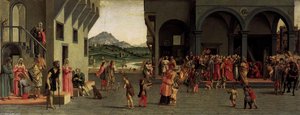
Scenes from the Story of Tobias (1500) čiji je Đulijano Bugjardini

Scenes from the Story of Tobias

1500 · Oil On Canvas · Staatliche Museen zu Berlin, Berlin

Giuliano Bugiardini's "Scenes from the Story of Tobias," painted in 1500, isn’t merely a depiction of a biblical narrative; it’s a vibrant snapshot of Renaissance life, brimming with social interaction and subtle symbolism. Housed within the hallowed halls of the Staatliche Museen in Berlin, this oil-on-wood masterpiece offers a captivating glimpse into a world where piety intertwined seamlessly with everyday existence. Measuring a substantial 60 x 159 cm, the painting…

2
Rape of Dinah (1535) čiji je Đulijano Bugjardini

Rape of Dinah

1535 · Oil · Kunsthistorisches Museum, Beč

The air in the plaza feels heavy with the sudden movement of bodies. In the center of the composition, a woman is gripped by men, her form a focal point of struggle against the rigid, geometric lines of the surrounding architecture. The scene is a collision of organic human limbs and the unyielding stone of a Renaissance cityscape. Deep reds and golds bleed into the shadows of the drapery, while…

3
Madonna and Child Enthroned with Saints Mary Magdalen and John the Baptist (1523) čiji je Đulijano Bugjardini

Madonna and Child Enthroned with Saints Mary Magdalen and John the Baptist

1523 · Oil On Panel · Metropoliten музеј у Њујорку, Њујорк

The composition rests upon a stone throne, a heavy and classical foundation that anchors the figures in a geometric stability. At the center, the Virgin Mary sits with a quiet, sculptural volume, her form defined by the deep ultramarine of her mantle and the sharp vermilion of her gown. She holds the Christ Child, whose presence provides the apex of a perfect pyramid. Around them, the air feels still, held…

4
Madonna with Christ-child (1517) čiji je Đulijano Bugjardini

Madonna with Christ-child

1517 · Oil On Panel · Bavarske državne slikopisne kolekcije, Minhen

In Madonna with Christ-child by Giuliano Bugiardini, the focus rests entirely upon the intimate connection between mother and child. The two figures occupy the center of the frame, arranged in a stable, pyramidal structure that draws the eye inward toward their shared space. The Virgin is draped in a crimson robe, a deep red that meets the heavy, dark blue of her mantle. Gold lining traces the edges of her…

5
Mary with the child and the juvenile Johannes (1514) čiji je Đulijano Bugjardini

Mary with the child and the juvenile Johannes

1514 · Oil On Panel · Gemäldegalerie, Berlin

The composition rests upon a stable, pyramidal structure, anchoring the figures within a quiet, sacred space. Mary sits as the central pillar, her form providing a sense of permanence amidst the soft contours of the scene. The light descends from the upper left, carving out the volume of her face and the heavy, rhythmic folds of her garments. Shadows pool in the recesses of the drapery, lending a three-dimensional weight…

6
The Virgin and Blessing Child, Young St. John and Angel (1510) čiji je Đulijano Bugjardini

The Virgin and Blessing Child, Young St. John and Angel

1510 · Oil On Panel · Gemäldegalerie, Berlin

The Virgin Mary sits in a three-quarter view, her form a soft curve against the stillness of the composition. She cradles the Christ Child upon her lap, her hands a gentle cradle for the divine. To the left, an angel with visible wings gazes toward the children, a silent witness to the intimacy of the scene. In the lower foreground, the young St. John stands, his presence grounding the celestial…

7
St. John the Baptist in the Wilderness (1530) čiji je Đulijano Bugjardini

St. John the Baptist in the Wilderness

1530 · Oil

A young man kneels in the silence of a rugged landscape. He is caught in a moment of profound listening, holding a small shell to his ear as if catching the whispers of the divine or the rush of distant waters. His body, rendered with the anatomical precision of the High Renaissance, shows the subtle tension of muscle and skin under a soft, diffused light. He wears only a simple…

8
St. John the Baptist in the Wilderness (1525) čiji je Đulijano Bugjardini

St. John the Baptist in the Wilderness

1525 · Oil On Panel · Pinacoteca Nazionale di Bologna, Bolonja

A single figure sits upon a craggy, ochre-colored rock formation within a landscape of muted earth tones. This man, identified as St. John the Baptist, is positioned centrally in a vertical composition. He is clad in a garment made of animal skin, rendered with a coarse, tactile texture that contrasts with the smoother rendering of his skin. His limbs are bent in a posture of quietude, and he holds a…

9
Virgin and child (1530) čiji je Đulijano Bugjardini

Virgin and child

1530 · Oil On Panel · Art Gallery of South Australia, Adelaide

The painting titled Virgin and child is a work by the Italian Renaissance painter Giuliano Bugiardini. Created about 1530, this European painting depicts a religious subject through a vertical composition. The figures are positioned against a backdrop of classical stone architecture and a distant landscape. The scene focuses on the physical closeness of the Virgin Mary and the Christ Child.

10
Madonna and Child with St. John and an angel (1525) čiji je Đulijano Bugjardini

Madonna and Child with St. John and an angel

1525 · Oil On Panel · Nacionalni muzej u Varšavi, Varšava

In Madonna and Child with St. John and an angel, Giuliano Bugiardini organizes the scene within a circular tondo format. The Virgin Mary is seated as the central focal point, providing a sense of stability to the entire arrangement. Around her, three smaller figures are positioned to create a balanced, pyramidal structure. This geometric arrangement directs the eye through the intimate connections between the figures, emphasizing a sense of maternal…

Slike umetnika Đulijano Bugjardini, rangirane od 11 do 30

Čuvena dela Đulijano Bugjardini po periodima

Motivi koji su privlačili pažnju Đulijano Bugjardini

Četiri teme koje se najčešće ponavljaju u ovim originalima, svaka sa svojim vrhunskim primerom.

Muzeji u kojima se čuvaju originalna dela umetnika Đulijano Bugjardini

8 muzeja u kojima se nalazi najviše slika sa ove stranice.

Muzej Grad Radovi umetnika Đulijano Bugjardini Slike iz ovog spiska
Staatliche Museen zu Berlin, BerlinStaatliche Museen zu Berlin Berlin 2 Scenes from the Story of Tobias, Scenes from the Story of Tobias
Metropoliten музеј у Њујорку, ЊујоркMetropoliten музеј у Њујорку Њујорк 2 Madonna and Child Enthroned with Saints Mary Magdalen and John the Baptist, Adam; Eve
Gemäldegalerie, BerlinGemäldegalerie Berlin 2 Mary with the child and the juvenile Johannes, The Virgin and Blessing Child, Young St. John and Angel
Walters Art Museum, BaltimoreWalters Art Museum Baltimore 2 Madonna and Child, Portrait of a Bolognese Gentleman in a Fur-lined Coat
National Gallery of Art, WashingtonNational Gallery of Art Washington 2 Leonardo de' Ginori, Portrait of a Young Woman
Kunsthistorisches Museum, BečKunsthistorisches Museum Beč 1 Rape of Dinah
Bavarske državne slikopisne kolekcije, MinhenBavarske državne slikopisne kolekcije Minhen 1 Madonna with Christ-child
Pinacoteca Nazionale di Bologna, BolonjaPinacoteca Nazionale di Bologna Bolonja 1 St. John the Baptist in the Wilderness

Đulijano Bugjardini, jedno autentično delo po deceniji

Radovi po decenijama

Izaberite deceniju da biste videli original koji je definiše.

Slike umetnika Đulijano Bugjardini: odgovori galerije

Koja je najpoznatija slika umetnika Đulijano Bugjardini?Otkrij odgovor

Scenes from the Story of Tobias (1500), Staatliche Museen zu Berlin, Berlin. Slede Rape of Dinah (1535) i Madonna and Child Enthroned with Saints Mary Magdalen and John the Baptist (1523).

Koliko je godina imao/la Đulijano Bugjardini kada je dovršio/la Scenes from the Story of Tobias?Otkrij odgovor

25 godina: Scenes from the Story of Tobias datira iz 1500, a Đulijano Bugjardini je rođen/a 1475.

Koja su najbolja 10 dela umetnika Đulijano Bugjardini?Otkrij odgovor

Scenes from the Story of Tobias, Rape of Dinah, Madonna and Child Enthroned with Saints Mary Magdalen and John the Baptist, Madonna with Christ-child, Mary with the child and the juvenile Johannes, The Virgin and Blessing Child, Young St. John and Angel, St. John the Baptist in the Wilderness, St. John the Baptist in the Wilderness, Virgin and child i Madonna and Child with St. John and an angel. Gornji rang pokazuje godinu i muzej za svako od njih.

Koliko je dela stvorio/la Đulijano Bugjardini?Otkrij odgovor

Naš katalog sadrži 30 dela umetnika Đulijano Bugjardini, datiranih od 1500 do 1539.

Gde se nalaze najpoznatiji originali umetnika Đulijano Bugjardini?Otkrij odgovor

Većinom u Staatliche Museen zu Berlin (Berlin), Metropoliten музеј у Њујорку (Њујорк) i Gemäldegalerie (Berlin). Tabela muzeja iznad sadrži njih sve.

Kada je Đulijano Bugjardini stvorio svoje najpoznatije slike?Otkrij odgovor

U 1520s: 9 od 30 dela na ovoj stranici nastalo je tada, od čega je Madonna and Child Enthroned with Saints Mary Magdalen and John the Baptist.

Koja su najranija i najkasnija poznata dela umetnika Đulijano Bugjardini?Otkrij odgovor

Na ovoj stranici, najstarije delo je iz Scenes from the Story of Tobias (1500), a najnovije iz Francesco Guicciardini (1539).

Kojim se motivima Đulijano Bugjardini najčešće bavio?Otkrij odgovor

Child (8), Woman (7) i Drapery (5), kroz svih 30 dela na ovoj stranici.

U kojoj je tehnici najviše radio/la Đulijano Bugjardini?Otkrij odgovor

Oil On Panel, za 11 od 30 dela na ovoj stranici.

Sa kojim umetničkim pravcem je Đulijano Bugjardini povezan/a?Otkrij odgovor

High renaissance i Renaissance, sudeći po originalima na ovoj stranici.

Koje originale umetnika Đulijano Bugjardini poseduje Staatliche Museen zu Berlin?Otkrij odgovor

Scenes from the Story of Tobias i Scenes from the Story of Tobias: Staatliche Museen zu Berlin, Berlin čuva 2 dela sa ove stranice.

Đulijano Bugjardini: umetnik

A Life Shaped by the Florentine Renaissance

Giuliano di Piero di Simone Bugiardini stands as a profound figure of the Italian Renaissance, a painter whose life and work were inextricably woven into the vibrant cultural fabric of Florence. His journey began in the heart of this artistic epicenter, where he likely found his earliest inspiration within the prestigious sculpture garden of Lorenzo de' Medici near the convent of San Marco. It was in this fertile environment, under the guidance of the sculptor Bertoldo, that Bugi.ardini first encountered the burgeoning brilliance of the era. His formative years were marked by deep connections to the masters of his time; he entered the workshop of Domenico Ghirlandaio during the early 1490s, a period that would shape his technical mastery and introduce him to fellow rising talents like the young Michelangelo.

The trajectory of Bugiardini's career was defined by both collaboration and independence. By 1503, he had established himself as an independent artist, joining the Florentine painters' confraternity, the Compagnia di San Luca. This era saw him engaged in a significant business partnership with Mariotto Albertinelli, a bond that lasted until 1509. Throughout his long career, Bugiardini maintained enduring friendships with some of the most monumental figures in art history. His relationship with Michelangelo was particularly noteworthy; not only did they share early training, but Bugiardini also captured the likeness of Michelangelo in portraiture and worked on pieces where the great master's influence was palpable, such as the figures designed for his Martyrdom of Saint Catherine.

Mastery of Sacred Narrative and Human Emotion

Bugiardini’s oeuvre is a testament to the versatility and spiritual depth characteristic of High Renaissance painting. While he was primarily a painter of religious subjects, his ability to infuse sacred narratives with human drama and social realism allowed his work to resonate far beyond the walls of chapels. In masterpieces such as Scenes from the Story of Tobias, painted in 1500, he transformed a biblical tale into a lively tableau of Renaissance life. Through this work, one observes a meticulous command of detail—the textures of fine clothing, the architectural precision, and the subtle, emotive expressions that bring the characters to life within a bustling, sunlit courtyard.

His religious compositions often utilized the classic pyramidal structure to evoke a sense of eternal peace and stability. In works like Holy Family with St John the Baptist, Bugiardini captured moments of profound grace and familial intimacy. His technique relied on the sophisticated use of oil paint, which permitted him to achieve subtle gradations of light and color, creating a sense of volume and atmospheric depth that was revolutionary. Whether depicting the serene presence of the Madonna or the complex movement of a procession, his brushwork breathed life into the divine, making the sacred accessible through the lens of human experience.

Artistic Legacy and Technical Sophistication

The historical significance of Giuliano Bugiardini lies in his role as a bridge between the traditions of the late 15th century and the burgeoning dynamism of the 16th century. His ability to execute not only grand altarpieces but also intimate portraits and mythological subjects demonstrates a breadth of skill that commanded respect across Italy, including periods of activity in Bologna. His work is characterized by several enduring artistic hallmarks:

  • Renaissance Realism: An exceptional ability to render the physical world, from the intricate patterns of drapery to the realistic anatomy of figures and animals.
  • Narrative Depth: The capacity to weave complex biblical or mythological stories into vibrant, social snapshots that reflect the spirit of Florentine society.
  • Color and Light: A rich palette featuring deep reds, vibrant blues, and earthy tones, utilized through careful layering to create texture and luminosity.
  • Classical Composition: The use of balanced, geometric arrangements to instill a sense of harmony and spiritual permanence in his sacred subjects.

Though often overshadowed by the more tempestuous giants of his era, Bugiardini’s contribution to the Renaissance is undeniable. He was an artist who could capture the very essence of spiritual devotion while simultaneously documenting the social textures of his time, leaving behind a legacy of beauty, precision, and profound human connection.