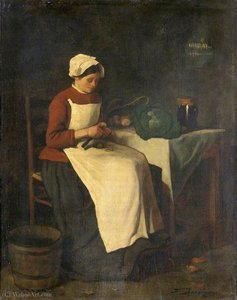
Portret Fransoa Bonvan

68 najpoznatijih slika umetnika Fransoa Bonvan, svaka potpuno jedinstvena

Ažurirano: новембар 2026 · rangirano prema našem koeficijentu popularnosti (pretrage, posete i porudžbine za svako delo) · 70 dela Fransoa Bonvan u našem katalogu

Ukratko

Woman Ironing (1858) je slika autora Fransoa Bonvan koja privlači najviše pažnje; original se nalazi u muzeju Philadelphia Museum of Art, Filadelfija. Nakon toga, pogled se seli na Sophie Unternährer at her easel (1848) i Woman Playing Games (1853). Među 70 dela umetnika Fransoa Bonvan u našem katalogu, ovih 68 su najpoznatija, od kojih je svako jedinstveni original predstavljen sa godinom nastanka, muzejom i razlogom zbog kojeg je i danas neprocenjivo.

1817 – 1887, Pariz Realism Najviše dela: Burrell Collection

Top 10 slika umetnika Fransoa Bonvan, iz ugla galerije

1
Woman Ironing (1858) čiji je Fransoa Bonvan

Woman Ironing

1858 · Oil · Philadelphia Museum of Art, Filadelfija

A single woman leans into her labor. The scene is tight, a quiet corner of a room where the air feels heavy with the scent of heated fabric. She is bent over her task, her body forming a soft curve against the stark, bright white of the linens. The light does not flood the room; it strikes only what is necessary. It catches the ridge of her shoulder, the pale…

2
Sophie Unternährer at her easel (1848) čiji je Fransoa Bonvan

Sophie Unternährer at her easel

1848 · Oil

The studio is swallowed by shadow, leaving only a single, concentrated pool of light to illuminate the scene. Within this luminous circle, Sophie Unternährer leans toward her canvas, her entire being pulled into the act of making. She is a figure of intense focus, caught in a private stillness that feels almost sacred. The light, spilling from the upper left, catches the heavy, creamy folds of her voluminous white dress,…

3
Woman Playing Games (1853) čiji je Fransoa Bonvan

Woman Playing Games

1853 · Oil On Panel · Centraal Museum, Utreht

The oil painting titled Woman Playing Games captures a singular, quiet moment of domesticity. Created by the French artist François Bonvin, the work belongs to the genre art tradition. It focuses on the private, unadorned rhythms of daily life, finding weight in the stillness of a single figure.

5
The Embroideress (La Brodeuse) (1857) čiji je Fransoa Bonvan

The Embroideress (La Brodeuse)

1857 · Oil · Museum Gouda, Gouda

The Embroideress (La Brodeuse) is a realist oil painting from 1857 that captures a solitary woman immersed in the quiet task of embroidery. The composition is centered on the seated figure, creating an atmosphere of domestic devotion and stillness. The scene is characterized by a dark, muted color palette of deep blacks and browns, which serves to highlight the stark white of the woman's collar and the warm, reddish-orange hue…

6
Drawing Water (1858) čiji je Fransoa Bonvan

Drawing Water

1858 · Oil On Canvas · Walters Art Museum, Baltimore

In "Drawing Water" by François Bonvin, a quiet moment of domestic labor unfolds within a vertically oriented space. The scene captures a solitary woman engaged in her daily chore, positioned slightly to the right of center. She leans toward a water dispenser, her form defined by the steady rhythm of her task. In the immediate foreground, a bucket sits waiting, grounding the viewer in this intimate, private sphere. The perspective…

7
Ave Maria : interior of the  Aramont convent (1870) čiji je Fransoa Bonvan

Ave Maria : interior of the Aramont convent

1870 · Oil On Canvas · Musée d'Orsay, Pariz

The scene unfolds within the quietude of Ave Maria : interior of the Aramont convent, a work that captures a moment of stillness through the eyes of François Bonvin. This painting emerges from the year 1870, offering a glimpse into a world of devotion and architectural weight. The atmosphere feels heavy with the presence of the past, as if the very air within the convent holds its breath.

8
Woman in White (1865) čiji je Fransoa Bonvan

Woman in White

1865 · Oil On Canvas · Musée des Beaux-Arts, Rem

In Woman in White, François Bonvin captures a moment of quietude through a vertically oriented composition. The subject is positioned slightly off-center, a profile of a woman seen from the side. She gazes downward, her eyes cast toward an unseen point below. This posture creates a sense of stillness against a dark, indistinct background that offers no distraction from her form. The space around her feels heavy and silent.

10
Interior of a Tavern (1867) čiji je Fransoa Bonvan

Interior of a Tavern

1867 · Oil On Canvas · Walters Art Museum, Baltimore

In Interior of a Tavern by François Bonvin, we find ourselves within a quiet, somber moment of 19th-century life. The scene is anchored by a woman in a red bodice and white apron, who occupies the center of the composition. To her left, a man sits quietly at a wooden table, while to her right, a standing man wearing a red vest and a dark hat directs his gaze toward…

Čuvena dela umetnika Fransoa Bonvan, od 11 do 68

11Young Woman with a Mandolin, Portrait of Louison Köhler (1873) čiji je Fransoa BonvanYoung Woman with a Mandolin, Portrait of Louison Köhler1873 · Cleveland Museum of Art 12The Scrubber (1887) čiji je Fransoa BonvanThe Scrubber1887 · Musée des Beaux-Arts 13La Servante indiscrete (1871) čiji je Fransoa BonvanLa Servante indiscrete1871 · Art Gallery of Hamilton 14Still Life with Oyster (1860) čiji je Fransoa BonvanStill Life with Oyster1860 · Yale University Art Gallery 15Still Life with Asparagus (1867) čiji je Fransoa BonvanStill Life with Asparagus1867 · Kröller-Müller Museum 16Attributes of Music (1863) čiji je Fransoa BonvanAttributes of Music1863 · Cleveland Museum of Art 17Still Life (1858) čiji je Fransoa BonvanStill Life1858 · Muzej fine umetnosti u Hjustonu 18Landscape with Barn (1869) čiji je Fransoa BonvanLandscape with Barn1869 · Museum Gouda 19Still Life with Oysters (1865) čiji je Fransoa BonvanStill Life with Oysters1865 · National Gallery of Ireland 20Still life with cherries. (1865) čiji je Fransoa BonvanStill life with cherries.1865 · Muzej kolekcije im. Jovana Pavla II 21The Candlestick (Still Life with Candle) (1878) čiji je Fransoa BonvanThe Candlestick (Still Life with Candle)1878 · Museum Gouda 22Still Life with Grapes (1877) čiji je Fransoa BonvanStill Life with Grapes1877 · Museum Gouda 23Still Life with Clogs (1875) čiji je Fransoa BonvanStill Life with Clogs1875 · Museum Gouda 24Port-Marly (1872) čiji je Fransoa BonvanPort-Marly1872 · Musée d'Orsay 25The Trio (1880) čiji je Fransoa BonvanThe Trio1880 · Centraal Museum 26Still Life with Vegetables (1880) čiji je Fransoa BonvanStill Life with Vegetables1880 · Museum Gouda 27Still Life With Brass Kettle (1883) čiji je Fransoa BonvanStill Life With Brass Kettle1883 · Museum Boijmans Van Beuningen 28Still life, two glazed earthenware pots. (1887) čiji je Fransoa BonvanStill life, two glazed earthenware pots.1887 · Musée des Beaux-Arts de Rouen 29Femme lisant čiji je Fransoa BonvanFemme lisantMusée Fabre 30'Miss' čiji je Fransoa Bonvan'Miss'Burrell Collection 31The Butcher čiji je Fransoa BonvanThe Butcher 32A woman ironing čiji je Fransoa BonvanA woman ironingNational Museum Cardiff 33Two countrywomen čiji je Fransoa BonvanTwo countrywomenBowes Museum 34The winder čiji je Fransoa BonvanThe winder 35The Blacksmiths, Memory of Treport čiji je Fransoa BonvanThe Blacksmiths, Memory of Treport 36Still life, François Bonvin, 1871 (1871) čiji je Fransoa BonvanStill life, François Bonvin, 18711871 · Rijksmuseum 37Stilleven met vier vruchten, glas en aardewerk, François Bonvin, 1827 - 1887 (1887) čiji je Fransoa BonvanStilleven met vier vruchten, glas en aardewerk, François Bonvin, 1827 - 18871887 · Rijksmuseum 38Still Life čiji je Fransoa BonvanStill LifeMusée des Beaux-Arts 39Still life čiji je Fransoa BonvanStill lifeYork Art Gallery 40Still Life with Jar of Cherries čiji je Fransoa BonvanStill Life with Jar of Cherries 41Woman at a Spinet čiji je Fransoa BonvanWoman at a SpinetBurrell Collection 42The crow čiji je Fransoa BonvanThe crowBurrell Collection 43Interior of a Tavern čiji je Fransoa BonvanInterior of a Tavern 44Grandmamma's breakfast čiji je Fransoa BonvanGrandmamma's breakfastBowes Museum 45Still Life with a Copper Pot čiji je Fransoa BonvanStill Life with a Copper PotBurrell Collection 46The violin čiji je Fransoa BonvanThe violinBurrell Collection 47The meadow čiji je Fransoa BonvanThe meadowNational Gallery 48The young housewife čiji je Fransoa BonvanThe young housewifeNational Museum Cardiff 49The Letter of Recommendation čiji je Fransoa BonvanThe Letter of Recommendation 50Housemaid At The Wasserholen čiji je Fransoa BonvanHousemaid At The WasserholenMusée d'Orsay 51Oysters čiji je Fransoa BonvanOystersBurrell Collection 52Interior čiji je Fransoa BonvanInteriorFitzwilliam Museum 53Charity čiji je Fransoa BonvanCharity 54Still Life with Game čiji je Fransoa BonvanStill Life with GameBurrell Collection 55Still Life with Oysters, a Wine Bottle and a Glass of Wine čiji je Fransoa BonvanStill Life with Oysters, a Wine Bottle and a Glass of WineBurrell Collection 56Peasant knitting čiji je Fransoa BonvanPeasant knitting 57Still Life with Book, Papers and Inkwell čiji je Fransoa BonvanStill Life with Book, Papers and InkwellNational Gallery 58Still Life with Apples and a Silver Goblet čiji je Fransoa BonvanStill Life with Apples and a Silver GobletKelvingrove Art Gallery and Museum 59Interior with an Old Woman Kneeling čiji je Fransoa BonvanInterior with an Old Woman Kneeling 60The Attributes of Painting čiji je Fransoa BonvanThe Attributes of PaintingBarber Institute of Fine Arts 61Nature morte čiji je Fransoa BonvanNature morteBerwick Museum and Art Gallery 62Still Life with a Tobacco Pot and a Pipe čiji je Fransoa BonvanStill Life with a Tobacco Pot and a PipeBurrell Collection 63Still Life with a Jug, Cheese, Onions, Fish and a Knife čiji je Fransoa BonvanStill Life with a Jug, Cheese, Onions, Fish and a KnifeBurrell Collection 64Still Life with a Glass, Pears and a Knife čiji je Fransoa BonvanStill Life with a Glass, Pears and a KnifeBurrell Collection 65Still Life with Asparagus čiji je Fransoa BonvanStill Life with AsparagusScottish National Gallery 66Still Life with a Book and an Ink Well čiji je Fransoa BonvanStill Life with a Book and an Ink WellBurrell Collection 67Still Life with Vegetables and Cooking Utensils čiji je Fransoa BonvanStill Life with Vegetables and Cooking UtensilsBurrell Collection 68Self portrait čiji je Fransoa BonvanSelf portraitBowes Museum

Motivi koji su privlačili pažnju Fransoa Bonvan

Četiri teme koje se najčešće ponavljaju u ovim originalima, svaka sa svojim vrhunskim primerom.

Muzeji u kojima se čuvaju originalna dela umetnika Fransoa Bonvan

8 muzeja u kojima se nalazi najviše slika sa ove stranice.

Muzej Grad Radovi umetnika Fransoa Bonvan Slike iz ovog spiska
Burrell Collection, GlasgowBurrell Collection Glasgow 13 'Miss', Woman at a Spinet, The crow
Museum Gouda, GoudaMuseum Gouda Gouda 6 The Embroideress (La Brodeuse), Landscape with Barn, The Candlestick (Still Life with Candle)
Musée d'Orsay, ParizMusée d'Orsay Pariz 3 Ave Maria : interior of the Aramont convent, Port-Marly, Housemaid At The Wasserholen
Bowes Museum, Barnard CastleBowes Museum Barnard Castle 3 Two countrywomen, Grandmamma's breakfast, Self portrait
Centraal Museum, UtrehtCentraal Museum Utreht 2 Woman Playing Games, The Trio
Walters Art Museum, BaltimoreWalters Art Museum Baltimore 2 Drawing Water, Interior of a Tavern
Musée des Beaux-Arts, RemMusée des Beaux-Arts Rem 2 Woman in White, The Scrubber
Cleveland Museum of Art, KlivlendCleveland Museum of Art Klivlend 2 Young Woman with a Mandolin, Portrait of Louison Köhler, Attributes of Music

Fransoa Bonvan kroz decenije: jedan jedinstveni original za svaku

Radovi po decenijama

Izaberite deceniju da biste videli original koji je definiše.

Slike umetnika Fransoa Bonvan: pitanja za galeriju

Koje je najpoznatije delo umetnika Fransoa Bonvan?Otkrij odgovor

Woman Ironing (1858), Philadelphia Museum of Art, Filadelfija. Slede Sophie Unternährer at her easel (1848) i Woman Playing Games (1853).

U kojoj je godini Fransoa Bonvan stvorio/la Woman Ironing?Otkrij odgovor

41 godina: Woman Ironing datira iz 1858, a Fransoa Bonvan je rođen/a 1817.

Koji je deset najpoznatijih slika autora Fransoa Bonvan?Otkrij odgovor

Woman Ironing, Sophie Unternährer at her easel, Woman Playing Games, The Guitar Player, The Embroideress (La Brodeuse), Drawing Water, Ave Maria : interior of the Aramont convent, Woman in White, Portrait of a Seated Woman i Interior of a Tavern. Gornji rang pokazuje godinu i muzej za svako od njih.

Koliko je poznatih dela umetnika Fransoa Bonvan?Otkrij odgovor

Naš katalog sadrži 70 dela umetnika Fransoa Bonvan, datiranih od 1848 do 1887.

Gde se mogu videti najpoznatiji originali umetnika Fransoa Bonvan?Otkrij odgovor

Većinom u Burrell Collection (Glasgow), Museum Gouda (Gouda) i Musée d'Orsay (Pariz). Tabela muzeja iznad sadrži njih sve.

U kom periodu je Fransoa Bonvan stvorio/la svoje najpoznatije slike?Otkrij odgovor

U 1870s: 9 od 68 dela na ovoj stranici nastalo je tada, od čega je Ave Maria : interior of the Aramont convent.

Ko je najraniji, a koje je najkasnije čuveno delo umetnika Fransoa Bonvan?Otkrij odgovor

Na ovoj stranici, najstarije delo je iz Sophie Unternährer at her easel (1848), a najnovije iz The Scrubber (1887).

Koje su teme Fransoa Bonvan preferirao/la?Otkrij odgovor

Woman (12), Life (12) i Table (5), kroz svih 68 dela na ovoj stranici.

Sa kojim materijalima je Fransoa Bonvan najčešće slikao?Otkrij odgovor

Oil On Canvas, za 10 od 68 dela na ovoj stranici.

Kojem umetničkom pravcu pripada delo umetnika Fransoa Bonvan?Otkrij odgovor

Realism i Contemporary realism, sudeći po originalima na ovoj stranici.

Koja originalna dela Fransoa Bonvan mogu videti u Burrell Collection?Otkrij odgovor

'Miss', Woman at a Spinet i The crow: Burrell Collection, Glasgow čuva 13 dela sa ove stranice.

Fransoa Bonvan: portret umetnika

The Quiet Observer: The Life and Legacy of François Bonvin

In the bustling, transformative landscape of nineteenth-century Paris, where the shadows of the Industrial Revolution began to lengthen over the city's cobblestone streets, there existed a painter who found profound beauty in the most unassuming corners of existence. François Bonvin (1817–1887) was not a chronicler of grand historical battles or mythological epodes; instead, he was a master of the intimate, a realist whose brush captured the silent dignity of the everyday. His life, marked by early hardship and a resilient spirit, mirrored the very subjects he painted—unadorned, honest, and deeply human.
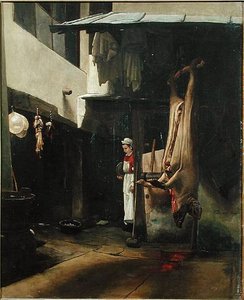
Born into humble circumstances as the son of a police officer and a seamstress, Bonvin’s childhood was far from the romanticized version of Parisian life often depicted in literature. The loss of his mother to tuberculosis when he was only four years old left him vulnerable to a world of scarcity and neglect. Raised in a crowded household with numerous siblings and facing the harsh realities of an undernourished upbringing, these early struggles instilled in him a profound empathy for the marginalized. It was this sensitivity that would later define his artistic vision, allowing him to see the poetic weight in a simple basket of fruit or the quiet labor of a domestic worker.

A Journey Through Light and Shadow

Bonvin’s path to artistry was as much a product of grit as it was of talent. While his formal education began at the École de dessin, supported by the generosity of a family friend, much of his true development occurred through solitary devotion and self-study. His time apprenticed to a printer provided him with a disciplined eye for detail, but it was his frequent pilgrimages to the Louvre that truly sculpted his soul. There, amidst the masterpieces of the past, he found his spiritual ancestors. He became deeply enamored with the Dutch Old Masters, particularly the dramatic chiaroscuro of Rembrandt and the spirited brushwork of Frans Hals.

This fascination with Northern European traditions allowed Bonvin to develop a technique that was uniquely his own—a blend of French precision and Dutch tonal depth. He mastered the art of capturing light as it falls upon varied textures: the cold sheen of a metal cup, the soft fuzz of a ripening strawberry, or the heavy, organic weight of an oyster shell. His work often features a muted, earthy palette that avoids the garishness of contemporary trends, opting instead for a nuanced gradation of tones that creates a sense of palpable atmosphere and stillness.

The Art of the Everyday

The significance of Bonvin’s oeuvre lies in its ability to elevate the mundane to the monumental. His paintings often function as windows into the private, domestic spheres of nineteenth-century France. Whether depicting a still life with four fruits or the poignant scene of A Woman Ironing, there is an unmistakable sense of presence and respect for the subject matter. He did not seek to embellish reality but to honor it.

His contributions to the Realist movement can be summarized through several key artistic hallmarks:

  • Mastery of Texture: An exquisite ability to render the tactile qualities of food, ceramics, and cloth.
  • Chiaroscuro Influence: The use of dramatic light and shadow to create depth and emotional resonance.
  • Empathetic Realism: A focus on the dignity of ordinary life and the beauty found in domesticity.
  • Tonal Nuance: A sophisticated approach to color that favors subtle, atmospheric transitions over bold pigments.

Though he may not have achieved the widespread fame of his contemporaries like Courbet, François Bonvin remains a vital figure for those who seek the soul within the ordinary. His legacy is found in every stroke that celebrates the quiet, the overlooked, and the enduringly beautiful aspects of our shared human experience.