A Legacy of Light and Realism: The Life of Elin Danielson-Gambogi
Elin Kleopatra Danielson-Gambogi stands as a luminous figure in the annals of Finnish art history, representing a transformative era when the quiet observations of Naturalism began to merge with the vibrant energy of Impressionism. Born in 1861 in Normarkku, Finland, her artistic identity was deeply rooted in a lineage of creativity. As the daughter of the celebrated sculptor Raffaello Gambogi, she grew up immersed in an environment where the meticulous study of form and the profound appreciation for craftsmanship were daily realities. This early exposure to the sculptural arts likely instilled in her a foundational understanding of volume and light, which would later define her mastery of the two-dimensional canvas.
Her journey through the artistic landscape of Scandinavia was marked by a rigorous pursuit of skill and a desire to capture the authentic pulse of human existence. While honing her talents at the Helsinki Art Academy, she absorbed the evolving stylistic precepts of her time, moving beyond mere imitation to find a voice that was uniquely hers. Her development was characterized by an ability to balance the precise, unflappable honesty of Realism with the fleeting, atmospheric qualities of Impressionism. This duality allowed her to document the world not just as it appeared, but as it felt, capturing the subtle shifts in light and the quiet emotional undertones of a single moment.
The Beauty of the Everyday: Themes and Technique
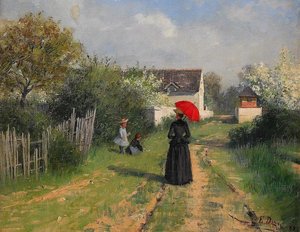
What truly distinguishes Danielson-Gambogi’s oeuvre is her profound commitment to portraying the dignity of ordinary life. Eschewing the grand, often detached narratives of mythology or historical epic, she turned her gaze toward the intimate corners of Finnish society. Her canvases serve as windows into domestic interiors and rural landscapes, where the mundane is elevated to the level of high art through her masterful command of color and texture.
In works such as Sisters, one can witness her ability to weave warmth and tenderness into a domestic scene, using light to create a sense of intimacy that draws the viewer into the private world of her subjects. Her technique often employed a delicate use of impasto, adding a tactile dimension to her oil paintings that mirrors the richness of the life she depicted. Whether it is the serene joy found in Italian Boats, where the water and figures dance in an Impressionistic light, or the poignant, tender symbolism present in Mother and Child, her work consistently explores the human condition through a lens of empathy and grace.
Historical Significance and Artistic Triumph
The significance of Elin Danielson-Gambogi extends far beyond her individual canvases; she was a pioneer who helped shape the trajectory of Finnish Realism. As part of a generation of artists often referred to as the "painter sisters," she challenged the prevailing conventions of her era, asserting that the quietest moments—a seated man at a table, a self-portrait reflecting internal contemplation, or the soft glow of a winter night—were worthy of the highest artistic devotion.
Her achievements are marked by several enduring contributions to the art world:
- Mastery of Light: Her ability to manipulate light to evoke mood and atmosphere remains one of her most celebrated technical triumphs.
- Social Observation: By focusing on the lives of ordinary people, she provided a vital sociological record of late 19th-century Finnish life.
- Stylistic Synthesis: She successfully bridged the gap between the structured observation of Naturalism and the emotive freedom of Impressionism.
Today, her work continues to resonate with modern audiences, offering a timeless connection to the beauty found in simplicity. Through her eyes, we are reminded that art does not require grand spectacles to be profound; it only requires the courage to look closely at the world around us and the skill to capture its fleeting, precious truths.