


1


Ažurirano: октобар 2026 · rangirano prema našem koeficijentu popularnosti (pretrage, posete i porudžbine za svako delo) · 22 dela Cornelius Varley u našem katalogu
Ukratko
Od svih originala koje je Cornelius Varley ostavio, najpoznatiji je Pastoral with Cattle and Figures in a Glade (1837), koji se nalazi u kolekciji Birmingham Museum and Art Gallery, Birmingem. Odmah za njima slede Portrait of J.M.W. Turner i Market place, hereford, (1803). Naš katalog sadrži 22 dela umetnika Cornelius Varley; galerija je čuvala 22 dela koja svet najviše admira, od kojih je svako prikazano sa svojim datumom, muzejom i pričom.


 Syon House From The Thames
12
 Llyn gwynant, north wales
13
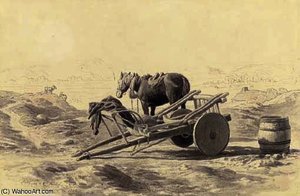 An irish cart
14
 A Shepherd And Sheep In A Wooded Landscape
15
 An ale house, formerly a chapel
16
 Study Of A Timber-framed Gabled Farmhouse
17
 A Welsh Mine
18
 Mountainous Landscape With A Castle
19
 View of exeter cathedral
20
 A hilly landscape
21
 Newstead Abbey
22
 An Ivy-covered Tower By An Open Track, Ireland
Četiri teme koje se najčešće ponavljaju u ovim originalima, svaka sa svojim vrhunskim primerom.
1 muzeja u kojima se nalazi najviše slika sa ove stranice.
| Muzej | Grad | Radovi umetnika Cornelius Varley | Slike iz ovog spiska |
|---|---|---|---|
 Birmingham Museum and Art Gallery |
Birmingem | 2 | Pastoral with Cattle and Figures in a Glade, Richmond, Surrey |
Izaberite deceniju da biste videli original koji je definiše.
Pastoral with Cattle and Figures in a Glade (1837), Birmingham Museum and Art Gallery, Birmingem. Slede Portrait of J.M.W. Turner i Market place, hereford, (1803).
56 godina: Pastoral with Cattle and Figures in a Glade datira iz 1837, a Cornelius Varley je rođen/a 1781.
Pastoral with Cattle and Figures in a Glade, Portrait of J.M.W. Turner, Market place, hereford,, Cottages at Llanllyfni, North Wales,, Remains of Parton Hall, Staffordshire,, Richmond, Surrey, Bell's Improved Reaping Machine, The Ruins Of Purton Hall, Staffordshire, Old Farm Cottages i The Market Place, Ross, Herefordshire. Gornji rang pokazuje godinu i muzej za svako od njih.
Naš katalog sadrži 22 dela umetnika Cornelius Varley, datiranih od 1803 do 1837.
Većinom u Birmingham Museum and Art Gallery (Birmingem). Tabela muzeja iznad sadrži njih sve.
U 1800s: 2 od 22 dela na ovoj stranici nastalo je tada, od čega je Market place, hereford,.
Na ovoj stranici, najstarije delo je iz Market place, hereford, (1803), a najnovije iz Pastoral with Cattle and Figures in a Glade (1837).
Buildings (4), Landscape (4) i Markets (2), kroz svih 22 dela na ovoj stranici.
Pastoral with Cattle and Figures in a Glade i Richmond, Surrey: Birmingham Museum and Art Gallery, Birmingem čuva 2 dela sa ove stranice.
In the vibrant, shifting landscape of nineteenth-century Britain, few figures embodied the harmonious intersection of scientific inquiry and artistic expression as profoundly as Cornelius Varley. Born in the London suburb of Hackney in 1781, Varley was a man whose very existence seemed to bridge the gap between the empirical rigor of the laboratory and the ethereal beauty of the watercolor studio. His early life was shaped by the meticulous influence of his uncle, a skilled maker of scientific instruments, under whom Varley acquired a foundational understanding of optics and the natural sciences. This unique education instilled in him a lifelong fascination with how light interacts with the world—a preoccupation that would eventually define both his groundbreaking inventions and his delicate brushwork.
The artistic soul of Varley was deeply intertwined with the cultural currents of his time, most notably the burgeoning Romantic movement. He shared a profound intellectual and spiritual bond with the visionary William Blake, a friendship that nourished a mutual interest in the unseen forces of imagination and perception. While Blake explored the mystical realms of the mind, Varley sought to capture the tangible wonders of the physical world through a lens of extreme precision. This duality—the ability to see both the scientific structure of an object and its poetic essence—allowed him to navigate the art world with a singular, observant eye, making him much more than a mere painter of landscapes.
Varley’s artistic journey truly took flight around 1800, following an evocative expedition through the rugged terrains of Wales alongside his brother, the renowned watercolorist John Varley. This period of travel served as a crucible for his developing style; the dramatic topography and ancient architecture of the Welsh landscape demanded a level of detail that would become his hallmark. As he transitioned from a student of science to a professional artist, he became a foundational figure in the British watercolor tradition. In 1803, he stood among the original founders of the Water-Colour Society, an achievement that cemented his status within the prestigious circles of London’s art community.
His technique was characterized by a meticulous attention to detail that mirrored his scientific training. Whether depicting the architectural grandeur of historical monuments or the tranquil, flowing scenes of the River Thames, Varley approached the paper with the precision of an instrument-maker. His works often possess a clarity and luminosity that suggest a deep understanding of light refraction and atmospheric conditions. This was not merely decorative art; it was an act of documentation, where every stroke of pigment served to record the precise interplay of shadow and brilliance upon the landscape.
Beyond the confines of the art gallery, Varley’s intellect left an indelible mark on the history of technology. He was a true polymath, utilizing his mastery of optics to invent the graphic telescope and the graphic microscope. These inventions were not mere curiosities but significant advancements that allowed for a more nuanced way of observing and projecting visual information. His ability to translate complex scientific principles into functional tools exemplifies the spirit of the age—a period where the boundaries between discovery and creation were beautifully blurred.
The historical significance of Cornelius Varley lies in his refusal to choose between the eye of the scientist and the heart of the artist. His life’s work stands as a testament to the idea that true understanding requires both measurement and emotion. Through his contributions to the Royal Academy, his leadership in scientific societies, and his enduring watercolor masterpieces, he helped shape the visual language of the Victorian era. He remains a celebrated figure for those who find beauty in the precise, and truth in the painted light.


