Portret Корнелије Трост

Slike umetnika Корнелије Трост: Najpoznatijih 81 kroz oči galerije

Ažurirano: октобар 2026 · rangirano prema našem koeficijentu popularnosti (pretrage, posete i porudžbine za svako delo) · 82 dela Корнелије Трост u našem katalogu

Ukratko

Za ljubitelje galerije, najpoznatije delo umetnika Корнелије Трост je Inspection of a Cavalry Regiment, perhaps by William of Hesse-Homburg (1742), čiji se original nalazi u muzeju Rijksmuseum, Amsterdam. The Regents of the Oudezijds Huiszittenhuis (1740) i A Couple Making Music, Cornelis Troost, 1743 (1743) čine triju koju svako oko prepoznaje. Od 82 dela umetnika Корнелије Трост u našem katalogu, galerija u nastavku predstavlja 81 najpoznatijih dela, od kojih je svako originalno, sa navedenom godinom nastanka, muzejom i onim što ga čini jedinstvenim.

1696 – 1750, Амстердам Rococo Najviše dela: Rijksmuseum

Top 10 slika umetnika Корнелије Трост u galeriji

1
Inspection of a Cavalry Regiment, perhaps by William of Hesse-Homburg (1742) čiji je Корнелије Трост

Inspection of a Cavalry Regiment, perhaps by William of Hesse-Homburg

1742 · Oil · Rijksmuseum, Amsterdam

In this expansive oil painting from 1742, we find ourselves amidst a grand military ceremony set within a wooded landscape. The scene captures a formal inspection of a cavalry regiment, where the rigid structure of military hierarchy meets the organic textures of the natural world. A procession of mounted soldiers and infantry moves through the scene, their presence creating a sense of rhythmic movement across the wide horizontal plane. The…

2
The Regents of the Oudezijds Huiszittenhuis (1740) čiji je Корнелије Трост

The Regents of the Oudezijds Huiszittenhuis

1740 · Oil On Canvas · Amsterdam Museum, Amsterdam

In this oil on canvas composition from 1740, five men are arranged within a structured interior. The group is positioned around a central table, forming a pyramidal configuration that directs the eye through the assembly. The men are dressed in 18th-century attire, featuring heavy fabrics such as silk and velvet. Their garments appear in shades of black, grey, and brown, though one central figure wears a coat of warm ochre.…

3
A Couple Making Music, Cornelis Troost, 1743 (1743) čiji je Корнелије Трост

A Couple Making Music, Cornelis Troost, 1743

1743 · Oil On Panel · Rijksmuseum, Amsterdam

Step closer and observe the intimacy of this 1743 interior. We find ourselves in a private room where the air seems to hold the soft notes of a melody. A man stands to the right, his posture relaxed as he breathes life into a recorder. Beside him, his wife sits in a moment of quiet concentration, her fingers poised to turn the corner of a page in a music book.…

4
Scene in a Coffee Shop (1750) čiji je Корнелије Трост

Scene in a Coffee Shop

1750 · Oil On Canvas · Ermitaž, Sankt Peterburg

The air in the room feels heavy with the scent of roasted beans and the low hum of conversation. Light pours through large windows on the left, slicing through the dimness to strike the edges of ceramic cups and the folds of heavy fabric. It is a wide, expansive space where the architecture of grand arches meets the intimate clutter of social life. A large, ornate medallion on the ceiling,…

5
The Organ Grinder (1743) čiji je Корнелије Трост

The Organ Grinder

1743 · Oil On Canvas · Mauritshuis, Хага

A Moment Captured on an Amsterdam Street The air feels heavy with the soft light of an overcast day as a small crowd gathers in this mid-18th century street scene. In the foreground, a man dressed in dark clothing sits quietly, his gaze fixed upon a woman who cradles a baby in her arms. Beside them, another woman stands near a child, their figures part of a loose, naturalistic grouping…

6
Harlequin, Magician and Barber: The Rivals Exposed (1738) čiji je Корнелије Трост

Harlequin, Magician and Barber: The Rivals Exposed

1738 · Oil On Canvas · Mauritshuis, Хага

Cornelis Troost's “Harlequin, Magician and Barber: The Rivals Exposed,” painted in 1738, isn’t merely a depiction of a bustling street scene; it’s a meticulously crafted window into the social fabric and subtle anxieties of 18th-century Amsterdam. This Baroque masterpiece, now housed within the Mauritshuis museum in The Hague, pulsates with life—a vibrant tableau of commerce, class distinctions, and perhaps even a touch of subversive commentary. Troost, a former actor who…

7
Double portrait of an unknown man and a boy (1722) čiji je Корнелије Трост

Double portrait of an unknown man and a boy

1722 · Print · Rijksmuseum Twenthe, Enschede

In this 1722 portrait, we find ourselves in a private, monochromatic world where the weight of lineage is felt through a subtle, sepia-toned atmosphere. An older man sits with a quiet, regal dignity, his presence anchoring the composition. Beside him, a young boy stands, creating a gentle diagonal that draws the eye through the space. There is a profound sense of stillness here, as if we have interrupted a private…

8
Aeneas and Dido Set Out for the Hunt (1731) čiji je Корнелије Трост

Aeneas and Dido Set Out for the Hunt

1731 · Oil On Canvas · Bavarske državne slikopisne kolekcije, Minhen

The oil painting titled Aeneas and Dido Set Out for the Hunt was created by the Dutch artist Cornelis Troost. This work dates to about 1731. It captures a moment of high drama within an ancient urban setting, where the figures of Aeneas and Dido move amidst a large, bustling entourage. The scene is framed by monumental architecture and the heavy presence of a central golden statue.

9
Triptych depicting the peasants' court from the comedy "Beslikte Swaantje" (1727) čiji je Корнелије Трост

Triptych depicting the peasants' court from the comedy "Beslikte Swaantje"

1727 · Oil On Panel · Amsterdam Museum, Amsterdam

This triptych painting, created in 1727, presents a dramatic scene from the comedy "Beslikte Swaantje", depicting a peasants' court. The composition is organized into three vertical panels, establishing a stage-like setting that offers a wide, panoramic view of a group of characters gathered within an interior. The scene is characterized by a frontal perspective, placing the viewer directly before the unfolding narrative, which enhances the overall theatrical atmosphere of the…

10
Triptych depicting the peasants' court from the comedy "Beslikte Swaantje" (center panel of triptych) (1727) čiji je Корнелије Трост

Triptych depicting the peasants' court from the comedy "Beslikte Swaantje" (center panel of triptych)

1727 · Oil · Amsterdam Museum, Amsterdam

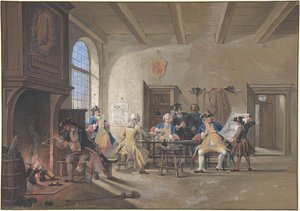
This 1727 oil painting captures a moment of dramatic tension from the comedy Beslikte Swaantje. The scene is set within a domestic interior, where a group of figures is gathered around a fireplace. A prominent character on the left, wearing a large, dark hat and a long cloak, gestures toward the assembly, driving the narrative forward. The composition relies on layered planes to create depth, with a smaller framed painting…

Slike umetnika Корнелије Трост, rangirane od 11 do 81

11Triptych depicting the peasants' court from the comedy "Beslikte Swaantje" (right panel of triptych) (1727) čiji je Корнелије ТростTriptych depicting the peasants' court from the comedy "Beslikte Swaantje" (right panel of triptych)1727 · Amsterdam Museum 12Triptych depicting the peasants' court from the comedy "Beslikte Swaantje" (left panel of triptych) (1727) čiji je Корнелије ТростTriptych depicting the peasants' court from the comedy "Beslikte Swaantje" (left panel of triptych)1727 · Amsterdam Museum 13Portrait of two men in an interior (1727) čiji je Корнелије ТростPortrait of two men in an interior1727 · Rijksmuseum Twenthe 14Portrait of Gerrit Sichterman ( -1730) (1726) čiji je Корнелије ТростPortrait of Gerrit Sichterman ( -1730)1726 · Groninger Museum 15Portrait of an unknown man (1732) čiji je Корнелије ТростPortrait of an unknown man1732 · Amsterdam Museum 16Portrait of een persoon genaamd Willem Roell (1700-1775) (1729) čiji je Корнелије ТростPortrait of een persoon genaamd Willem Roell (1700-1775)1729 · Amsterdam Museum 17Portrait of een persoon genaamd Elisabeth de Famars (1715-1780) (1724) čiji je Корнелије ТростPortrait of een persoon genaamd Elisabeth de Famars (1715-1780)1724 · Amsterdam Museum 18Inspectors of the Collegium Medicum in Amsterdam, 1724 (1724) čiji je Корнелије ТростInspectors of the Collegium Medicum in Amsterdam, 17241724 · Rijksmuseum 19Portrait of Maria de Lange (1696-1744), wife of Cornelius Ascanius van Sypesteyn, with her three young children (1727) čiji je Корнелије ТростPortrait of Maria de Lange (1696-1744), wife of Cornelius Ascanius van Sypesteyn, with her three young children1727 · Kasteel-Museum Sypesteyn 20Depart for hunting with monumental architecture (1731) čiji je Корнелије ТростDepart for hunting with monumental architecture1731 21Portrait of the Inspectors of the Collegium Medicum, Cornelis Troost, 1724 (1724) čiji je Корнелије ТростPortrait of the Inspectors of the Collegium Medicum, Cornelis Troost, 17241724 22Herman Boerhaave (1668-1738) (1740) čiji je Корнелије ТростHerman Boerhaave (1668-1738)1740 · Amsterdam Museum 23Portrait of Jeronimus Tonneman and his Son Jeronimus (1736) čiji je Корнелије ТростPortrait of Jeronimus Tonneman and his Son Jeronimus1736 · National Gallery of Ireland 24Anna Homout b. Horneman (1740) čiji je Корнелије ТростAnna Homout b. Horneman1740 25Dutch delivery room (1741) čiji je Корнелије ТростDutch delivery room1741 · Museum Boijmans Van Beuningen 26Het beslikte Zwaentje or the court house at Puyterveen (1741) čiji je Корнелије ТростHet beslikte Zwaentje or the court house at Puyterveen1741 · Museum Boijmans Van Beuningen 27Portrait of Herman Boerhaave, teacher of medicine in Leiden (1736) čiji je Корнелије ТростPortrait of Herman Boerhaave, teacher of medicine in Leiden1736 28Portrait of the Tolling Family (1742) čiji je Корнелије ТростPortrait of the Tolling Family1742 · Museum de Fundatie 29Guardroom Scene (1744) čiji je Корнелије ТростGuardroom Scene1744 30Portrait of a Man (1730) čiji je Корнелије ТростPortrait of a Man1730 · Mauritshuis 31The Delivery Room (1748) čiji je Корнелије ТростThe Delivery Room1748 · Rijksmuseum 32The Doctor's Visit (1750) čiji je Корнелије ТростThe Doctor's Visit1750 33Nursery Visit (1750) čiji je Корнелије ТростNursery Visit1750 34Portrait of Louise Christina Trip, Wife of Gerrit Sichterman (1725) čiji je Корнелије ТростPortrait of Louise Christina Trip, Wife of Gerrit Sichterman1725 · Rijksmuseum 35Reinier Adriaansz (1737) čiji je Корнелије ТростReinier Adriaansz1737 · Mauritshuis 36Lady with Cupid and a Songbook (1745) čiji je Корнелије ТростLady with Cupid and a Songbook1745 · Mauritshuis 37Love Scene (1736) čiji je Корнелије ТростLove Scene1736 · Rijksmuseum 38Rumor erat in casa (1740) čiji je Корнелије ТростRumor erat in casa1740 · Mauritshuis 39Guardroom Scene;Allegory on the War with France in 1747 (1747) čiji je Корнелије ТростGuardroom Scene;Allegory on the War with France in 17471747 · Mauritshuis 40False Virtue Discovered: The Discovery of Volkert in the Laundry Basket (1739) čiji je Корнелије ТростFalse Virtue Discovered: The Discovery of Volkert in the Laundry Basket1739 · Mauritshuis 41The Mathematicians or the Young Lady Who Fled: The Dispute between Doctors Raasbollius and Urinaal (1741) čiji je Корнелије ТростThe Mathematicians or the Young Lady Who Fled: The Dispute between Doctors Raasbollius and Urinaal1741 · Mauritshuis 42Nemo Loquebatur (1740) čiji je Корнелије ТростNemo Loquebatur1740 · Mauritshuis 43Portrait of Maria Magdalena Stavenisse, Wife of Jacob de Witte of Elkerzee, Councilor of Zierikzee, Cornelis Troost, c. 1726 (1726) čiji je Корнелије ТростPortrait of Maria Magdalena Stavenisse, Wife of Jacob de Witte of Elkerzee, Councilor of Zierikzee, Cornelis Troost, c. 17261726 · Rijksmuseum 44Regents of the Aalmoezeniersweeshuis Orphanage in Amsterdam, 1729, Cornelis Troost, 1729 (1729) čiji je Корнелије ТростRegents of the Aalmoezeniersweeshuis Orphanage in Amsterdam, 1729, Cornelis Troost, 17291729 · Rijksmuseum 45Pefroen and the Sheep (1739) čiji je Корнелије ТростPefroen and the Sheep1739 · Mauritshuis 46Erat Sermo inter Fratres (1740) čiji je Корнелије ТростErat Sermo inter Fratres1740 · Mauritshuis 47Three Governors of the Surgeons Guild, Amsterdam (1731) čiji je Корнелије ТростThree Governors of the Surgeons Guild, Amsterdam1731 · Rijksmuseum 48Self-Portrait (1745) čiji je Корнелије ТростSelf-Portrait1745 · Mauritshuis 49Rumor erat in Casa (There was a Commotion in the House) (1740) čiji je Корнелије ТростRumor erat in Casa (There was a Commotion in the House)1740 · Mauritshuis 50Captain Ulrich or Greed Thwarted: Disguised, Godefroy and his Servant Put Captain Ulrich to Flight (1738) čiji je Корнелије ТростCaptain Ulrich or Greed Thwarted: Disguised, Godefroy and his Servant Put Captain Ulrich to Flight1738 · Mauritshuis 51Portrait of a Gentleman (1716) čiji je Корнелије ТростPortrait of a Gentleman1716 52Portrait of a Man, Cornelis Troost, 1723 (1723) čiji je Корнелије ТростPortrait of a Man, Cornelis Troost, 17231723 · Rijksmuseum 53Portrait of the Physician Herman Boerhaave, Professor at the University of Leiden, Cornelis Troost, 1735 (1735) čiji je Корнелије ТростPortrait of the Physician Herman Boerhaave, Professor at the University of Leiden, Cornelis Troost, 17351735 · Rijksmuseum 54Alexander the Great at the Battle of the Granicus against the Persians, Cornelis Troost, 1737 (1737) čiji je Корнелије ТростAlexander the Great at the Battle of the Granicus against the Persians, Cornelis Troost, 17371737 · Rijksmuseum 55Portrait of Isaac Sweers, Chief Officer of Amsterdam and Governor of the Dutch East India Company, Cornelis Troost, 1730 - 1740 (1740) čiji je Корнелије ТростPortrait of Isaac Sweers, Chief Officer of Amsterdam and Governor of the Dutch East India Company, Cornelis Troost, 1730 - 17401740 · Rijksmuseum 56Jeronimus Tonneman and his Son (1736) čiji je Корнелије ТростJeronimus Tonneman and his Son1736 57The Phoenix, Cornelis Troost, 1720 - 1750 (1750) čiji je Корнелије ТростThe Phoenix, Cornelis Troost, 1720 - 17501750 · Rijksmuseum 58Portrait of Ludolf Backhuysen II, Painter and Dragoon, Grandson of the Marine Painter Ludolf Backhuysen I, Cornelis Troost, 1735 - 1750 (1750) čiji je Корнелије ТростPortrait of Ludolf Backhuysen II, Painter and Dragoon, Grandson of the Marine Painter Ludolf Backhuysen I, Cornelis Troost, 1735 - 17501750 · Rijksmuseum 59An Amsterdam Canal House Garden, Cornelis Troost, c. 1740 - 1745 (1745) čiji je Корнелије ТростAn Amsterdam Canal House Garden, Cornelis Troost, c. 1740 - 17451745 · Rijksmuseum 60The Discovery of Jan Claasz (1738) čiji je Корнелије ТростThe Discovery of Jan Claasz1738 · Mauritshuis 61the consultation čiji je Корнелије Тростthe consultation 62motherhood čiji je Корнелије Тростmotherhood 63Saartje Jans is Asked for her Hand in Marriage (1738) čiji je Корнелије ТростSaartje Jans is Asked for her Hand in Marriage1738 · Mauritshuis 64Ibant qui poterant, qui non potuere cadebant (1739) čiji je Корнелије ТростIbant qui poterant, qui non potuere cadebant1739 · Mauritshuis 65Loquebantur Omnes (1740) čiji je Корнелије ТростLoquebantur Omnes1740 · Mauritshuis 66Self-Portrait, Cornelis Troost, 1715 - 1730 (1730) čiji je Корнелије ТростSelf-Portrait, Cornelis Troost, 1715 - 17301730 · Yale Center for British Art 67Regents of the Aalmoezeniersweeshuis Orphanage in Amsterdam, 1729, Cornelis Troost, 1729 (1729) čiji je Корнелије ТростRegents of the Aalmoezeniersweeshuis Orphanage in Amsterdam, 1729, Cornelis Troost, 17291729 · Rijksmuseum 68Gerrit Sichterman (1688-1730). Quartermaster-General of the Cavalry, Colonel of the Oranje-Groningen Infantry Regiment, Commandant of Grave, Cornelis Troost, c. 1725 (1725) čiji je Корнелије ТростGerrit Sichterman (1688-1730). Quartermaster-General of the Cavalry, Colonel of the Oranje-Groningen Infantry Regiment, Commandant of Grave, Cornelis Troost, c. 17251725 · Rijksmuseum 69Gerrit Sichterman (1688-1730). Quartermaster-General of the Cavalry, Colonel of the Oranje-Groningen Infantry Regiment, Commandant of Grave, Cornelis Troost, 1725 (1725) čiji je Корнелије ТростGerrit Sichterman (1688-1730). Quartermaster-General of the Cavalry, Colonel of the Oranje-Groningen Infantry Regiment, Commandant of Grave, Cornelis Troost, 17251725 · Rijksmuseum 70Self-portrait, Cornelis Troost, 1739 (1739) čiji je Корнелије ТростSelf-portrait, Cornelis Troost, 17391739 · Rijksmuseum 71Self portrait čiji je Корнелије ТростSelf portrait 72Jan lepeltak čiji je Корнелије ТростJan lepeltakRijksmuseum 73The Ambassador of the Rascals Exposes himself from the Window of 't Bokki Tavern in the Haarlemmerhout čiji je Корнелије ТростThe Ambassador of the Rascals Exposes himself from the Window of 't Bokki Tavern in the HaarlemmerhoutRijksmuseum 74Family group at a harpsichord. čiji je Корнелије ТростFamily group at a harpsichord.Rijksmuseum 75The feigned sadness first company, eleventh stage of the comedy The discovered apparent virtue čiji je Корнелије ТростThe feigned sadness first company, eleventh stage of the comedy The discovered apparent virtue 76The Spendthrift or the Wasteful Woman, act III, scene V, from the Play by Thomas Asselijn (Joanna and the Polish Jewish Traders) čiji je Корнелије ТростThe Spendthrift or the Wasteful Woman, act III, scene V, from the Play by Thomas Asselijn (Joanna and the Polish Jewish Traders)Rijksmuseum 77The Wedding of Kloris and Roosje čiji je Корнелије ТростThe Wedding of Kloris and RoosjeMauritshuis 78Singing Round the Star on Twelfth Night čiji je Корнелије ТростSinging Round the Star on Twelfth NightMauritshuis 79Blindman's buff (1740) čiji je Корнелије ТростBlindman's buff1740 · Museum Boijmans Van Beuningen 80The anatomy of Dr Willem Roell čiji je Корнелије ТростThe anatomy of Dr Willem RoellAmsterdam Museum 81Portrait of a Music Lover (1736) čiji je Корнелије ТростPortrait of a Music Lover1736 · Rijksmuseum

Čuvena dela Корнелије Трост po periodima

Motivi koji su privlačili pažnju Корнелије Трост

Četiri teme koje se najčešće ponavljaju u ovim originalima, svaka sa svojim vrhunskim primerom.

Muzeji u kojima se čuvaju originalna dela umetnika Корнелије Трост

8 muzeja u kojima se nalazi najviše slika sa ove stranice.

Muzej Grad Radovi umetnika Корнелије Трост Slike iz ovog spiska
Rijksmuseum, AmsterdamRijksmuseum Amsterdam 25 Inspection of a Cavalry Regiment, perhaps by William of Hesse-Homburg, A Couple Making Music, Cornelis Troost, 1743, Inspectors of the Collegium Medicum in Amsterdam, 1724
Mauritshuis, ХагаMauritshuis Хага 21 The Organ Grinder, Harlequin, Magician and Barber: The Rivals Exposed, Portrait of a Man
Amsterdam Museum, AmsterdamAmsterdam Museum Amsterdam 10 The Regents of the Oudezijds Huiszittenhuis, Triptych depicting the peasants' court from the comedy "Beslikte Swaantje", Triptych depicting the peasants' court from the comedy "Beslikte Swaantje" (center panel of triptych)
Museum Boijmans Van Beuningen, RotterdamMuseum Boijmans Van Beuningen Rotterdam 3 Dutch delivery room, Het beslikte Zwaentje or the court house at Puyterveen, Blindman's buff
Rijksmuseum Twenthe, EnschedeRijksmuseum Twenthe Enschede 2 Double portrait of an unknown man and a boy, Portrait of two men in an interior
Ermitaž, Sankt PeterburgErmitaž Sankt Peterburg 1 Scene in a Coffee Shop
Bavarske državne slikopisne kolekcije, MinhenBavarske državne slikopisne kolekcije Minhen 1 Aeneas and Dido Set Out for the Hunt
Groninger Museum, GroningenGroninger Museum Groningen 1 Portrait of Gerrit Sichterman ( -1730)

Корнелије Трост, jedno autentično delo po deceniji

Radovi po decenijama

Izaberite deceniju da biste videli original koji je definiše.

Slike umetnika Корнелије Трост: odgovori galerije

Koja je najpoznatija slika umetnika Корнелије Трост?Otkrij odgovor

Inspection of a Cavalry Regiment, perhaps by William of Hesse-Homburg (1742), Rijksmuseum, Amsterdam. Slede The Regents of the Oudezijds Huiszittenhuis (1740) i A Couple Making Music, Cornelis Troost, 1743 (1743).

Koliko je godina imao/la Корнелије Трост kada je dovršio/la Inspection of a Cavalry Regiment, perhaps by William of Hesse-Homburg?Otkrij odgovor

46 godina: Inspection of a Cavalry Regiment, perhaps by William of Hesse-Homburg datira iz 1742, a Корнелије Трост je rođen/a 1696.

Koja su najbolja 10 dela umetnika Корнелије Трост?Otkrij odgovor

Inspection of a Cavalry Regiment, perhaps by William of Hesse-Homburg, The Regents of the Oudezijds Huiszittenhuis, A Couple Making Music, Cornelis Troost, 1743, Scene in a Coffee Shop, The Organ Grinder, Harlequin, Magician and Barber: The Rivals Exposed, Double portrait of an unknown man and a boy, Aeneas and Dido Set Out for the Hunt, Triptych depicting the peasants' court from the comedy "Beslikte Swaantje" i Triptych depicting the peasants' court from the comedy "Beslikte Swaantje" (center panel of triptych). Gornji rang pokazuje godinu i muzej za svako od njih.

Koliko je dela stvorio/la Корнелије Трост?Otkrij odgovor

Naš katalog sadrži 82 dela umetnika Корнелије Трост, datiranih od 1716 do 1750.

Gde se nalaze najpoznatiji originali umetnika Корнелије Трост?Otkrij odgovor

Većinom u Rijksmuseum (Amsterdam), Mauritshuis (Хага) i Amsterdam Museum (Amsterdam). Tabela muzeja iznad sadrži njih sve.

Kada je Корнелије Трост stvorio svoje najpoznatije slike?Otkrij odgovor

U 1740s: 23 od 81 dela na ovoj stranici nastalo je tada, od čega je Inspection of a Cavalry Regiment, perhaps by William of Hesse-Homburg.

Koja su najranija i najkasnija poznata dela umetnika Корнелије Трост?Otkrij odgovor

Na ovoj stranici, najstarije delo je iz Portrait of a Gentleman (1716), a najnovije iz Scene in a Coffee Shop (1750).

Kojim se motivima Корнелије Трост najčešće bavio?Otkrij odgovor

Man (18), Woman (13) i 18th century (13), kroz svih 81 dela na ovoj stranici.

U kojoj je tehnici najviše radio/la Корнелије Трост?Otkrij odgovor

Oil On Canvas, za 28 od 81 dela na ovoj stranici.

Sa kojim umetničkim pravcem je Корнелије Трост povezan/a?Otkrij odgovor

Rococo, sudeći po originalima na ovoj stranici.

Koje originale umetnika Корнелије Трост poseduje Rijksmuseum?Otkrij odgovor

Inspection of a Cavalry Regiment, perhaps by William of Hesse-Homburg, A Couple Making Music, Cornelis Troost, 1743 i Inspectors of the Collegium Medicum in Amsterdam, 1724: Rijksmuseum, Amsterdam čuva 25 dela sa ove stranice.

Корнелије Трост: umetnik

Prozor u zlatno doba Amsterdama

Kornelije Trost, ime neraskidivo vezano za živopisni tapiserij osamnaestoveg Amsterdama, bio je mnogo više od običnog umetnika; bio je oštar posmatrač i majstorski hroničar svog doba. Rođen u srcu Dučke republike 8. oktobra 1696. godine u Amsterdamu, Trostov put od ambicioznog glumca do proslavljenog slikara otkriva fascinantnu spojnicu umetničkih strasti i ličnog preobražaja. Početno obučen za scensku izvođačku umetnost, on nije pronašao svoj pravi poziv usred aplauza i drame, već u pedantnom detalju i suptilnim nijansama slikarstva. Trajektorija njegovog života obeležena je svesnom promenom – namernim odbacivanjem svetla reflektora zarad tihe kontemplacije poteza četkicom, što ga je na kraju dovelo do toga da postane jedna od najznačajnijih figura u holandskoj rokoko žanrovskoj umetnosti.

Trostovo umetničko obrazovanje počelo je pod tutelom Arnolda Bunena, poštovanog portretiste koji je prepoznao urođeni talenat svog učenika. Ovo usvajanje pružilo je ključni temelj, ali su upravo Trostovi rani crteži istinski pokazali njegov prepoznatljiv stil – posebno onaj iz 1908. godine koji prikazuje kneza Evgena Savojskog i ozloglašenu knjižare i špijuna, Luisa Renara, kako se upuštaju u tajne aktivnosti unutar luksuznog amsterdamskog bordela. Ovo delo, prepuno duhovitosti i intriga, nagovestilo je teme koje će kasnije istraživati sa tako očaravajućom veštinom: složenost društvenog života, mamorljivost uživanja i skrivene struje ispod fasade uglednosti.

Elegancija rokoka i društvena naracija

Kako je njegova karijera sazrevala, Trost je postao majstor u hvatanju delikatne ravnoteže između razigranosti i sofisticiranosti. Njegov rad je nesumnjivo bio pod uticajem tadašnjih umetničkih trendova, uključujući dramatične kompozicije Vilijama Hogarta, poznatog po svojim satiričnim prikazima londonske društvene scene, kao i elegantnu gracioznost francuskih majstora poput Vatoa, Bušea i Lankreta. Ova sinteza holandskog realizma i francuske rokoko elegancije omogućila mu je da stvori dela koja su istovremeno duboko ukorenjena u lokalnoj stvarnosti i izuzetno prefinjena.

Njegov repertoar bio je izrazito raznolik, protežući se od intimnih portreta do monumentalnih grupnih kompozicija. Neki od njegovih najtrajnijih doprinosa svetu umetnosti uključuju:

  • Portret inspektora Collegium Medicum (1724): Zadivljujuće ulje na platnu u stilu rokoka koje prikazuje vrhunac holandske umetničke veštine i institucionalne elegancije osamnaestog veka.
  • Portret Marije Magdalene Stavenise (oko 1726): Barokno remek-delo koje koristi prefinjen detalj kako bi dočaralo aristokratsko bogatstvo i status.
  • Regenti dečjeg sirotišta Aalmoezeniersweeshuis (1729): Monumentalni grupni portret koji služi kao prozor u društvene strukture Amsterdama, koristeći dramatično osvetljenje i raskošno okruženje kako bi preneo osećaj građanskog značaja.

Nasleđe majstora posmatrača

Značaj Kornelijusa Trosta leži u njegovoj sposobnosti da deluje kao vizuelni istoričar jedne tranzicionog ere. Iako je era velikih majstora holandskog zlatnog doba već prošla, Trost je udahnuo novi život u holandsku tradiciju, prožimajući je vedrinom i dekorativnim šarmom pokreta rokoka. Njegove slike ne prikazuju samo lica; one beleže duh jednog doba – šuštanje svile, treptaj svećice i suptilne društvene hijerarhije amsterdamske elite.

Kroz svoje duhovite portrete i očaravajuće žanrovske scene, Trost je ostavio za sobom nasleđe koje i danas očarava posetioce. On ostaje ključna figura koja je premostila jaz između teških, dramatičnih tradicija sedamnaestog veka i vazdušaste, graciozne estetike osamnaestog veka, osiguravajući da društvene nijanse njegovog voljenog Amsterdama ostanu sačuvane u pigmentu za generacije koje dolaze.