Early Life, Family and Training
Bessie Hoover Wessel was born on January 7, 1889, in Brookville, Indiana. Her path toward a professional career in art was shaped early by her father, a school teacher who provided the necessary encouragement to pursue the craft. This familial support proved decisive when she moved to Cincinnati as a youngster, a move that placed her in a central hub for her developing technical skills.
Her formal education began in 1906 when she enrolled in the Cincinnati Art Academy. This period of study was defined by a succession of influential instructors. She first trained under Lewis Henry Meakin before moving on to study with Herman Wessel. These early years established the technical foundation required for the diverse range of subjects she would later tackle.
A significant shift in her training occurred when Frank Duveneck invited her to join his classes. She remained a student of Duveneck from 1909 to 1915. This six-year period of instruction under his guidance was a critical component of her development, providing the rigorous training that would define her professional output for decades to come.
Career and Artistic Activity in Cincinnati
Bessie Wessel’s presence in the Cincinnati art scene was defined by institutional involvement and professional collaboration. In 1915, she joined the faculty of the Art Academy, though her tenure there was brief; she resigned in 1917. During this period, her influence extended into leadership roles, as she served as President of the Women's Art Club from 1917 to 1919. Her professional life became inextricably linked with that of Herman Henry Wessel. The couple married in August 1917 at the home of Frank Duveneck, a connection that solidified their standing within the local creative community.
The Wessels established themselves as leading figures in the Cincinnati art world, operating from a shared studio located near their home in Eden Park. This workspace allowed them to maintain a constant, productive presence in the city. Their partnership was marked by a disciplined approach to their respective practices, a necessity for two artists working in close proximity. Beyond their own production, the couple became the recognized authorities on authenticating the works of Frank Duveneck, a responsibility that cemented their importance to the regional art history of Ohio.
Artistic Style and Subject Matter
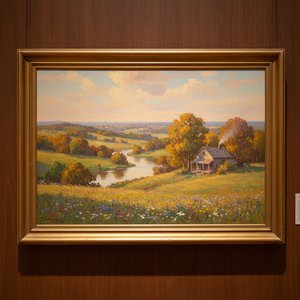
Wessel’s output was defined by a technical versatility that spanned from large-scale landscapes to the delicate precision of miniatures. She frequently utilized ivory as a substrate, a choice that demanded a disciplined, controlled hand. This technical rigor translated into a diverse body of work including still lifes, marine scenes, and landscapes. Her ability to navigate different scales and surfaces suggests a painter who prioritized the physical demands of her medium over a singular, repetitive aesthetic.
Her reputation rests heavily on her portraiture, specifically her ability to capture the likenesses of children and Native Americans. She was particularly acclaimed for her child portraiture, a focus she maintained through the 1960s. This was not a fleeting interest; she eventually produced over two hundred portraits. Her depictions of Indian subjects, such as Red Coat Indian or Portrait Of A Sioux Aunt, demonstrate a specific commitment to these subjects that distinguishes her from many of her contemporaries who focused solely on traditional European portraiture.
- Red Coat Indian
- Portrait Girl With Teddy Bear
- Portrait Of A Sioux Aunt
- Jenny Indian Man
- Indian Girl And Her Dog
Later Years and Death
The trajectory of Wessel's productivity was interrupted by the demands of motherhood. While raising her son, she was less active as a painter, a period of relative quietude that shifted the focus away from her professional output. This was not a permanent departure from her craft, however. Once her son was grown, she returned to a full painting career, maintaining her presence in the art world through the mid-20th century.
Her late-career output remained focused on the subjects that defined her reputation, particularly her acclaimed child portraiture. She continued to exhibit her work well into the 1960s, demonstrating a sustained technical proficiency that lasted decades after her initial training. This longevity ensured her continued relevance in the Cincinnati art scene long after her early years as a faculty member and club president.
Bessie Hoover Wessel died in Cincinnati, Ohio, on January 29, 1973. Her death marked the end of a long career that spanned the transition from the early 20th-century academic traditions to the modern era.
Pitanja i odgovori
Postoji li hronološki pregled radova umetnika Bessie Hoover Wessel?
Hronološki prikaz radova umetnika Bessie Hoover Wessel dostupan je na njegovoj stranici Hronika, gde se dela predstavljaju redom stvaranja, poglavlje po poglavlje.
Gde se mogu pronaći dela umetnika Bessie Hoover Wessel grupisanom prema umetničkim pravcima?
Stranica Svi umetnički pravci grupiše dela umetnika Bessie Hoover Wessel prema umetničkom pravcu.
Kako mogu da pronađem sva dela umetnika Bessie Hoover Wessel prema određenom mediju?
Stranica Svi mediji grupiše dela umetnika Bessie Hoover Wessel prema tehnici.
Gde se mogu pronaći dela umetnika Bessie Hoover Wessel klasifikovana prema temi?
Radove umetnika Bessie Hoover Wessel možete istražiti prema tematici na njegovoj stranici Atlas tema.