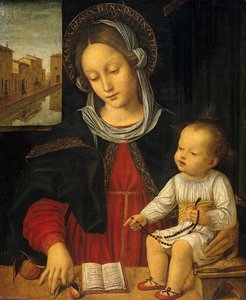
The Serene Spirit of the Lombard Renaissance
In the golden age of the Italian Renaissance, few artists captured the quietude of devotion as profoundly as Ambrogio Bergognone, born Ambrogio da Fossano. A master whose brushwork breathed life into the spiritual landscapes of Lombardy, his name remains a testament to an era defined by both monumental ambition and intimate piety. While the precise details of his early years remain partially veiled by the mists of history, his artistic identity is inextricably linked to the fertile cultural soil of Northern Italy. Emerging from the traditions of the late 15th century, Bergognone developed a style that eschewed the dramatic turbulence found in other regions, opting instead for a luminous, contemplative grace that invited the viewer into a state of silent prayer.
The foundations of his technique were likely laid under the watchful eyes of masters such as Vincenzo Foppa and Bernardino Zenale. These influences instilled in him a deep respect for the Lombard tradition—a style characterized by a subtle use of light, a soft approach to form, and an extraordinary attention to the tactile reality of fabrics and landscapes. As he matured, his work began to reflect a unique synthesis of these inherited lessons and a personal quest for emotional clarity. His ability to render the divine not as something distant and terrifying, but as something present and tender, became the hallmark of his burgeoning career.
A Legacy Carved in Stone and Pigment
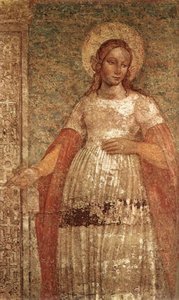
Perhaps no site serves as a more magnificent testament to Bergognone’s genius than the Certosa di Pavia. This monastic complex, a jewel of Renaissance architecture, provided the stage for some of his most ambitious collaborative endeavors. Working alongside his brother Bernardino and other luminaries like Bartolomeo Pola, he contributed to the creation of breathtakingly intricate decorations that transformed the space into a celestial vision on earth. His involvement in the monumental choir stall ensemble and the delicate frescoes within the basilica showcases a versatility that bridged the gap between large-scale architectural decoration and the fine, meticulous detail required for devotional panels.
His mastery is particularly evident when examining his religious compositions, where he often explored themes of compassion and divine presence. In works such as The Compassion of Christ between two angels, one can observe his unparalleled ability to use subtle tonal gradations to evoke a sense of profound melancholy and holiness. His paintings do not merely depict biblical events; they inhabit them. Through the careful arrangement of figures and the soft, atmospheric light that seems to emanates from within the canvas itself, Bergognone achieved a level of sfumato and emotional depth that resonated deeply with the spiritual sensibilities of his patrons, including the influential Ludovico Sforza.
The Enduring Resonance of a Master
As the tides of the Renaissance shifted toward the more complex and muscular styles of the High Renaissance, Bergognone’s commitment to a serene, devotional aesthetic ensured his place in the pantheon of great Lombard painters. His later years, spent navigating the shifting political landscapes of Milan, saw him continuing to secure prestigious commissions that allowed him to refine his expressive capabilities. Even as compositions became more sophisticated, the core of his work remained anchored in a profound sense of peace and a meticulous devotion to detail.
Today, the significance of Ambrogio Bergognone lies in his ability to act as a bridge between the structured traditions of the early Renaissance and the emotive potential of the centuries that followed. His oeuvre serves as a vital window into the soul of the Lombard Renaissance, offering a glimpse into a world where art was the ultimate vessel for the divine. To study his work is to experience a rare form of visual stillness, a reminder of the power of art to transcend time and touch the eternal through the simple, masterful rendering of light, shadow, and grace.