Introduction
Close your eyes for a moment and imagine the soft, rhythmic scratch of a metal burin against copper, a sound that has echoed through the quiet studios of history for centuries. Before the world was captured in the fluid, light-drenched brushstrokes of Monet or the swirling emotional depths of Van Gogh, there was the precise, disciplined language of the line. Engraving is an art of patience and profound intention; it is the delicate dance of carving light out of darkness, one meticulous stroke at a time.
Historically, these masterworks served as the very heartbeat of cultural exchange. In eras when a painting was a singular treasure locked within a palace or a cathedral, engravings acted as the messengers of beauty. They traveled across borders, carrying the whispers of Renaissance intellect and the dramatic shadows of the Baroque to the hands of scholars, poets, and dreamers alike. Through the medium of print, a single vision could become a shared human experience, democratizing art and allowing the intricate details of a master's mind to reach the far corners of the known world.
Even in our modern age of instant digital imagery, these legendary engravings retain a soul that pixels simply cannot replicate. There is a tactile, almost visceral connection to the paper—a sense of weight and permanence found in the way ink settles into the grooves of a pressed sheet. We find meaning today not just in their technical perfection, but in their ability to capture the essence of an era through texture, contrast, and the sheer human effort required to create them.
As we wander through this curated selection, prepare to encounter works that did more than merely decorate; they redefined the boundaries of what a line could achieve. We shall journey through ten transformative masterpieces—works that challenged the eyes of their contemporaries and forever altered the trajectory of art history. Let us begin our walk through these storied grooves of ink and memory.
Plate six, from A Rake's Progress - William Hogarth
 Plate six, from A Rake's Progress - William Hogarth
While many view the 18th century through a lens of powdered elegance, William Hogarth used his engraving needle to strip away the veneer, revealing the raw, often grotesque reality beneath. In Plate six, from A Rake's Progress , Hogarth achieves a breathtaking feat of narrative density; he does not merely depict a scene, but orchestrates a symphony of moral decay. Through meticulous hatching and dramatic chiaroscuro, he captures the claustrophobic chaos of a tavern where bribery, gambling, and debauchery collide in a flurry of shadows and sharp, biting lines.
This masterpiece stands among the top 10 legendary engraving masterpieces because it transformed printmaking from simple illustration into a powerful medium for social critique. The technical precision required to render such frantic energy—the glint of scattered coins, the heavy textures of velvet and wood—demands an intense, focused intellect. Much like the disciplined spirit needed to execute such intricate detail, bringing a piece of this profound historical gravity into a modern study or home office can foster an atmosphere of deep contemplation and sophisticated, productive thought.
The Two on the Cross - Salvador Dalí
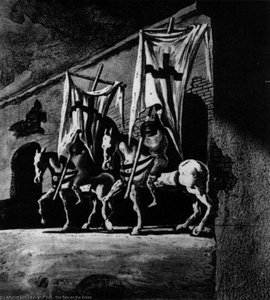 The Two on the Cross - Salvador Dalí
To gaze upon Salvador Dalí’s The Two on the Cross is to step directly into the fractured architecture of a dream. Created in 1942, this monochrome etching does not merely depict figures; it captures the profound, unsettling tension between the sacred and the subconscious. Through the masterful use of hatching and cross-hatching, Dalí breathes a haunting volume into the stark black and white, where draped fabric adorned with crosses looms over riders lost in a landscape of shadows and light.
This work earns its place among the world's greatest engravings through its ability to evoke a universal sense of spiritual unease and mystery. It is a masterclass in surrealist symbolism, using geometric precision and distorted perspectives to challenge our perception of reality. At OriginalUniqueArt.com, we believe such evocative power should not be confined to museum archives. Our hand-painted oil reproductions are meticulously crafted to preserve this very soul—capturing the deep tonal range and the dramatic interplay of light that makes Dalí’s vision so enduringly transformative for any collector's home.
Virgin and Child - Andrea Mantegna
 Virgin and Child - Andrea Mantegna
In the quietude of Andrea Mantegna’s Virgin and Child , one does not merely encounter a religious icon; one enters a space where the weight of history and the grace of the divine converge. There is a profound, monumental stillness in the way the Madonna holds her child, an emotion so tender yet anchored by a sculptural gravity that feels as eternal as ancient marble. As one of our Top 10 Legendary 'Engraving' Masterpieces That Changed Art Forever , this work captures a psychological depth that serves as a universal mirror for the human experience—reflecting both the vulnerability of new life and the strength of maternal devotion.
Through the meticulous alchemy of line and light, Mantegna uses chiaroscuro to breathe life into heavy, flowing drapery, creating an illusionistic depth that draws the soul inward. To bring such a piece into your home is to invite a sense of sacred peace; displaying this powerful emotional resonance can transform a personal sanctuary into a space for profound reflection and calm, much like walking through a silent, sun-drenched gallery.
Big Fishes Eat Little Fishes - Pieter Bruegel the Elder
 Big Fishes Eat Little Fishes - Pieter Bruegel the Elder
Imagine standing before a swirling, monochromatic tide where the boundary between sea and soul dissolves into a frantic dance of survival. In Pieter Bruegel the Elder’s Big Fish Eat Little Fish , we are not merely observing an underwater scene; we are witnessing the visceral pulse of existence itself. The engraving captures a hauntingly beautiful chaos, where a monstrous predator looms over a teeming, vulnerable world, its scales rendered with such meticulous hatching that you can almost feel the cold, rhythmic ripple of the water.
This masterpiece earns its place among the top 10 legendary engravings because it transcends mere maritime imagery to become a profound Flemish allegory for power and greed. Bruegel uses the stark contrast of light and shadow to mirror the brutal realities of human nature, reminding us that the cycle of strength and weakness is as eternal as the tides. Bringing such a storied, contemplative piece into your home does more than decorate a wall; it invites a sense of historical depth and intellectual grace, turning a modern space into a sanctuary for profound reflection and timeless storytelling.
Adam (detail) - Albrecht Dürer
 Adam (detail) - Albrecht Dürer
Imagine standing in the quiet, hallowed air of a Renaissance chapel, where the scent of old stone meets the profound weight of a divine encounter. In this breathtaking detail from Albrecht Dürer’s 1507 masterpiece, we witness more than just anatomy; we feel the very breath of creation. As Adam gazes upward, his eyes alight with an aching aspiration for the divine, we are pulled into a moment of pure, spiritual yearning. This work earns its place among the top 10 legendary engraving masterpieces because it captures the heartbeat of humanism—the beautiful, fragile intersection of scientific observation and soulful faith.
Dürer’s mastery of line and light transforms a simple figure into an eternal symbol of our search for meaning. The meticulous musculature and the serene, upward tilt of his face evoke a sense of wonder that transcends centuries. Bringing such profound depth into a modern home allows us to invite this same spirit of contemplation and grace into our daily lives, turning a mere room into a sanctuary of timeless reflection.
Job and his family restored to prosperity 1 - William Blake
 Job and his family restored to prosperity 1 - William Blake
To gaze upon Job and his family restored to prosperity by William Blake is to witness a soul emerging from the shadows into a soft, divine light. In this breathtaking engraving, Blake transcends mere biblical illustration, weaving a tapestry of profound spiritual renewal that resonates deeply with the human experience of resilience. It earns its place among the world's most legendary engravings through its unparalleled ability to marry intricate, rhythmic linework with an overwhelming sense of emotional relief and grace.
Blake’s mastery of hatching and cross-hatching creates a landscape that feels both tactile and ethereal, where every fold of fabric and every leaf in the background vibrates with symbolic weight. This work is a cornerstone of the Romantic movement, pushing the boundaries of how printmaking can convey complex, mystical narratives. Today, the transformative power of such a masterpiece remains timeless; through our high-fidelity oil reproductions, you can bring this profound sense of peace and historical grandeur into your own home or private gallery, allowing Blake’s vision of hope to illuminate your personal sanctuary.
The Lady of Shalott (Moxon Tennyson) - Dante Gabriel Rossetti
 The Lady of Shalott (Moxon Tennyson) - Dante Gabriel Rossetti
In the hauntingly beautiful engraving The Lady of Shalott , Dante Gabriel Rossetti captures a moment of profound, tragic stillness that lingers in the soul long after the first glance. There is a heavy, breathless quality to the scene; we find ourselves drawn to the figure of Elaine, lying prostrate amidst the shadows, her fate irrevocably woven into the very fabric of the landscape. Through masterful, dense cross-hatching, Rossetti breathes a tactile life into the monochrome, creating textures so rich you can almost feel the cold stone and the swirling, mournful waters of the river.
This masterpiece serves as a universal mirror for our own moments of vulnerability and longing. The symbolism—from the reflective mirrors of confinement to the swans marking the journey toward the unknown—offers a psychological depth that transcends its Victorian origins. To invite such an evocative piece into your home is to transform a mere room into a sanctuary for profound reflection. It is a work that does not just decorate a wall; it invites a quiet, soulful dialogue with the history of human emotion, making it a cornerstone of this collection of legendary engraving masterpieces.
The Seven Sorrows of the Virgin - Albrecht Dürer
 The Seven Sorrows of the Virgin - Albrecht Dürer
To encounter Albrecht Dürer’s "The Seven Sorrows of the Virgin" is to step into a sacred, whispered intimacy, as if uncovering a hidden jewel within the vast treasury of the German Renaissance. This 1496 masterpiece secures its place among the world's most legendary engravings through its profound emotional intelligence, transforming a religious narrative into a visceral study of human endurance. Dürer moves beyond mere line work; using his unparalleled mastery of hatching and cross-hatching , he breathes a sculptural, rhythmic life into each panel, making the weight of grief feel almost palpable to the touch.
The work unfolds like a silent symphony of shadows, where every bowed head and clenched hand communicates a deep, theological resonance. For the discerning collector, this engraving offers more than historical significance; it brings an intellectual gravity and a timeless, monochromatic elegance to a refined interior. It is a piece that commands presence, inviting a slow, meditative gaze that bridges the gap between the divine and our own shared human experience, making it a cornerstone of any truly curated collection.
Lust - Pieter Bruegel the Elder
 Lust - Pieter Bruegel the Elder
There is a gaze in Lust by Pieter Bruegel the Elder that follows you—not with judgment, but with a profound, haunting understanding . This isn't merely an engraving; it is a mirror held up to the chaotic impulses of the human soul. Created around 1558, this masterpiece captures a fever dream of Northern Renaissance excess, where every meticulous line etched into the plate vibrates with moral weight.
As you wander through the densely populated landscape, your eye is drawn to the central pavilion—a stage for temptation—amidst a sea of figures gripped by shame or revelry. Through masterful hatching and cross-hatching , Bruegel and his engraver create a dramatic interplay of monochromatic light and shadow, casting much of this human folly into a mysterious, velvety gloom. Now, imagine that profound depth in your own space. This work does not just watch you; it reminds you that you are part of the eternal human story, making the invisible complexities of desire visible through the sheer power of ink and intention.
Satan going forth from the presence of the Lord 1 - William Blake
 Satan going forth from the presence of the Lord 1 - William Blake
Before the world recognized his visionary genius, William Blake lived much of his life in the shadows of obscurity, often viewed more as a mystic than a master engraver. In Satan going forth from the presence of the Lord , we witness the precise moment where his spiritual intensity meets technical perfection. This masterpiece is not merely an etching; it is a psychological landscape of rebellion and divine weight. Through meticulous line work and deep, velvety shadows, Blake captures the heavy atmosphere of Satan’s departure, using stark contrasts to evoke the palpable tension between celestial authority and fallen defiance.
The engraving’s ability to transform dark, brooding textures into a profound theological drama marks it as one of the most significant works in our collection of legendary engravings. The way light struggles against the oppressive blacks and muted reds creates a sense of eternal movement. To possess such a piece is to invite a spirit of deep contemplation and intellectual rigor into your space; its dramatic scale and emotional depth serve to inspire a focused, sophisticated atmosphere, perfect for a modern study or a quiet corner dedicated to profound thought.
Conclusion
As the light softens and the shadows of the gallery lengthen, we find ourselves leaving more than just a collection of lines and ink behind. To walk through the history of these legendary engravings is to realize that they are not merely relics of a bygone era, frozen in the quiet stillness of museum halls, but living, breathing pulses of human emotion that continue to beat within our modern world. Each delicate stroke and intricate cross-hatch carries a whisper from the past, a persistent reminder of our shared capacity for wonder, precision, and profound feeling.
These masterpieces do not belong solely to the archives; they live on in the way we perceive light, in the way we find beauty in detail, and in the very homes where we seek solace and inspiration. They remain vibrant forces, capable of transforming a simple room into a sanctuary of thought and grace. Whether it is the rhythmic movement of a landscape or the haunting depth of a portrait, these works continue to shape our aesthetic souls and invite us to see the world with renewed tenderness.
We invite you to carry this sense of discovery with you, letting the elegance of these historic impressions find a permanent place in your own story. Should you wish to surround yourself with this enduring legacy, we invite you to explore our full collection , where the timeless spirit of the masters awaits your rediscovery.