The Salon Rejection & The Birth of a Movement
The story of Impressionism is, at its heart, a tale of rebellion. In the mid-19th century, the Parisian art world was dominated by the rigid standards of the Académie des Beaux-Arts. Historical and mythological subjects, meticulously rendered with academic precision, were favored; landscapes and scenes of modern life were considered decidedly less important. Artists striving for recognition navigated a complex system culminating in the annual Salon de Paris – acceptance meant success, rejection often meant obscurity. In 1874, a group of artists—Claude Monet, Pierre-Auguste Renoir, Edgar Degas, Camille Pissarro, and others—found themselves excluded from this prestigious exhibition. Rather than accept defeat, they took matters into their own hands, forming the “Anonymous Society of Painters, Sculptors, Printmakers, etc.” and organizing an independent exhibition that would forever alter the course of art history.
This initial show, held in Nadar’s photography studio, was met with derision. Critics mocked the artists' loose brushwork, unconventional compositions, and focus on everyday subjects. Louis Leroy, a journalist for Le Charivari, famously coined the term “Impressionism” after Claude Monet’s painting, “Impression, soleil levant”, intending it as an insult – he accused the work of being merely a sketch, an ‘impression’ rather than a finished piece. Ironically, the name stuck, becoming synonymous with this groundbreaking new style and encapsulating its core philosophy: to capture the fleeting moment, the subjective experience of light and color.
Capturing the Ephemeral: Plein Air Painting & Impressionist Technique
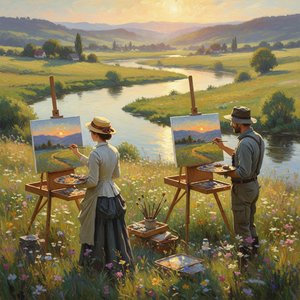
Central to the Impressionists’ revolution was their embrace of en plein air painting – working directly from nature, outdoors. This wasn't merely a change in location; it fundamentally altered their approach to representation. Prior to this, artists typically sketched outdoors and completed paintings in the studio, relying on memory and pre-conceived notions. The Impressionists sought to record the immediate effects of sunlight and atmosphere, recognizing that these conditions were constantly shifting. This pursuit necessitated new techniques.
They abandoned traditional blending methods, instead applying small, broken brushstrokes of pure, unmixed color directly onto the canvas. This technique, influenced by artists like Eugène Delacroix and J.M.W. Turner, allowed them to simulate the vibrancy of light and create a sense of movement and atmosphere. Monet’s series paintings – haystacks, Rouen Cathedral, water lilies – exemplify this dedication. He didn't aim to depict a single, definitive image but rather to capture the same subject under varying conditions of light and weather, revealing its inherent mutability. The texture of these works is palpable; you can almost feel the sun on your skin as you gaze upon them.
Modernity on Canvas: Depicting Everyday Life and Urban Landscapes
Impressionism wasn’t just about technique; it was a reflection of a changing world. As Paris underwent massive reconstruction under Napoleon III, artists turned their attention to the city itself – its bustling boulevards, railway stations, cafes, and theaters. They depicted scenes of modern life, capturing the energy and dynamism of an increasingly industrialized society. This focus on contemporary subjects was radical for its time.
Monet’s paintings of Saint-Lazare Station, for example, transformed a mundane industrial space into a captivating study of light, steam, and color. Renoir's depictions of Parisian social life – dances at the Moulin de la Galette, boating parties on the Seine – celebrated leisure and pleasure. These artists weren’t interested in grand narratives or historical allegories; they sought to capture the beauty and complexity of everyday existence. They painted what they saw, not what they were *told* to see.
Color, Light, and Perception: The Radical Palette of the Impressionists
The Impressionists’ use of color was revolutionary. They understood that light is not simply a neutral illumination but rather a spectrum of colors that constantly changes depending on atmospheric conditions and the surrounding environment. They rejected the traditional academic palette in favor of brighter, more vibrant hues, often applying them directly to the canvas without pre-mixing. This approach created a sense of luminosity and immediacy.
They also explored the principles of complementary color – placing contrasting colors side by side to heighten their intensity. Shadows were not rendered as dark browns or blacks but rather as mixtures of blues, violets, and greens, reflecting the way light interacts with surfaces in reality. This emphasis on accurate depiction of light wasn’t merely an aesthetic choice; it was a fundamental shift in how artists perceived and represented the world around them. The goal was to recreate the sensation of seeing, not simply to reproduce a visual likeness.
Beyond Representation: The Influence of Japanese Prints & Photography
The Impressionists weren’t working in isolation. They were influenced by a variety of contemporary developments, including the burgeoning field of photography and the influx of ukiyo-e woodblock prints from Japan. Photography challenged the traditional role of painting as a means of accurate representation, freeing artists to explore more subjective approaches. Japanese prints, with their bold compositions, flattened perspectives, and emphasis on pattern and color, offered new aesthetic possibilities.
Artists like Degas were particularly fascinated by the compositional techniques found in ukiyo-e, incorporating them into his paintings of dancers and bathers. The influence can be seen in their unconventional cropping, asymmetrical arrangements, and use of negative space. These influences broadened their artistic horizons and contributed to the unique visual language of Impressionism.
The Lasting Impact: From Post-Impressionism to Contemporary Art
Though initially met with resistance, Impressionism eventually gained widespread acceptance and profoundly influenced subsequent generations of artists. Post-Impressionists like Van Gogh, Cézanne, and Gauguin built upon the foundations laid by Monet and his contemporaries, pushing the boundaries of color, form, and expression even further. The emphasis on subjective experience and individual style paved the way for modern art movements such as Fauvism, Cubism, and Expressionism.
Today, Impressionist paintings are celebrated worldwide for their beauty, innovation, and enduring appeal. The movement’s legacy extends beyond the realm of painting, influencing photography, literature, and music. The desire to capture the fleeting moment, to find beauty in the everyday, remains a powerful force in contemporary art. At OriginalUniqueArt, we are dedicated to making these masterpieces accessible to all, offering high-quality reproductions that allow you to experience the magic of Impressionism firsthand.