The Original Glitch: El Greco’s Proto-Expressionist Vision
 Christ on the Cross
El Greco’s ‘Christ on the Cross’: A Descent into Spiritual Turmoil Doménikos Theotokópoulos, universally known as El Greco – “the Greek” – stands as one of art history's most singular and profoundly emotive figures. Born in Crete in 1541, his artisti...
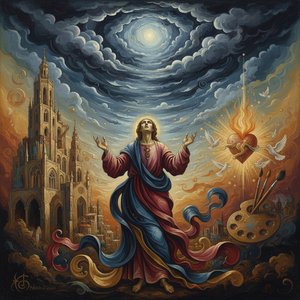
Long before the digital age introduced the concept of a visual glitch, Doménikos Theotokópoulos—the man the world knows as El Greco—was already breaking the code of reality. To look upon his work is to witness a deliberate departure from the polished, harmonious perfection of the High Renaissance. He did not seek to replicate the physical world with photographic accuracy; instead, he sought to capture its vibration. His canvases act as a visceral confrontation, where the boundaries between the earthly and the divine dissolve into a fever dream of light and motion. In masterpieces like Christ on the Cross, we see a descent into spiritual turmoil that feels startlingly modern. The figures are not merely painted; they are stretched, contorted, and elongated, pulling the viewer upward through a landscape of flickering, flame-like brushstrokes that anticipate the raw emotional power of 20th-century Expressionism by hundreds of years.
This was not an error in technique, but a profound mastery of emotion. By eschewing traditional perspective for a flattened, more intense space, El Greco created an immersive experience that refuses to let the eye rest. His early training in the Byzantine tradition provided him with a meticulous understanding of religious iconography, yet his time in Venice and Rome allowed him to infuse that precision with a new, restless energy. The result is a style that feels less like a static historical relic and entirely more like a living, breathing presence—a precursor to the fragmented forms of Cubism and the psychological depth of modern abstract movements.
Distorted Elegance: How Mannerist Forms Command Modern Interiors
 Mannerism
Mannerism is a style in European art that emerged in the later years of the Italian High Renaissance around 1520, spreading by about 1530 and lasting until about the end of the 16th century in Italy, when the Baroque style largely replaced it. Northe...
In the contemporary design landscape, where minimalism often risks becoming sterile, there is a growing hunger for pieces that possess architectural weight and psychological depth. This is precisely where the Mannerist aesthetic of El Greco finds its second life. Mannerism, characterized by sophisticated distortions and dramatic compositions, offers a striking counterpoint to the clean lines of modern urban living. When a collector introduces an elongated, dramatic figure into a sleek, contemporary room, it creates a tension that is both sophisticated and commanding. The way El Greco manipulates light—using chiaroscuro not just to define form but to suggest a supernatural presence—provides a focal point that can anchor an entire gallery wall or a grand staircase.
The beauty of these distorted forms lies in their ability to command attention without relying on cluttered detail. The stark verticality and the dramatic, often dark color palettes of his Toledo period work seamlessly with modern textures like polished concrete, matte metals, and dark woods. These works do not merely decorate a space; they transform it into a sanctuary of spirit and stone. For the discerning collector, selecting a piece that embraces this intentional distortion is an act of bold curation, signaling an appreciation for art that dares to move beyond the surface level of beauty into the realm of the sublime.
Beyond the Canvas: Remixing El Greco for Contemporary Aesthetics
At OriginalUniqueArt.com, we believe that art history should not be a closed book, but a living, breathing medium for reinvention. The true excitement for the modern collector lies in the ability to remix these historical titans. Imagine the impact of taking the haunting, elongated silhouettes of El Greco and applying them to a contemporary subject, or perhaps performing a "Period Shift" where a modern portrait is reimagative through his lens of spiritual intensity. We offer the unique opportunity to bridge the gap between the 16th-century Spanish Counter-Reformation and the high-impact energy of today’s street art and graphic movements.
Our artists, all holders of prestigious Fine Arts degrees, specialize in this very alchemy. They can take a personal photograph and reconstruct it using El Greco's signature impasto technique—thick, visible brushstrokes that provide a tactile depth far superior to any digital print. Whether it is through our AI Masterpiece Transformation tool, which allows you to see your photos reimagined in a Cubist or Surrealist style before a human artist commits them to 100% cotton canvas, or our custom color-matching services, the goal is to create something entirely singular. We don't just reproduce; we evolve. This process ensures that your collection remains as fresh and provocative as the era of Pop Art itself, while retaining the soul and craftsmanship of a true master.
From Byzantine Roots to Urban Edge: A Visual Evolution
 El Greco
A Life Forged in Faith and Fire Doménikos Theotokópoulos, known to the world as El Greco – “the Greek” – was a painter whose life and work defied easy categorization. Born in 1541 on the island of Crete, then under Venetian rule, his artistic journey...
The journey of El Greco is one of constant, restless transformation—a narrative arc that mirrors the evolution of modern urban identity. Born in Crete under Venetian rule, his artistic DNA was forged in the meticulous, iconographic traditions of Byzantium. As he moved through the vibrant, color-drenched streets of Venice and the sophisticated workshops of Rome, he absorbed the mastery of Titian and Tintoretto, eventually finding his ultimate expression in the spiritual heartland of Toledo. This trajectory—from the rigid precision of icons to the fluid, dramatic energy of the Spanish Renaissance—is a blueprint for the modern creator who seeks to synthesize diverse influences into a unique visual language.
This evolution is what makes his work so resonant with today's culturally literate audience. Just as we draw inspiration from gaming aesthetics, anime, and streetwear, El Greco drew from every culture he encountered to build something that defied categorization. His ability to marry the meticulousness of his Greek roots with the sensuality of Venetian oil paint creates a visual tension that feels incredibly "now." It is an art of movement, of transition, and of finding beauty in the struggle between the earthly and the divine—a theme that remains as relevant in our fast-paced, digital world as it was in the 16th century.
Curating the Chaos: Integrating Bold Masterpieces into Minimalist Spaces
 Masterpieces of Light and Spirit: The Top 25 El Greco Artworks
Introduction To step into the world of El Greco is to leave the boundaries of the physical realm and enter a space where light, shadow, and spirit collide in a breathtaking dance of elongated forms and celestial fire. His canvases do not merely depic...
Integrating a work of such intense emotional gravity into a minimalist or modern space requires a confident hand. The key is to treat the artwork not as an accessory, but as the primary architectural element. A large-format, multi-panel reproduction—perhaps splitting a dramatic scene across three or five panels—can serve to expand the perceived boundaries of a room, much like a window into another dimension. By using our Group Set Paintings, collectors can create a cohesive, modern look that flows seamlessly across wide walls or staircases, ensuring that the energy of the brushwork is felt throughout the entire space.
To achieve this balance, we recommend focusing on the interplay of light and shadow. In a room dominated by neutral tones, an El Greco-inspired piece with its deep blacks, muted grays, and sudden, brilliant highlights can act as a powerful visual anchor. For those seeking a more seamless integration, our MirrorWrap or ExtendedWrap options allow the painting to continue around the edges of the canvas, removing the frame entirely and allowing the art to bleed into the very structure of the room. Ultimately, curating El Greco is about embracing the beautiful chaos—allowing the distorted, the dramatic, and the divine to breathe life into the structured elegance of modern design.
Explore more at OriginalUniqueArt.com.