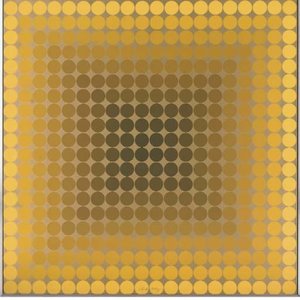
Ulje na platnu
 Sve o delu Molnar







































 Za umetnička dela ili reprodukcije čija je bilo koja strana veća od 105 cm (približno 41 inč), okvir će biti isporučen u obliku rastavljenog seta za sklapanje. Ovaj metod osigurava bezbednu dostavu i sprečava oštećenja tokom transporta.


A Symphony of Circles: Unveiling Victor Vasarely’s “Molnar”
Victor Vasarely's "Molnar" is more than just a painting; it’s an invitation into the mesmerizing world of Op Art, a realm where perception itself becomes the subject. This striking composition – a dominant red circle enveloped by a constellation of smaller circles in vibrant hues – immediately captivates with its dynamic energy and illusionistic depth. The work, echoing Vasarely's pioneering explorations of optical art, demonstrates a masterful manipulation of color and form to create an experience that transcends simple visual representation.
The Genesis of Optical Illusions
Born in 1906 in Pécs, Croatia (then part of Austria-Hungary), Károly Vaszary – later known as Victor Vasarely – initially pursued a medical career before dedicating himself to the burgeoning field of visual art. His formative years were deeply influenced by the Bauhaus movement and Sándor Bortnyik’s “Műhely” workshop, where he absorbed the principles of functional design and geometric abstraction. This training provided the foundation for his revolutionary approach: to explore how the human eye perceives and interprets shapes and colors. "Molnar" exemplifies this philosophy perfectly, drawing upon techniques developed by Vasarely and other pioneers of Op Art – artists who sought to challenge traditional notions of representation by directly engaging with the viewer’s visual system.
Decoding the Composition
The painting's intricate arrangement is a deliberate exercise in controlled chaos. The large, red circle acts as an anchor, drawing the eye inward while simultaneously creating a sense of space and depth. The smaller circles, rendered in a spectrum of colors – green, yellow, pink, brown, and blue – are not randomly scattered; they’re meticulously positioned to create a dynamic interplay of light and shadow, further enhancing the illusion of three-dimensional form. This technique, characteristic of Vasarely's work, relies on the principles of optical mixing, where adjacent colors appear to blend together due to the way our eyes perceive them. The overall effect is one of constant movement and shifting perspective, a testament to the artist’s understanding of visual perception.
Symbolism and Emotional Resonance
"Molnar" transcends mere aesthetic appeal; it speaks to fundamental questions about reality and perception. Vasarely's work often explored themes of order and chaos, suggesting that these two forces are inextricably linked within the human experience. The circles themselves can be interpreted as representing wholeness, unity, or even the infinite – concepts frequently explored in geometric abstraction. Beyond its intellectual depth, "Molnar" evokes a powerful emotional response, inviting viewers to lose themselves in its mesmerizing patterns and contemplate the nature of visual reality. It’s a piece that demands attention, stimulating the senses and challenging our assumptions about how we see the world.
Pitanja i odgovori
Da li je Molnar ručno oslikano ili odštampano?
Ručno oslikano: profesionalni umetnik kopira Molnar uljanim bojama na platnu od lana.
Koju veličinu treba da odaberem za Molnar?
Dimenzije se kreću od 31.6 x 31.7 cm (дин20925) do 239.2 x 240.1 cm (дин216675); tabela na ovoj stranici navodi glavne korake i njihove cene.
Koliko dugo traje dostava?
Isporuka traje od 4 do 5 nedelja, uz besplatnu ekspresnu dostavu širom sveta; na ovoj stranici je ponuđena opcija hitne proizvodnje. Možete ga vratiti u roku od 100 dana uz pun povraćaj sredstava, bez ikakvih uslova.
Koji je medij koristio/la Виктор Вазарели za delo Molnar?
Acrylic On Canvas
 Pregledaj u prostoru

 Pošalji
 Podeli
 Detalji o delu
 Informativni list


 Preuzmi
 Slični predmeti
 Rendgenski snimak
 Automatska prezentacija
 Pitanja i odgovori

 Statistika