 Ulje na platnu
 Sve o delu Where







































 Za umetnička dela ili reprodukcije čija je bilo koja strana veća od 105 cm (približno 41 inč), okvir će biti isporučen u obliku rastavljenog seta za sklapanje. Ovaj metod osigurava bezbednu dostavu i sprečava oštećenja tokom transporta.


A Symphony of Color and Flow
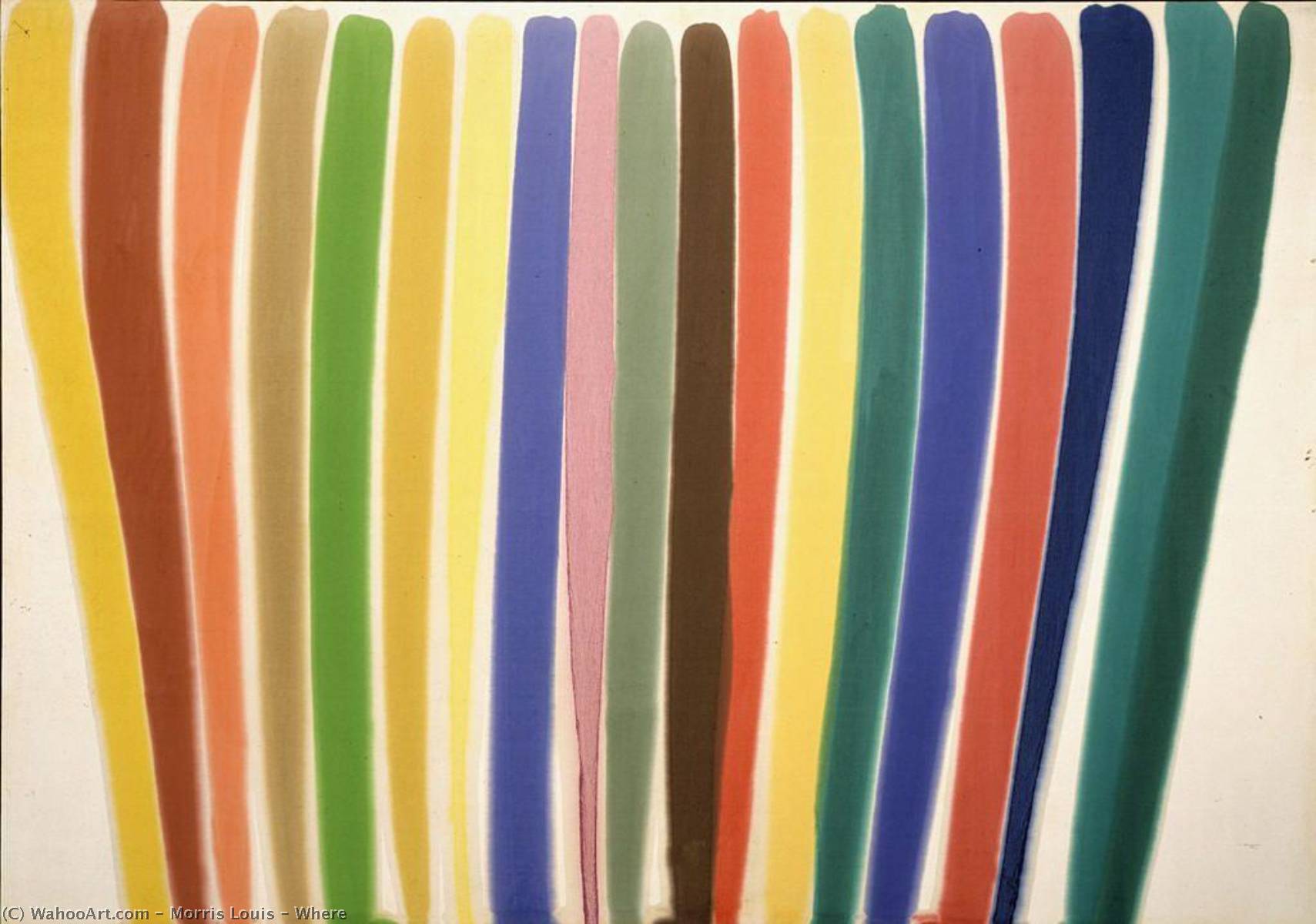
In the vast landscape of mid-century modernism, few works capture the ethereal essence of movement quite like "Where" by Morris Louis. Created in 1960, this monumental masterpiece serves as a profound testament to the era of Abstract Expressionism, specifically the evolution into Color Field painting. At first glance, the viewer is met with a breathtaking vertical composition where elongated, rectangular forms of varying hues dance across the canvas. There is no traditional subject matter here—no figures to anchor the eye or landscapes to provide a sense of place. Instead, the artwork invites us into a purely sensory experience, where the interplay of light, pigment, and shape creates a rhythmic progression that feels both spontaneous and meticulously balanced.
The technique employed by Louis is nothing short of revolutionary. Utilizing acrylic resin on canvas, he achieved a unique texture and finish that allows colors to bleed and merge with a dreamlike fluidity. The painting features a striking arrangement of horizontal stripes in a vibrant palette—reds, blues, greens, yellows, oranges, and purples—that occasionally coalesce into a mesmerizing checkerboard pattern. This method creates a sense of depth and luminosity, as if the light is emanating from within the layers of paint itself. The soft edges and blended hues suggest a watercolor-like delicacy, yet the scale of the piece—a commanding 252 x 362 cm—imparts a powerful, physical presence that demands attention in any space.
The Legacy of Innovation
To understand "Where," one must look back to the transformative period of the 1940s and 1950s when Morris Louis emerged as a pivotal figure in the American art scene. Moving away from the heavy, gestural brushwork of early Abstract Expressionism, Louis pioneered a style that emphasized the inherent properties of paint and the flatness of the canvas. His discovery of Magna paint—an oil-based acrylic—allowed him to manipulate pigment with unprecedented freedom, leading to his famous "veil" paintings. In "Where," we see the culmination of this experimentation, where the artist rejects representational forms in favor of exploring the emotional resonance of pure color and geometric abstraction.
For the discerning collector or interior designer, this piece offers more than just visual splendor; it provides a focal point of profound serenity and contemplation. The harmonious color scheme and the rhythmic, linear progression of the forms evoke a sense of peace, making it an ideal centerpiece for sophisticated, contemporary environments. Whether placed in a grand gallery setting or a curated residential lounge, a high-quality reproduction of "Where" brings with it the historical weight of the Smithsonian American Art Museum's collection and the timeless allure of a movement that redefined the boundaries of modern art.
Pitanja i odgovori
Da li je Where ručno oslikano ili odštampano?
Ručno oslikano: profesionalni umetnik kopira Where uljanim bojama na platnu od lana.
Koju veličinu treba da odaberem za Where?
Dimenzije originala su 252 x 362 cm. Dimenzije se kreću od 26.5 x 37.7 cm (дин20925) do 169.0 x 240.7 cm (дин159028); tabela na ovoj stranici navodi glavne korake i njihove cene.
Koliko dugo traje dostava?
Isporuka traje od 4 do 5 nedelja, uz besplatnu ekspresnu dostavu širom sveta; na ovoj stranici je ponuđena opcija hitne proizvodnje. Možete ga vratiti u roku od 100 dana uz pun povraćaj sredstava, bez ikakvih uslova.
Koji je medij koristio/la Morris Louis za delo Where?
Acrylic On Canvas
 Pregledaj u prostoru

 Pošalji
 Podeli
 Detalji o delu
 Informativni list


 Preuzmi
 Slični predmeti
 Rendgenski snimak
 Automatska prezentacija
 Pitanja i odgovori

 Statistika