 Ulje na platnu
 Sve o delu Blue Landscape







































 Za umetnička dela ili reprodukcije čija je bilo koja strana veća od 105 cm (približno 41 inč), okvir će biti isporučen u obliku rastavljenog seta za sklapanje. Ovaj metod osigurava bezbednu dostavu i sprečava oštećenja tokom transporta.


Identification of Blue Landscape by Marc Chagall
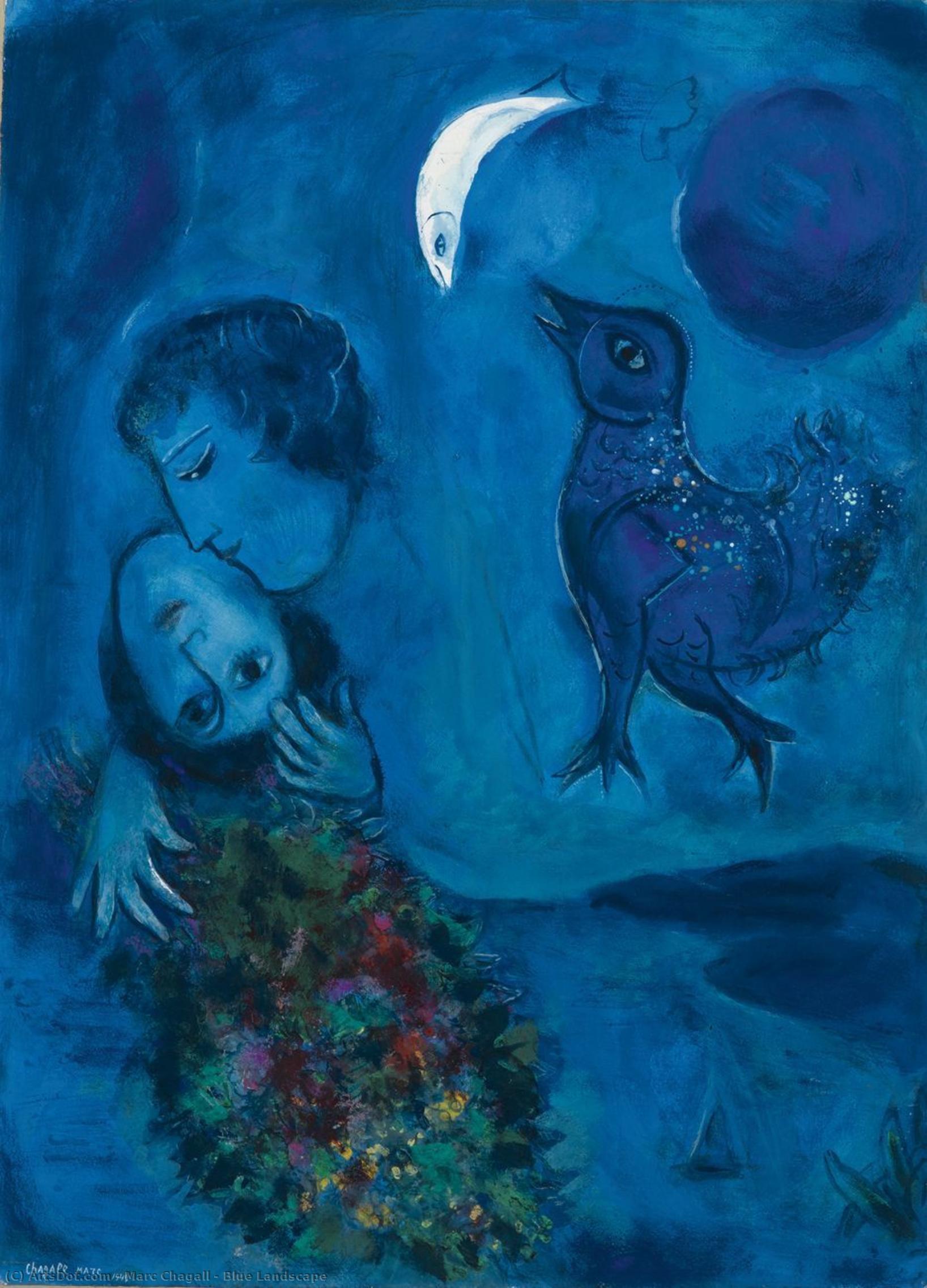
The gaze meets Blue Landscape, a work where the boundaries between reality and a dreamlike vision begin to dissolve. Created by Marc Chagall in 1949, this piece exists as a profound meditation on memory and the enduring weight of human connection. It is a gouache work that captures a specific, quiet moment of intimacy, suspended within a vast and celestial atmosphere.
In this scene, the artist uses the medium of gouache to build a world that feels both deeply personal and strangely universal. The work invites a sense of wonder, as if we are peering into a private memory held by the soul. Every stroke contributes to a vision that prioritizes the pulse of emotion over the rigid rules of the physical world. It is a quiet, blue-hued space where the echoes of love and remembrance seem to linger in the air.
Composition and Visual Elements of the Work
In the foreground, a man and a woman are locked in a tender embrace. They share a quiet, intimate moment, their bodies positioned as if caught in the middle of a slow dance. The woman reaches up, her arms encircling the man's neck, while he gazes down into her face. This central tableau anchors the scene, radiating a profound sense of love and connection that pulls the viewer into their private world.
Above this couple, the sky opens up into a vast, nocturnal expanse. Two birds soar through the air, one drifting toward the left and the other toward the right, their wings cutting through the stillness. The heavens are crowded with stars that dot the darkness, creating a deep, celestial atmosphere. A moon hangs in the upper reaches of the frame, casting a gentle luminescence that washes over the landscape below. This soft light settles upon the earth, bathing the entire scene in a quiet, dreamlike glow.
Technique and Artistic Style of the Artist
The gouache on paper breathes with a soft, matte texture, allowing the colors to settle into the fibers of the page. Chagall moves away from the rigid constraints of academic tradition, leaning instead into the raw, direct expression of Primitivism. There is a sense that the artist is not merely painting a scene, but is instead sketching a memory as it floats through the mind. The lines do not seek to define the world with clinical precision; instead, they flow with a lyrical, unstudied grace that feels deeply personal.
In this space, realism and dreamlike distortions exist in a delicate, constant dance. The figures do not obey the strict laws of anatomy or gravity. Instead, they bend and sway, caught in a moment of emotional weight that transcends physical form. This choice prioritizes the resonance of feeling over the accuracy of the human frame. The artist seeks to capture the essence of a kiss or the weight of an embrace, allowing the shapes to shift and drift as if seen through the haze of a half-remembered dream.
Color Palette and Symbolic Meaning
The scene unfolds within a world dominated by shades of blue. This color does not merely describe the night; it breathes through every corner of the composition. Deep indigo shadows pool in the depths of the landscape, while pale cerulean washes across the sky, creating a sense of infinite space. These tones do not simply represent the atmosphere of a nighttime setting. Instead, the blue carries a weight of meaning, embodying peace, contemplation, and the quiet essence of love. The color acts as a vessel for the emotions shared between the embracing figures.
Every hue works to translate a feeling rather than a literal sight. The moonlight, which casts a gentle luminescence upon the landscape, works in harmony with the celestial blues to foster an atmosphere of serenity and tranquility. This use of color moves beyond the descriptive, turning the sky and the earth into a symbolic realm where memory and emotion reside. The blue is a language of the soul, speaking of the profound connections that endure even when the physical world fades into a dreamlike state.
Historical Context and Themes
The world feels heavy in the wake of World War II, a time when the shadows of devastation linger over the landscape. In this era of reconstruction and loss, the work emerges as a quiet whisper of resilience. It speaks to the capacity for hope even when the surroundings feel fractured. There is a profound sense of survival here, a refusal to let the darkness of the age extinguish the light of human connection.
A certain melancholy drifts through the scene, rooted in the artist's own history of displacement. The memory of exile from Soviet Russia leaves a trace upon the soul of the work. This personal history of wandering and searching informs the emotional weight of the embrace. It is a meditation on the things we carry with us—the memories of home, the ache of loss, and the enduring power of emotion. The piece reaches into the depths of human experience to find what remains when everything else is stripped away.
Pitanja i odgovori
Da li je Blue Landscape ručno oslikano ili odštampano?
Ručno oslikano: profesionalni umetnik kopira Blue Landscape uljanim bojama na platnu od lana.
Koju veličinu treba da odaberem za Blue Landscape?
Dimenzije originala su 77 x 56 cm. Dimenzije se kreću od 37.3 x 26.8 cm (дин20932) do 248.2 x 178.6 cm (дин171644); tabela na ovoj stranici navodi glavne korake i njihove cene.
Koliko dugo traje dostava?
Isporuka traje od 4 do 5 nedelja, uz besplatnu ekspresnu dostavu širom sveta; na ovoj stranici je ponuđena opcija hitne proizvodnje. Možete ga vratiti u roku od 100 dana uz pun povraćaj sredstava, bez ikakvih uslova.
Gde se nalazi originalno delo Blue Landscape?
Original se nalazi u kolekciji Von der Heydt Museum, Wuppertal.
Koji je medij koristio/la Марк Шагал za delo Blue Landscape?
Gouache
 Pregledaj u prostoru

 Pošalji
 Podeli
 Detalji o delu
 Informativni list


 Preuzmi
 Slični predmeti
 Rendgenski snimak
 Automatska prezentacija
 Pitanja i odgovori

 Statistika