Neoclassicism · 1786
Thomas Witter (Džon Ramadž, 1786)
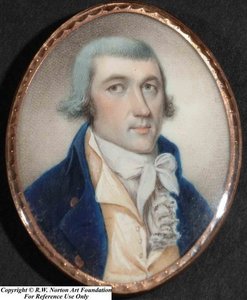
Džon Ramadž (1748–1802) je napravio Thomas Witter. Datirano je iz 1786. Pripada pokretu Neoclassicism. Izrađeno je u Watercolor. Čuva se u muzeju Metropoliten музеј у Њујорку u mestu Њујорк, Сједињено Америчке Државе. Dimenzije su 4 × 4 cm.
- 1786
- Watercolor
- 4 × 4 cm
- Metropoliten музеј у Њујорку

 Pregledaj u prostoru

 Ručno oslikano uljanim bojama
 Pošalji
 Podeli
 Informativni list za štampu


 Preuzmi
 Slični predmeti
 Rendgenski snimak
 Automatska prezentacija
 Pitanja i odgovori

 Statistika
Thomas Witter, ukratko
- Naslov
- Thomas Witter
- Umetnik
- Džon Ramadž (1748–1802)
- Mesto rođenja umetnika
- Dublin, Irska
- Datum
- 1786
- Tehnika
- Watercolor
- Dimenzije
- 4 × 4 cm
- Gde se može videti
- Metropoliten музеј у Њујорку, Њујорк, Сједињено Америчке Државе
- Pokret
- Neoclassicism
- Period
- Early Modern
- Tema
- man, portrait, mustache, white hair, cravat, grayscale
Šta prikazuje Thomas Witter?
Identification of the Portrait of Thomas Witter
The gaze of Thomas Witter meets the viewer through this intimate watercolor portrait, a work that captures a quiet moment of reflection. Painted by John Ramage in 1786, the piece presents a man caught in a state of contemplation. He appears as a gentleman of his era, his presence rendered with a delicate touch that suggests a life of dignity and perhaps a touch of melancholy. The portrait focuses closely on his head and shoulders, creating a sense of immediate, personal encounter.
This small-scale watercolor painting offers a glimpse into the character of the subject. Ramage, an artist known for his ability to capture individual presence, uses the medium to define the contours of Witter's face and the subtle textures of his attire. The man's white hair and prominent mustache are rendered with precision, framing a face that seems to hold a silent story. Every line and shade works to preserve the likeness of Thomas Witter, ensuring his image remains present and palpable.
Composition and Visual Elements
The portrait centers on the head and shoulders of the subject, all contained within the gentle curves of an oval frame. He gazes downward, his eyes cast toward something unseen, wearing an expression of quiet melancholy or deep contemplation. His white hair is styled with neat precision, and a prominent mustache defines his face. He wears a formal suit, the details of which are anchored by a tie or cravat wrapped carefully around his neck.
A grayscale palette governs the entire scene, moving through a full range of tones from the deepest blacks to the brightest whites. This monochromatic approach creates a sense of stillness. Soft, diffused lighting washes over the man, illuminating his features evenly and avoiding any harsh or jarring shadows. The light settles upon his face, revealing the subtle contours of his features and the texture of his clothing without disrupting the calm atmosphere of the moment.
Technique and Artistic Materials
The artist works within a delicate 4 x 4 cm space, utilizing watercolor on paper to build a quiet, grayscale world. Through the careful layering of gray paint washes, a sense of volume emerges from the flat surface. These tonal variations create a soft, diffused light that settles across the subject, building depth through subtle shifts in shadow rather than harsh lines. The monochromatic palette relies entirely on these gradations to define the form of the man's face and the structure of his attire.
Fine, deliberate lines define the character of the portrait. The artist uses precise strokes to render the details of the mustache and the subtle wrinkles of the skin, capturing a sense of lived experience. These same linear techniques extend to the clothing, where lines trace the heavy folds of the fabric. A tactile contrast exists between the different surfaces; the skin appears smooth under the light, while the texture of the clothing feels slightly more rugged and coarse.
U kom muzeju se nalazi Thomas Witter?
Metropoliten музеј у Њујорку
Њујорк, Сједињено Америчке Државе
Poreklo i istorija Metropoliten музеја у Њујорку Metropoliten музеј у Њујорку započeo je svoje postojanje vizijom koju je delila grupa poslovnika, finansijera, kao i vodećih umetnika i mislilaca. Nakon što je institucija zvanično osnovana 1870. godine, počela je potraga za trajnim domom koji bi mogao da smesti njene stalno rastuće kolekcije.


Slike visoke rezolucije za Thomas Witter
Džon Ramadž, Thomas Witter (1786), Metropoliten музеј у Њујорку. Javno dobro.
Odgovori na pitanja o Thomas Witter
U kom muzeju se čuva originalni "Thomas Witter"?
Delo „Thomas Witter”, autor Džon Ramadž je izloženo u muzeju Metropoliten музеј у Њујорку, Њујорк, Сједињено Америчке Државе. Navod o muzeju odnosi se na originalno delo, a ne na reprodukcije.
U kojoj godini je nastalo delo „Thomas Witter”, autor Džon Ramadž?
Delo „Thomas Witter”, autor Džon Ramadž datira iz 1786. godine.
Kojom tehnikom je izrađeno "Thomas Witter"?
Džon Ramadž je koristio/la tehniku Watercolor za delo "Thomas Witter". Ova tehnika definiše materijalnu prirodu originalnog dela.
Kolikih je dimenzija originalnog dela "Thomas Witter"?
„Thomas Witter“ u svom izvornom obliku ima dimenzije 4 x 4 cm. Originalne dimenzije su koristan pokazatelj pri odabiru veličine reprodukcije.
Šta predstavlja delo "Thomas Witter"?
Teme prisutne u delu „Thomas Witter”, autor Džon Ramadž obuhvataju man, portrait, mustache, white hair, cravat, grayscale, što zajedno sažima suštinu ovog umetničkog dela.
Da li je delo „Thomas Witter”, autor Džon Ramadž u javnom vlasništvu?
„Thomas Witter”, autor Džon Ramadž pripada u javnom vlasništvu – autorska prava su istekla. Ovaj status određuje način na koji se slika dela može reprodukovati.
Ko je autor dela "Thomas Witter"?
Delo "Thomas Witter" pripisuje se umetniku Džon Ramadž.
Koji umetnički pravac obuhvata „Thomas Witter”, autor Džon Ramadž?
Umetnički pravac koji se povezuje sa delom „Thomas Witter”, autor Džon Ramadž je Neoclassicism. Ova klasifikacija smešta rad među srodne umetnike i umetnička dela.
U kom periodu karijere Džon Ramadž pripada delo "Thomas Witter"?
U okviru karijere umetnika Džon Ramadž, delo "Thomas Witter" pripada periodu Mature Period, što omogućava poređenje sa drugim radovima ovog autora.
O umetniku, Džon Ramadž
1748–1802, Irska
Džon Ramadž
Život koji je spajao svetove: Priča o Džonu Ramadžu Rođen u Dablinu, u Irskoj, 1748. godine, život Džona Ramadža bio je priča o izuzetnim tranzicijama i umetničkoj posvećenosti, putovanje koje ga je odvelo iz rafiniranog sveta irskog zlatarstva u rastuću umetničku scenu kolonijalne Amerike. Detalji koji se odnose na njegov rani porodični život ostaju neuhvatljivi, ali je poznato da je 1763. godine završio formalno obrazovanje u Dablinskom društvu umetnika, čime je postavili temelje u tehnikama crtanja i slikarstva koji će služiti kao temelj njegovih budućih poduhvata.
Takođe i Džon Ramadž
 Portrait of a Gentleman1780
 Governor George Clinton1785
 Major Greene, B.A1777
 Gilbert Van Cortlandt1785
Eseji o delu Thomas Witter
 25 Masterpieces by Jean-Antoine Watteau: The Essence of Rococo EleganceExplore 25 iconic Rococo masterpieces by Jean-Antoine Watteau. Discover the full collection online at OriginalUniqueArt.com.
 Dutch Baroque Masters: 10 Paintings That Shaped an Era | OriginalUniqueArtJourney through the Golden Age with our guide to the Top 10 Dutch Baroque masterpieces! Explore iconic paintings by Rembrandt, Vermeer & Fr…
 Monochromatic Form: Integrating Black, White, and Gray Abstract Art into Modern Architectural SpacesMaster the art of integrating monochromatic abstraction into modern architecture with expert curation. Elevate your space today.