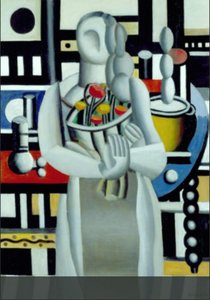
Ulje na platnu
 Sve o delu Stalingrad







































 Za umetnička dela ili reprodukcije čija je bilo koja strana veća od 105 cm (približno 41 inč), okvir će biti isporučen u obliku rastavljenog seta za sklapanje. Ovaj metod osigurava bezbednu dostavu i sprečava oštećenja tokom transporta.


The Creation of Stalingrad by Fernand Léger
In 1924, Fernand Léger turned his gaze toward the heavy, rhythmic pulse of industrial labor. His painting, Stalingrad, emerged from this fascination with the intersection of man and machine. The canvas captures a moment of intense industrial collaboration, where the human form and the mechanical tool become inseparable. It is a scene of construction and movement, a study of how steel and muscle work in tandem to reshape a landscape.
The work is rooted in the language of Cubism, utilizing fragmented planes to organize the chaos of the machine age. At the same time, it carries the simplified, direct clarity often associated with Naïve Art. This duality allows the subject matter to remain grounded. The heavy machinery and the workers are not mere decorations; they are the structural bones of the composition. Fernand Léger sought to translate the energy of the modern era into a visual reality of intersecting lines and solid forms.
Steel pistons and heavy cranes define the space. The work exists in the tension between the organic and the manufactured. It is a quiet record of strength.
Artistic Movements and Stylistic Influences
The canvas is anchored in the fractured logic of Cubism. It follows the path cleared by the pioneers of the movement, breaking the world into a sequence of overlapping planes and geometric shards. This is not a soft dissolution of form, but a structural dismantling. The artist’s own hand developed a specific variation of this language, often called Tubism, which emphasizes cylindrical, tubular shapes. These rounded, mechanical volumes replace the organic curves of the natural world with the hard, rhythmic precision of the machine age.
There is a heavy, industrial pulse within these shapes. The work looks toward the future, acting as a forerunner to the Pop Art movement that would emerge decades later. By treating modern, mechanical subjects with such directness, the artist bridges the gap between fine art and the objects of a consumer society. The painting captures a moment where the human figure and the machine become inseparable parts of a single, moving mechanism. Steel and shadow define the new reality.
Pitanja i odgovori
Da li je Stalingrad ručno oslikano ili odštampano?
Ručno oslikano: profesionalni umetnik kopira Stalingrad uljanim bojama na platnu od lana.
Koju veličinu treba da odaberem za Stalingrad?
Dimenzije originala su 32 x 50 cm. Dimenzije se kreću od 29.9 x 33.4 cm (дин26245) do 217.2 x 242.6 cm (дин206288); tabela na ovoj stranici navodi glavne korake i njihove cene.
Koliko dugo traje dostava?
Isporuka traje od 4 do 5 nedelja, uz besplatnu ekspresnu dostavu širom sveta; na ovoj stranici je ponuđena opcija hitne proizvodnje. Možete ga vratiti u roku od 100 dana uz pun povraćaj sredstava, bez ikakvih uslova.
Koji je medij koristio/la Fernan Leže za delo Stalingrad?
Oil On Canvas
 Pregledaj u prostoru

 Pošalji
 Podeli
 Detalji o delu
 Informativni list


 Preuzmi
 Slični predmeti
 Rendgenski snimak
 Automatska prezentacija
 Pitanja i odgovori

 Statistika