Expressionism
Sunset (Емил Нолде)
Sunset je delo umetnika Емил Нолде (1867–1956). Pripada pokretu Expressionism. Izrađeno je u Oil On Canvas.
- Oil On Canvas

 Pregledaj u prostoru

 Ručno oslikano uljanim bojama
 Pošalji
 Podeli
 Vodič


 Preuzmi
 Slični predmeti
 Rendgenski snimak
 Automatska prezentacija
 Pitanja i odgovori

 Statistika
Sunset: the essentials
- Naslov
- Sunset
- Umetnik
- Емил Нолде (1867–1956)
- Rođen/a u
- Нордел, Данска
- Tehnika
- Oil On Canvas
- Pokret
- Expressionism
- Period
- Modern
- Tema
- sun, ocean, sky, boat, waves, orange
Looking at Sunset
The Weight of Light
The sun hangs as a heavy, bright circle at the center of the sky, a singular eye watching the descent of the day. Below it, the atmosphere burns with shades of yellow, orange, and red, bleeding into one another to create a warm, thick air. The ocean receives this light, its waves rolling gently toward the shore in a rhythmic, quiet motion. A lone boat floats upon the water, a small, silent shape amidst the vastness of the sea and sky. The composition pulls the eye toward that central orb, where the light is most intense.
The Language of Color
The paint is applied with a sense of urgency, a spontaneous and impulsive movement of the brush that leaves the surface textured and alive. This technique does not seek to smooth the world, but to capture the immediate sensation of a fading light. The artist uses color as the very substance of the form, rather than a mere layer applied to a shape. In this work, the elements of sky, land, and sea fuse into a single, emotive play of light.
- Oil on canvas
- Heightened use of color
- Spontaneous brushstrokes
- Signed 'Emil Nolde' in the lower left
The Pulse of the Sea
The sea is an elemental force here, an imposing presence that mirrors the artist's own connection to the coast. There is a tension between the peaceful ambiance of the floating boat and the intense, brooding energy of the colors. The brushwork moves swiftly, capturing a specific moment of weather before the light shifts into shadow. It is a study of the internal weight of a landscape, where the color carries the emotional gravity of the setting sun. The tide pulls at the shore.
Sunset in high resolution

Емил Нолде, Sunset. Javno dobro.
Digitalni stručnjak proverava boje u odnosu na originalno delo i retušira datoteku, vernu umetnikovim potezima četkice.
Buy the high-resolution imageQuestions about Sunset
Na koji način se tema dela "Sunset" odnosi na uobičajene teme umetnika Емил Нолде?
Učestale teme umetnika Емил Нолде obuhvataju post-impressionism, die brücke group, vincent van gogh, expressive use of color, nature and the sea; delo "Sunset" fokusira se na sun, ocean, sky, boat, waves, orange, yellow, red.
Koliko je zasićena paleta dela "Sunset"?
Paleta dela "Sunset" ima Clear Color Presence zasićenost.
Ko je autor dela "Sunset" i u kom umetničkom pravcu?
Delo "Sunset" delo je Емил Нолде u stilu Expressionism. Umetnik i pravac definišu tradiciju ovog dela.
Koju emociju prenosi „Sunset”, autor Емил Нолде?
Emocionalni ton zabeležen za „Sunset”, autor Емил Нолде je Dramatic, što sažima osećaj koji ovo delo izražava.
Da li je "Sunset" u celini svetliji ili tamniji?
Zabeležene vrednosti za „Sunset”, autor Емил Нолде su: osvetljenost bright, luminansa Gentle Luminance.
Kakvu atmosferu odiše "Sunset"?
Opšta atmosfera dela „Sunset”, autor Емил Нолде je Bold. Ova atmosfera opisuje opšti dojam koji delo ostavlja.
Kolika je bojno ujednačena kompozicija dela „Sunset”, autor Емил Нолде?
Boje dela „Sunset”, autor Емил Нолде odražavaju Discordant Palette harmoniju. Harmonija opisuje međusobni odnos boja.
Gde i kako se preporučuje postaviti „Sunset”, autor Емил Нолде?
„Sunset“ je predloženo za Mood, a preporučeni prostor je Living Room.
Mogu li videti „Sunset”, autor Емил Нолде pod različitim svetlima?
X-Ray prikaz dela „Sunset”, autor Емил Нолде možete videti na stranici Rentgensko posmatranje: to je interaktivno istraživanje slike kroz jedanaest optičkih slojeva.
About the artist, Емил Нолде
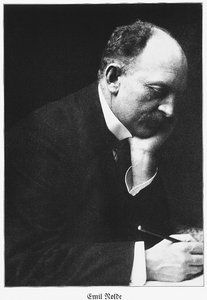
1867–1956, Данска
Емил Нолде
The Life and Identity of Emile Nolde Born Hans Emil Hansen on 7 August 1867, the man who would become known as Emile Nolde grew up near the village of Nolde in the Duchy of Schleswig. His early years were shaped by the rural, agrarian life of his family. He eventually moved away from this path, choosing instead to work as a wood carver and furniture decorator. This tactile, physical labor preceded his shift toward painting and printmaking.
Also by Емил Нолде
 Sea with Red Sky
 Couple on the beach1903
 Masks1911
 Christ among the Children

Essays around Sunset
 Shifting Tides: The Luminous Language of Light in Impressionist SeascapesExplore the evolution of light and motion in Impressionist seascapes through masterworks. Dive into this luminous journey today.
 Sails and Sunlight: The Fleeting Motion of Boats in Impressionist ArtExplore the luminous evolution of maritime Impressionism from Courbet to Monet. Rediscover the magic of light and water today.
 The Language of Brushstrokes: How Texture and Technique Reveal the Soul of ArtDiscover the profound connection between texture and emotion in Impressionist art. Explore how masterful brushstrokes by Renoir and Monet c…