Romanticism
Alpine Landscape (Alexandre Calame)
Alexandre Calame (1810–1864) je napravio Alpine Landscape. Pripada pokretu Romanticism. Izrađeno je u Oil On Canvas. Dimenzije su 45 × 31 cm.
- Oil On Canvas
- 45 × 31 cm

 Pregledaj u prostoru

 Ručno oslikano uljanim bojama
 Pošalji
 Podeli
 Informativni list za štampu


 Preuzmi
 Slični predmeti
 Rendgenski snimak
 Automatska prezentacija
 Pitanja i odgovori

 Statistika
Alpine Landscape, ukratko
- Naslov
- Alpine Landscape
- Umetnik
- Alexandre Calame (1810–1864)
- Mesto rođenja umetnika
- Веве, Швајцарска
- Tehnika
- Oil On Canvas
- Dimenzije
- 45 × 31 cm
- Pokret
- Romanticism
- Period
- 19th Century
- Tema
- alpine landscape, mountain scenery, swiss alps view, river valley scene, atmospheric perspective, landscape painting
Šta prikazuje Alpine Landscape?
Identification of the Alpine Landscape
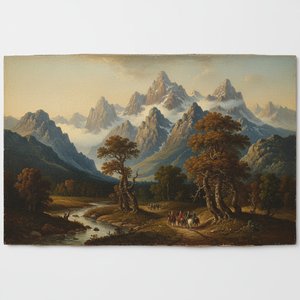
Alpine Landscape is an oil painting by the Swiss artist Alexandre Calame. The canvas captures a mountainous valley where a river winds through the terrain. A rocky outcrop anchors the left side of the scene, leading the eye toward distant, receding peaks. This work reflects the artist's lifelong preoccupation with the rugged topography of his homeland.
Alexandre Calame was born in 1810 in Vevey, Switzerland. He spent much of his life observing the textures of the Alps, from the weight of granite to the movement of mountain streams. The artist eventually passed away in 1864 in Menton, France. In this specific composition, the light remains diffused, as if filtered through an overcast sky or the soft glow of early morning.
The scene focuses on the scale of the natural world. Trees and shrubs ground the foreground, providing a sense of texture against the vastness of the background. The mountains rise in geometric triangles, their forms softening as they vanish into the atmospheric distance. A quiet stillness settles over the valley.
Composition and Visual Elements
A rocky outcrop anchors the left side of the frame, its jagged edges catching the light to pull the eye into the scene. From this stone threshold, the gaze follows a river as it winds through a mountainous valley. In the foreground, the earth is textured with the presence of shrubs and trees, grounding the viewer amidst the wild vegetation. These small, detailed forms provide a tactile entry point before the eye moves toward the vastness of the background.
The composition relies on a steady use of perspective to carve out a sense of immense depth. The mountains recede into the distance, their scale dwarfing the river and the greenery below. This arrangement emphasizes the sheer magnitude of the alpine terrain. The verticality of the peaks meets the horizontal flow of the water, creating a structured balance within the natural chaos. The light remains diffused, casting soft shadows across the mountain slopes and the valley floor. A quiet stillness settles over the stone and the stream.
Technique and Artistic Materials
Oil paint meets canvas in this landscape. The artist applied thin, translucent washes of pigment, layering them one after another in a sequence of glazes. This meticulous process builds a luminous depth, allowing light to settle within the layers. It is a slow accumulation of color. The surface holds the weight of the mountain and the softness of the air.
The brushwork captures the physical reality of the terrain. Roughness defines the stone of the rocky outcrop, while the texture of the foliage is rendered with precise, tactile strokes. Light enters the scene as a diffused glow, suggesting the quiet of an overcast day or the pale clarity of early morning. Shadows settle into the mountain crevices, creating a sense of immense scale through tonal modulation. The atmosphere feels heavy with moisture, as if the light itself is filtered through a mountain mist.
The Artistic Style of Calame
A sense of the sublime anchors this work, a hallmark of the Romanticism movement. Calame was a pivotal figure within the Düsseldorf School of Painting, bringing a disciplined eye to the untamed wilderness. He treats the mountains not as static stone, but as living, breathing entities. Through a mastery of atmospheric perspective, the distant peaks recede into a soft, hazy light, creating a profound sense of depth. This tonal modulation allows the viewer to feel the weight of the air between the rocky foreground and the far horizon.
The brushwork is expressive, capturing the rugged textures of the landscape. He uses these strokes to convey the emotional impact of nature, translating the scale of the valley into a felt experience. There is a palpable emotion in the way light hits the river and the cliffs, suggesting the solitude of the high Alps. His connection to these mountains is evident in the precise, almost tactile rendering of the terrain. The scene remains quiet, held in a delicate balance of light and shadow.
Related Works by Alexandre Calame
The artist’s hand often returned to the weight of the mountains and the movement of the air. In 1838, he captured the tension of a storm at Handeck, where the sky meets the jagged rock. This energy persists in his 1856 work, Storm in the Alps, a scene of chaotic weather and turbulent clouds. He also documented the specific topography of the Valley of Lauterbrunnen in 1856, rendering the deep clefts of the Swiss terrain. These works reflect a lifelong preoccupation with the raw power of the high passes.
Water remains a constant presence in his compositions, shifting from the violent to the still. He painted the Lake of the Four Cantons, near Brunnen, in 1853, finding a different rhythm in the alpine waters. His vision extended beyond the peaks to the warmth of the south, seen in Pozzuoli and the Bay of Naples, 1844. Even in more quiet studies, such as Landscape with Oaks, about 1859, the meticulous observation of nature remains central. The light continues to shift across the stone.
Slike visoke rezolucije za Alpine Landscape
Alexandre Calame, Alpine Landscape.
Alexandre Calame (1810–1864), Alpine Landscape, oil on canvas. Javno dobro. Slika: OriginalUniqueArt.com.
Odgovori na pitanja o Alpine Landscape
Kojom tehnikom je izrađeno "Alpine Landscape"?
"Alpine Landscape" je urađeno u tehnici Oil On Canvas.
Koje su stvarne dimenzije dela „Alpine Landscape”, autor Alexandre Calame?
„Alpine Landscape“ u svom izvornom obliku ima dimenzije 45 x 31 cm. Originalne dimenzije su koristan pokazatelj pri odabiru veličine reprodukcije.
Šta prikazuje „Alpine Landscape”, autor Alexandre Calame?
Teme prisutne u delu „Alpine Landscape”, autor Alexandre Calame obuhvataju alpine landscape, mountain scenery, swiss alps view, river valley scene, atmospheric perspective, landscape painting, nature’s grandeur”, što zajedno sažima suštinu ovog umetničkog dela.
Da li je "Alpine Landscape" slobodan od autorskih prava?
„Alpine Landscape”, autor Alexandre Calame pripada u javnom vlasništvu – autorska prava su istekla. Ovaj status određuje način na koji se slika dela može reprodukovati.
Ko je umetnik koji stoji iza dela "Alpine Landscape"?
Autor dela "Alpine Landscape" je Alexandre Calame. Delo je katalogizovano pod imenom Alexandre Calame.
Koji umetnički pravac obuhvata „Alpine Landscape”, autor Alexandre Calame?
„Alpine Landscape“ je delo Romanticism pokreta. Ovaj pokret označava umetničku tradiciju kojoj je delo pripada.
U kojoj periodi karijere umetnika Alexandre Calame pripada delo "Alpine Landscape"?
U okviru karijere umetnika Alexandre Calame, delo "Alpine Landscape" pripada periodu Mature Period, što omogućava poređenje sa drugim radovima ovog autora.
Da li je delo "Alpine Landscape" autora Alexandre Calame u javnom vlasništvu i zašto?
"Alpine Landscape" autora Alexandre Calame je u u javnom vlasništvu – autorska prava su istekla. Autorska prava se računaju od godine smrti umetnika, a Alexandre Calame je preminuo/la 1864.
Šta "Alpine Landscape" deli sa ostatkom stvaralaštva umetnika Alexandre Calame?
„Alpine Landscape“ pripada Romanticism periodu stvaralaštka umetnika Alexandre Calame, čije su upečatljive teme obuhvatale romantic nature's beauty, düsseldorf school influence, swiss landscape focus", alpine sublime ideal, detailed observation, calame's signature style, nature as spiritual space.
O umetniku, Alexandre Calame

1810–1864, Швајцарска
Alexandre Calame
Alexandre Calame (1810 – 1864): Hvatanje Alpinog veličanstva Alexandre Calame, rođen u Arabie (današnji Vevey), u Švajcarskoj 1810. godine, bio je švajcarski pejzažni slikar koji je stekao značajnu slavu tokom ere romantizma i smatra se ključnom figurom u okviru dečansko-dukseldorfske škole slikarstva. Njegovo umetničko putovanje započelo je usred teških okolnosti — očev bankrot onemogućio mu je formalno obrazovanje, primoravajući ga da od tinejdžerskih godina radi kao bankarski službenik. Ipak, ta pragmatična nužda podstakla je njegovu strast prema umetnosti, koju je negao susret sa bankarom Diodatijem, koji mu je omogućio dragoceno podučavanje kod Françoisa Didaya, slavnog dečanskog pejzažnog slikara.
O umetniku Alexandre Calame Istaknuta dela umetnika Alexandre Calame
Takođe i Alexandre Calame
 Torrent in the Alps1849
 Valley of Lauterbrunnen1856
 The Mythen1861
 Landscape1837
Eseji o delu Alpine Landscape
 Alpine Grandeur: A Study of Mountain Landscapes in Classical and Romantic ArtExplore the evolution of mountain landscapes from Flemish masters to German Expressionism. Discover the sublime power of Alpine art history.
 19th century Swiss paintersLouis Buvelot left Switzerland for Melbourne in 1864 to become the father of Australian landscape painting. How did his Swiss training chan…
 Majestic Peaks on Canvas: A Historical & Artistic Exploration of Mountains in Fine ArtExplore the history of mountain painting! Discover Romantic masterpieces & key artists like Dahl & Calame. Learn about the Sublime & Pictur…