Portret Гистав Моро

100 najpoznatijih slika umetnika Гистав Моро, izbor iz galerije

Ažurirano: октобар 2026 · rangirano prema našem koeficijentu popularnosti (pretrage, posete i porudžbine za svako delo) · 535 dela Гистав Моро u našem katalogu

Ukratko

Od svih originala koje je Гистав Моро ostavio, najpoznatiji je Припојање (1876). Odmah za njima slede Faeton (1878) i Sirene, oko 1885.. Naš katalog sadrži 535 dela umetnika Гистав Моро; galerija je čuvala 100 dela koja svet najviše admira, od kojih je svako prikazano sa svojim datumom, muzejom i pričom.

1826 – 1898, Париз Simbolističko slikarstvo Najviše dela: Musée Gustave Moreau

Top 10 slika umetnika Гистав Моро: izbor galerije

1
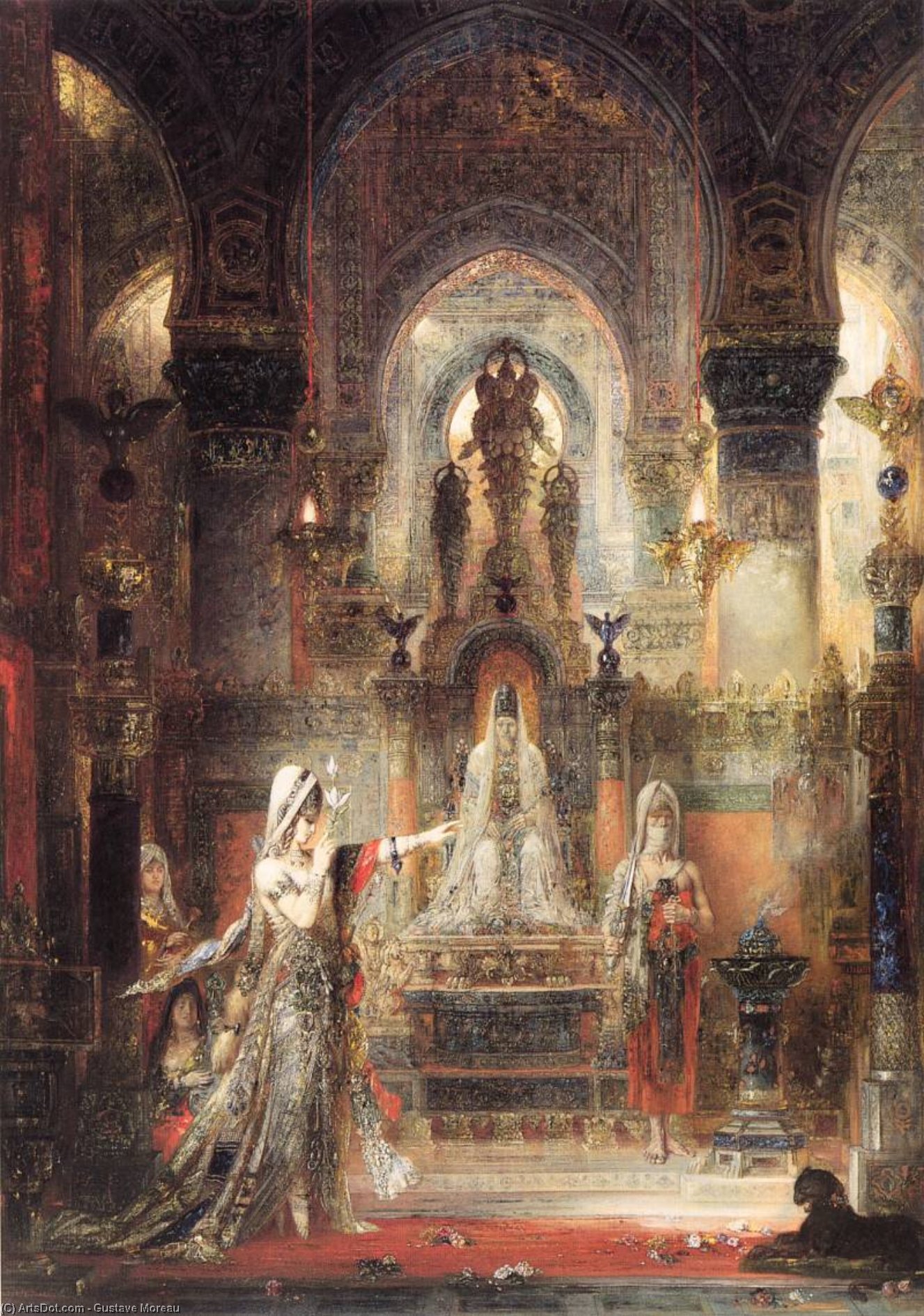
Припојање (1876) čiji je Гистав Моро

Припојање

1876 · Ulje na platnu

Gustav Morov "Pojava" (1876) je remek-delo koje prevazilazi vreme, spajajući ono sveto sa onim senzualnim u očaravajućem prikazu simbolističke umetnosti. Ovaj akvarel, koji se čuva u muzeju Orsay, beleži biblijskom trenutak kada Salome pleše pred Herodom Antipasom, dok je njena vizija proganjana odsečenom glavom Svetog Jovana Krstitelja. Morova složena kompozicija i luminozna paleta stvaraju vanzemaljsku atmosferu koja nastavlja da očarava posmatrače i više od jednog veka kasnije.

2
Faeton (1878) čiji je Гистав Моро

Faeton

1878 · Ulje na platnu · Luvr, Pariz

Feiton: Simfonija mita i simbolizma Moreauov Feiton, završen 1878. godine, predstavlja zadivljujući primer simbolističkog slikarstva—delo koje prevazilazi puko prikazivanje kako bi zaranja u carstva mita, emocija i ljudskog opstanka. Trenutno smešten u prestižnom Louvru u Parizu, ovaj uljani rad na platnu poziva posmatrače u dramatičnu i psihološki nabijenu naraciju. Ponovo ispričani mit: Scena neobuzdane ambicije Slika prikazuje klimaks iz grčke mitologije u kojem Feiton, sin sunčevog boga Heliosa, pokušava da…

3
Sirene, oko 1885. čiji je Гистав Моро

Sirene, oko 1885.

Ulje na platnu · Grand Palais, Pariz

Podmorska odiseja duše Delo Gustava Morea Sirene, oko 1885. predstavlja mnogo više od obične pomorske fantastike; to je duboki portal u samo srce simbolističkog pokreta. Dok posmatrači spuštaju se u ovo raskošno podvodno carstvo, susreću trio sirena čije prisustvo prevazilazi puki mit.Inspirisan epskim pričama Homerove Odiseje, Moreo ponovo interpretira opasni susret Odiseja i Sirena, ne kao fizičku borbu, već kao psihološku meditaciju o iskušenju, žudnji i dualnosti ljudske prirode. Centralna…

4
Salome sa glavom Jovana Krstitelja (1876) čiji je Гистав Моро

Salome sa glavom Jovana Krstitelja

1876 · Akril na platnu · Metropoliten музеј у Њујорку, Њујорк

Ulje na drvetu Gustava Morea iz 1876. godine, Salome sa glavom Svetog Jovana Krstitelja, nije spektakl trijumfa niti jezivo prikaza, već intimno i uznemirujuće istraživanje psihološkog prostora. Dimenzija svega 22 x 12 cm i izvedeno na drvetu, ovo minijaturno platno poseduje ogromnu snagu, trenutno očaravajući posetioce u Metropoliten muzeju u New Yorku. Morea nam ne prikazuje sam čin, niti Salome kako uživa u svojoj pobedi; umesto toga, on nudi trenutak…

5
Jason i Medeja (1865) čiji je Гистав Моро

Jason i Medeja

1865 · Akril na platnu · Luvr, Pariz

Gustave Moreau: A Vision of Mythic Darkness Moreau’s “Jason and Medea” isn't merely a depiction of Greek mythology; it’s an immersion into a realm where darkness reigns supreme, illuminated by flashes of unsettling beauty. Painted in 1865 during the height of Symbolist fervor, this monumental canvas transcends simple storytelling, aiming instead to evoke profound psychological states—fear, desire, and ultimately, despair—through meticulously crafted visual language. Moreau’s ambition wasn't to recreate Homeric…

6
Jupiter i Semela (1890) čiji je Гистав Моро

Jupiter i Semela

1890 · Ulje na platnu · Musée Gustave Moreau, Pariz

Vazduh se zgušnjava od teške, električne napetosti dok se granica između smrtnog i božanskog rastvara. U ovom prostoru, Jupiter, kralj bogova, sedi na masivnom tronu, njegov pogled je fiksiran pravo napred sa strogom, intenzivnom ravnodušnošću široko otvorenih očiju. On nije samo mitska figura, već prisustvo koje zrači zastrašujućim sjajem. Preko njegovog desnog stezna leži Semela, njeno telo uhvaćeno u preciznom trenutku tranzicije između života i uništenja. Njene ruke su povučene…

7
The Daughters of Thespius (1853) čiji je Гистав Моро

The Daughters of Thespius

1853 · Oil On Canvas · Musée Gustave Moreau, Pariz

A Portal into the Mythic Dreamscape In the heart of nineteenth-century Paris, Gustave Moreau emerged not merely as a painter, but as a weaver of dreams, and nowhere is this more evident than in his monumental work, The Daughters of Thespius. Created in 1853, this breathtaking oil on canvas serves as an early testament to the artist's profound ability to conjure realms that exist at the intersection of reality and…

8
Jupiter and Semele (1895) čiji je Гистав Моро

Jupiter and Semele

1895 · Oil On Canvas

In the grand tapestry of nineteenth-century art, few threads shimmer with as much mystery and nocturnal beauty as Gustave Moreau’s Jupiter and Semele. Completed in 1895, this monumental canvas stands as a cornerstone of the Symbolist movement, embodying a profound fascination with dreamlike imagery and psychological exploration. The painting plunges viewers into a scene brimming with dramatic tension, capturing a pivotal moment from Greek mythology where the celestial and the…

9
Zjawljenje (1876) čiji je Гистав Моро

Zjawljenje

1876 · Ulje na platnu · Fogg Museum, Cambridge

U ovom uljanom platnu, svetlucava, lebdeća glava zauzima gornji centralni deo okvira. Blistavi halo od bele svetlosti, podsećajući na eksploziju zvezda, okružuje ovu glavu, bacajući zrake širom scene. Ispod ovog zjave, žena sa dugom, talasastom smeđom kosom stoji u raskošnom, polunogom odeći. Nosi izvezenu otvorenu haljinu, krunu i razno dragulje. Njena desna ruka proteže se ka lebdećoj figuri, dok se kod njenih nogu odmara leopard. Pozadina sadrži masivne stubove korinškog…

10
Jakov i anđeo (1876) čiji je Гистав Моро

Jakov i anđeo

1876 · Ulje na platnu · Fogg Museum, Cambridge

Ovo platno beleži noćnu borbu između smrtnog Jakova i božanskog prisustva. Postavljena u turbulentni pejzaž pod bledošću meseca, kompozicija je usredsređena na fizičku napetost rvanja. Sa leve strane, anđeoska figura je oblečena u zamamljene, draguljem ukrašene odore, dok joj glavu kruniše višebojni halo od zračenja svetlosti. Nasuprot njoj, mišićava muška figura teži sa dinamičnim naporom, a telo joj je iskrivljeno u vrelini susreta. Scena koristi duboke plave i zemljane braon…

Izbor umetnika Гистав Моро se nastavlja, od 11 do 100

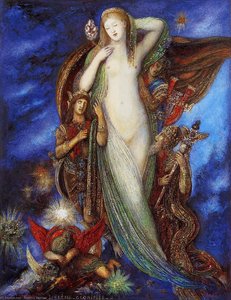
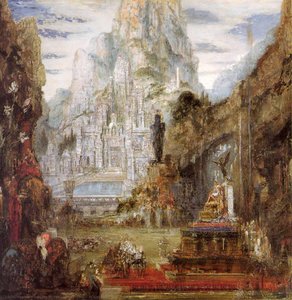
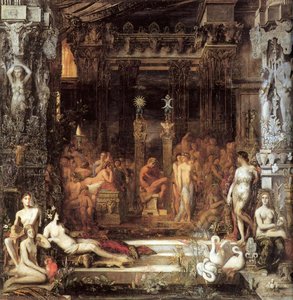
11Salome Dancing (1886) čiji je Гистав МороSalome Dancing1886 · Musée d'Orsay 12Salome u zatvoru (1876) čiji je Гистав МороSalome u zatvoru1876 · Национални музеј западне уметности 13Salom Dancing before Herod (1876) čiji je Гистав МороSalom Dancing before Herod1876 · Armand Hammer Muzej Umetnosti 14The Muses Leaving Their Father Apollo to go and Enlighten th čiji je Гистав МороThe Muses Leaving Their Father Apollo to go and Enlighten thMusée Gustave Moreau 15Hercules and the Lernaean Hydra (1876) čiji je Гистав МороHercules and the Lernaean Hydra1876 · Musée Gustave Moreau 16helene glorifiee čiji je Гистав Мороhelene glorifiee 17Pijata (1854) čiji je Гистав МороPijata1854 · Städel Museum 18Sainte Cécile et les Anges de la musique čiji je Гистав МороSainte Cécile et les Anges de la musique 19The Triumph of Alexander the Great (1892) čiji je Гистав МороThe Triumph of Alexander the Great1892 · Musée Gustave Moreau 20Salome Dancing before Herod čiji je Гистав МороSalome Dancing before HerodHammer Museum 21Sapfina smrt (1850) čiji je Гистав МороSapfina smrt1850 · Musée Gustave Moreau 22Jakov i anđeo (1878) čiji je Гистав МороJakov i anđeo1878 · Musée Gustave Moreau 23Les Argonautes čiji je Гистав МороLes Argonautes 24The Death of Sappho (1872) čiji je Гистав МороThe Death of Sappho1872 · Musée Municipal 25Pieta čiji je Гистав МороPietaНационални музеј западне уметности 26Hercules and the Hydra (1876) čiji je Гистав МороHercules and the Hydra1876 27The Suitors čiji je Гистав МороThe SuitorsMusée Gustave Moreau 28Prince Hamlet kill King Claudius čiji je Гистав МороPrince Hamlet kill King Claudius 29La Toilette (1885) čiji je Гистав МороLa Toilette1885 · Artizon Museum 30The Sphinx (1864) čiji je Гистав МороThe Sphinx1864 31Jupiter et Sémélé čiji je Гистав МороJupiter et Sémélé 32Ganymede (1886) čiji je Гистав МороGanymede1886 33Tetovirana Salome (1875) čiji je Гистав МороTetovirana Salome1875 · Musée Gustave Moreau 34Saint Michael Vanquishing Satan (1882) čiji je Гистав МороSaint Michael Vanquishing Satan1882 35La Vie de l'Humanité l'Age d'or, Adam Le soir. Le Sommeil čiji je Гистав МороLa Vie de l'Humanité l'Age d'or, Adam Le soir. Le Sommeil 36Sappho (1893) čiji je Гистав МороSappho1893 37Les Anges voyageurs ou Les voyageurs čiji je Гистав МороLes Anges voyageurs ou Les voyageurs 38Saint George and the Dragon čiji je Гистав МороSaint George and the Dragon 39Hercule et le Lion de Némée čiji je Гистав МороHercule et le Lion de Némée 40The Birth of Venus čiji je Гистав МороThe Birth of Venus 41Rape of Deianira (1850) čiji je Гистав МороRape of Deianira1850 · Musée Gustave Moreau 42Apollo Vanquishing the Serpent Python (1885) čiji je Гистав МороApollo Vanquishing the Serpent Python1885 · Nacionalna galerija Kanade 43Apollo and the Nine Muses čiji je Гистав МороApollo and the Nine Muses 44Prometheus, Variant (1870) čiji je Гистав МороPrometheus, Variant1870 · Musée Gustave Moreau 45Naissance de Vénus čiji je Гистав МороNaissance de Vénus 46Léda čiji je Гистав МороLéda 47Salome with Column (1890) čiji je Гистав МороSalome with Column1890 48Salome (1875) čiji je Гистав МороSalome1875 · Musée Gustave Moreau 49Jacob and the Angel čiji je Гистав МороJacob and the Angel 50King David (1878) čiji je Гистав МороKing David1878 · Musée Gustave Moreau 51Pasiphaë (1880) čiji je Гистав МороPasiphaë1880 · Musée Gustave Moreau 52The Peacock complaining to Juno (1881) čiji je Гистав МороThe Peacock complaining to Juno1881 53Salome Carrying the Head of John the Baptist on a Platter (1876) čiji je Гистав МороSalome Carrying the Head of John the Baptist on a Platter1876 54La Vie de l'Humanité l'Age d'or, Adam Le Midi. L'Extase čiji je Гистав МороLa Vie de l'Humanité l'Age d'or, Adam Le Midi. L'Extase 55Hercule et les filles de Thespius čiji je Гистав МороHercule et les filles de Thespius 56St. Elisabeth of Hungary (The Miracle of the Roses) (1879) čiji je Гистав МороSt. Elisabeth of Hungary (The Miracle of the Roses)1879 57L'enlèvement d'Europe ou Jupiter et Europe čiji je Гистав МороL'enlèvement d'Europe ou Jupiter et EuropeMusée Gustave Moreau 58Cleopatra (1887) čiji je Гистав МороCleopatra1887 59Jacob et l'Ange čiji je Гистав МороJacob et l'AngeMusée Gustave Moreau 60The Pietà (1867) čiji je Гистав МороThe Pietà1867 · Harvard Art Museums 61Salome in the Garden (1878) čiji je Гистав МороSalome in the Garden1878 62Bethsabée čiji je Гистав МороBethsabée 63Delilah (1896) čiji je Гистав МороDelilah1896 · Museo de Arte de Ponce 64Diana bathing (1900) čiji je Гистав МороDiana bathing1900 · Musée Gustave Moreau 65Galatée čiji je Гистав МороGalatée 66Death of Sappho (1870) čiji je Гистав МороDeath of Sappho1870 67Moïse sauvé des eaux čiji je Гистав МороMoïse sauvé des eauxMusée Gustave Moreau 68Les Licornes čiji je Гистав МороLes Licornes 69The Chimera (1867) čiji je Гистав МороThe Chimera1867 · Fogg Art Museum 70Moses, in Sight of the Promised Land, Takes His Sandals Off (1854) čiji je Гистав МороMoses, in Sight of the Promised Land, Takes His Sandals Off1854 · Musée Gustave Moreau 71Lucretia and Tarquin (1850) čiji je Гистав МороLucretia and Tarquin1850 · Musée Gustave Moreau 72The childhood of Sixtus V. (1853) čiji je Гистав МороThe childhood of Sixtus V.1853 · Musée d'Orsay 73Cléopâtre čiji je Гистав МороCléopâtre 74Hercules and the Stymphalian Birds (1872) čiji je Гистав МороHercules and the Stymphalian Birds1872 · Frances Lehman Loeb Art Center 75The Entombment (1867) čiji je Гистав МороThe Entombment1867 · Harvard Art Museums 76Sémélé čiji je Гистав МороSémélé 77Life of Humanity (1886) čiji je Гистав МороLife of Humanity1886 · Musée Gustave Moreau 78Evening and Sorrow (1882) čiji je Гистав МороEvening and Sorrow1882 79La Vie de l'Humanité l'Age de fer, Caïn. Le Soir. La Mort čiji je Гистав МороLa Vie de l'Humanité l'Age de fer, Caïn. Le Soir. La Mort 80A Saint in the Desert (1879) čiji je Гистав МороA Saint in the Desert1879 · Petit Palais 81The Poet and the Siren čiji je Гистав МороThe Poet and the Siren 82Françoise de Rimini čiji je Гистав МороFrançoise de Rimini 83Ebauche pour Le Triomphe d'Alexandre le Grand čiji je Гистав МороEbauche pour Le Triomphe d'Alexandre le Grand 84Saint Martin (1882) čiji je Гистав МороSaint Martin1882 85Young Man and Death (1865) čiji je Гистав МороYoung Man and Death1865 86The Magi (1860) čiji je Гистав МороThe Magi1860 · Musée Gustave Moreau 87Diomedes Devoured by His Horses (1865) čiji je Гистав МороDiomedes Devoured by His Horses1865 · Detroit Institute of Arts 88untitled (6379) čiji je Гистав Мороuntitled (6379) 89Rose thé čiji je Гистав МороRose thé 90Hercules and the Lernaean Hydra (1878) čiji je Гистав МороHercules and the Lernaean Hydra1878 91Voices of Evening (1885) čiji je Гистав МороVoices of Evening1885 · Musée Gustave Moreau 92The Chimera (1867) čiji je Гистав МороThe Chimera1867 93Dalila čiji je Гистав МороDalila 94Venice (1885) čiji je Гистав МороVenice1885 · Musée Gustave Moreau 95Les Prétendants čiji je Гистав МороLes Prétendants 96Poète persan čiji je Гистав МороPoète persan 97Mystical Flower (1890) čiji je Гистав МороMystical Flower1890 · Musée Gustave Moreau 98Scottish Horseman (1854) čiji je Гистав МороScottish Horseman1854 · Musée Gustave Moreau 99The Poet and the Saint (1868) čiji je Гистав МороThe Poet and the Saint1868 100Salome (Entering the Banquet Room) (1875) čiji je Гистав МороSalome (Entering the Banquet Room)1875

Čuvena dela Гистав Моро po periodima

Motivi koji su privlačili pažnju Гистав Моро

Četiri teme koje se najčešće ponavljaju u ovim originalima, svaka sa svojim vrhunskim primerom.

Muzeji u kojima se čuvaju originalna dela umetnika Гистав Моро

8 muzeja u kojima se nalazi najviše slika sa ove stranice.

Muzej Grad Radovi umetnika Гистав Моро Slike iz ovog spiska
Musée Gustave Moreau, ParizMusée Gustave Moreau Pariz 85 Jupiter i Semela, The Daughters of Thespius, The Muses Leaving Their Father Apollo to go and Enlighten th
Musée d'Orsay, ParizMusée d'Orsay Pariz 7 Salome Dancing, The childhood of Sixtus V.
Fogg Museum, CambridgeFogg Museum Cambridge 4 Zjawljenje, Jakov i anđeo
Национални музеј западне уметности, TokyoНационални музеј западне уметности Tokyo 3 Salome u zatvoru, Pieta
Harvard Art Museums, KembriđHarvard Art Museums Kembriđ 3 The Pietà, The Entombment
Luvr, ParizLuvr Pariz 2 Faeton, Jason i Medeja
Metropoliten музеј у Њујорку, ЊујоркMetropoliten музеј у Њујорку Њујорк 2 Salome sa glavom Jovana Krstitelja
Petit Palais, ParizPetit Palais Pariz 2 A Saint in the Desert

Гистав Моро deceniju po deceniju: original koji definiše svaku od njih

Radovi po decenijama

Izaberite deceniju da biste videli original koji je definiše.

Pitanja kolekcionara o slikama umetnika Гистав Моро

Po kojem delu je Гистав Моро najpoznatiji/a?Otkrij odgovor

Припојање (1876). Slede Faeton (1878) i Sirene, oko 1885..

Koliko je godina imao/la Гистав Моро kada je nastalo delo Припојање?Otkrij odgovor

50 godina: Припојање datira iz 1876, a Гистав Моро je rođen/a 1826.

Koja su deset najpoznatijih slika umetnika Гистав Моро?Otkrij odgovor

Припојање, Faeton, Sirene, oko 1885., Salome sa glavom Jovana Krstitelja, Jason i Medeja, Jupiter i Semela, The Daughters of Thespius, Jupiter and Semele, Zjawljenje i Jakov i anđeo. Gornji rang pokazuje godinu i muzej za svako od njih.

Koliko je slika ostavio Гистав Моро?Otkrij odgovor

Naš katalog sadrži 535 dela umetnika Гистав Моро, datiranih od 1850 do 1896.

U kojim muzejima se nalaze remek-dela umetnika Гистав Моро?Otkrij odgovor

Većinom u Musée Gustave Moreau (Pariz), Musée d'Orsay (Pariz) i Fogg Museum (Cambridge). Tabela muzeja iznad sadrži njih sve.

U kojim godinama je Гистав Моро naslikao svoja najpoznatija dela?Otkrij odgovor

U 1870s: 23 od 100 dela na ovoj stranici nastalo je tada, od čega je Припојање.

Koja su prva i poslednja čuvena originalna dela umetnika Гистав Моро?Otkrij odgovor

Na ovoj stranici, najstarije delo je iz Sapfina smrt (1850), a najnovije iz Delilah (1896).

Koje je motive Гистав Моро najčešće birao/la?Otkrij odgovor

Mythology (50), Religion (12) i Fantasy (11), kroz svih 100 dela na ovoj stranici.

Koju je tehniku najčešće koristio/la Гистав Моро?Otkrij odgovor

Oil On Canvas, za 43 od 100 dela na ovoj stranici.

Kojem umetničkom pravcu pripada Гистав Моро?Otkrij odgovor

Simbolističko slikarstvo, sudeći po originalima na ovoj stranici.

Čija se dela umetnika Гистав Моро nalaze u Musée Gustave Moreau?Otkrij odgovor

Jupiter i Semela, The Daughters of Thespius i The Muses Leaving Their Father Apollo to go and Enlighten th: Musée Gustave Moreau, Pariz čuva 26 dela sa ove stranice.

Гистав Моро: život i delo

A Dream Weaver of Symbolism: The Life and Art of Gustave Moreau

Gustave Moreau, a name synonymous with the ethereal beauty and enigmatic depths of Symbolist painting, emerged from 19th-century Paris as a singular artistic voice. Born in April 6, 1826, into a bourgeois family—his father an architect and archivist—Moreau’s early life was steeped in intellectual curiosity and aesthetic sensibility. From a young age, he displayed a remarkable gift for drawing, nurtured through traditional academic training at the École des Beaux-Arts under figures like François-Édouard Picot. However, Moreau's artistic path would diverge sharply from the prevailing Realist and Impressionist currents of his time. He wasn’t interested in capturing fleeting moments or objective reality; instead, he sought to unlock the hidden realms of myth, religion, and the human psyche through a deeply personal and symbolic visual language. His journey was one of inward exploration, translating subjective emotions and spiritual yearnings onto canvas with an obsessive attention to detail and a vibrant, often opulent palette.

The Forge of Imagination: Influences and Artistic Development

Moreau’s artistic development wasn't born in a vacuum. While rejecting the dominant trends of his era, he drew inspiration from diverse sources. The dramatic use of color and exotic subject matter found in the works of Eugène Delacroix ignited a passion for narrative painting imbued with emotional intensity—a fascination that would shape many of his early compositions. He held Renaissance masters like Michelangelo and Leonardo da Vinci in high esteem, admiring their mastery of composition, anatomy, and psychological insight; figures whose monumental sculptures and paintings profoundly impacted his artistic sensibilities. Yet, Moreau wasn’t merely imitating these artists; he was synthesizing their influences into something entirely new. His formative years were spent absorbing the art of antiquity and the Renaissance, meticulously copying Old Master paintings—not as an exercise in mere replication, but as a means of immersing himself in their techniques and unlocking their secrets. This dedication to craft, combined with his burgeoning interest in mythology and literature, laid the foundation for his unique artistic vision. He diligently studied the works of Dante Alighieri and Friedrich Nietzsche, whose philosophical ideas resonated deeply with his own spiritual quest.

A World of Symbols: Themes and Techniques

Moreau’s paintings are not simply illustrations of myths or biblical stories; they are complex allegories that invite contemplation and interpretation. He delved into narratives like those of Salome, Orpheus, Jupiter and Semele, exploring their underlying psychological and spiritual truths—truths far beyond the surface appearance of the tales themselves. His canvases teem with symbolic imagery—serpents representing temptation, jewels signifying earthly desires, and figures embodying abstract concepts like grief, loss, or redemption. He masterfully created a dreamlike atmosphere through intricate detail, rich textures, and an unsettling juxtaposition of light and shadow; techniques honed during his extensive travels to Italy where he encountered the grandeur of Roman ruins and the artistic fervor of Florentine Renaissance studios. Moreau’s technique was characterized by meticulous layering of paint—a painstaking process that resulted in surfaces shimmering with iridescent colors and evoking a sense of otherworldly beauty. He prioritized expressive power over realistic representation, focusing on color and form to convey mood and meaning—a deliberate departure from the prevailing Impressionist preoccupation with capturing fleeting visual sensations.

Notable Works

  • Salome Dancing before Herod: Perhaps his most iconic work, this painting exemplifies Moreau’s opulent style and fascination with biblical narratives; its unsettling gaze and dramatic lighting continue to captivate viewers today.
  • Jupiter and Semele: A monumental depiction of Greek mythology showcasing Moreau's mastery of composition and color—a testament to his ambition and artistic prowess.
  • Orpheus: Several paintings by Moreau explore the myth of Orpheus, reflecting themes of loss, grief, and artistic inspiration; these works demonstrate his profound understanding of human emotion.
  • The Apparition: Demonstrrates Moreau’s skill in creating ethereal and otherworldly scenes—a hallmark of his Symbolist style.
  • Desdemona: A poignant portrayal of Shakespeare's tragic heroine, imbued with psychological depth and emotional resonance.

Legacy and Influence: The Enduring Power of Symbolism

Though initially met with mixed reactions from the Parisian art establishment, Moreau gradually gained recognition as a pivotal figure in the burgeoning Symbolist movement during the 1890s—a movement that championed imagination, subjectivity, and artistic freedom. Unlike many of his contemporaries who actively sought public acclaim, he remained somewhat reclusive, preferring to work independently and avoid artistic controversies; prioritizing artistic integrity above social prestige. Nevertheless, Moreau’s influence extended far beyond his immediate circle. He accepted a professorship at the École des Beaux-Arts in 1893, where he profoundly impacted generations of artists—including Henri Matisse and Georges Rouault—inspiring them to embrace Symbolist principles and forge their own distinctive artistic paths. His unwavering belief in the transformative power of art—coupled with his meticulous craftsmanship and profound understanding of mythology—established him as a towering presence in the history of modern art. Gustave Moreau died April 18, 1898, leaving behind an unparalleled body of work that continues to inspire artists and scholars alike—a legacy enshrined in the Musée Gustave Moreau, established in his former studio and home in Paris—where visitors can immerse themselves in the captivating world of this extraordinary artist.