Portret Едвард Берн-Џоунс

Slike umetnika Едвард Берн-Џоунс: Najpoznatijih 99 kroz oči galerije

Ažurirano: октобар 2026 · rangirano prema našem koeficijentu popularnosti (pretrage, posete i porudžbine za svako delo) · 635 dela Едвард Берн-Џоунс u našem katalogu

Ukratko

Iz perspektive galerije, najpoznatije delo umetnika Едвард Берн-Џоунс je Očaravanje Merlina. The fight: St George kills the dragon (1866) i The Beguiling of Merlin (Merlin and Vivien) (1874) čine triju koju svako oko prepoznaje. Od 635 dela umetnika Едвард Берн-Џоунс u našem katalogu, galerija u nastavku predstavlja 99 najpoznatijih dela, od kojih je svako originalno, sa navedenom godinom nastanka, muzejom i onim što ga čini jedinstvenim.

1833 – 1898, Бирмингем Late medieval style Najviše dela: Birmingham Museum and Art Gallery

Top 10 slika umetnika Едвард Берн-Џоунс u galeriji

1
Očaravanje Merlina čiji je Едвард Берн-Џоунс

Očaravanje Merlina

Ulje na platnu

je ulje na platnu čiji je autor Edward Burne-Jones. Ovo delo priobražava trenutak tihe zarobljenosti iz arturijanskih legendi. Scena je usredsređena na fatalnu privučenost čarobnjaka Merlina prema Nimue, Gospi od jezera. Ona je poznata pod više imena, uključujući Nimiane, Vivian ili Vivien.

2
The fight: St George kills the dragon (1866) čiji je Едвард Берн-Џоунс

The fight: St George kills the dragon

1866 · Oil On Canvas · Art Gallery of New South Wales, Sidnej

The work is titled The fight: St George kills the dragon. This oil on canvas was executed by the artist Edward Burne-Jones in 1866. The painting functions as a lyrical response to the legend of St George, presenting the subject through a specific visual language. The composition focuses on the physical struggle between the knight and the beast.

3
The Beguiling of Merlin (Merlin and Vivien) (1874) čiji je Едвард Берн-Џоунс

The Beguiling of Merlin (Merlin and Vivien)

1874 · Oil On Canvas · Lady Lever Art Gallery, Liverpool

The Beguiling of Merlin (Merlin and Vivien) is a significant work by the British Pre-Raphaelite painter Edward Burne-Jones. Created between 1872 and 1877, the painting emerged during a transformative period in the artist's career. It was commissioned by Frederick Richards Leyland, a prominent Liverpool ship-owner and art collector.

4
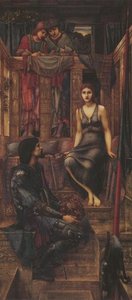
King Cophetua and the Beggar Maid (1884) čiji je Едвард Берн-Џоунс

King Cophetua and the Beggar Maid

1884 · Oil On Canvas · Tate Britain, London

In the grand tapestry of the Pre-Raphaelite movement, few works capture the ethereal intersection of myth and human emotion as profoundly as Edward Coley Burne-Jones’s "King Cophetua and the Beggar Maid." Completed in 1884, this masterpiece serves as a visual symphony, translating the poetic soul of Alfred Tennyson into a tangible, breathtaking reality. The painting does not merely depict a meeting between two individuals; it captures a moment of cosmic…

5
The Heart of the Rose (1890) čiji je Едвард Берн-Џоунс

The Heart of the Rose

1890 · Oil On Panel · William Morris Gallery, Walthamstow

Edward Coley Burne-Jones's "The Heart of the Rose," painted in 1889, isn’t merely a depiction of a scene; it’s an immersion into a world steeped in Pre-Raphaelite romanticism and medieval allegory. This exquisite work, now meticulously reproduced for WahooArt, transcends its canvas to evoke a profound sense of longing, mystery, and the enduring power of love—a testament to Burne-Jones's mastery of color, texture, and symbolic storytelling. The painting draws heavily…

6
The Baleful Head (1886) čiji je Едвард Берн-Џоунс

The Baleful Head

1886 · Oil On Canvas · Staatsgalerie, Štutgart

A Portrait Steeped in Mythic Resonance: Exploring Burne-Jones’ “The Baleful Head” Edward Coley Burne-Jones (1833 – 1898), a luminary of the Pre-Raphaelite Brotherhood and arguably its most commercially successful artist, crafted "The Baleful Head" in 1886—a painting that transcends mere visual representation to delve into profound psychological and symbolic depths. This arresting image depicts a woman cradling a babe while gazing intently at the infant’s head, framed by an ancient…

7
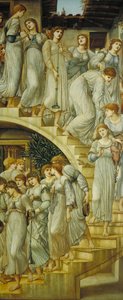
The Golden Stairs (also known as 'The King's Wedding' or 'Music on the Stairs') (1876) čiji je Едвард Берн-Џоунс

The Golden Stairs (also known as 'The King's Wedding' or 'Music on the Stairs')

1876 · Oil On Canvas · Tate Gallery, London

A Dream Woven in Light: Exploring Burne-Jones’s ‘The Golden Stairs’ Edward Coley Burne-Jones's “The Golden Stairs,” painted in 1876, isn’t merely a depiction of women on stairs; it’s an immersive experience—a carefully constructed tableau of elegance, mystery, and the ephemeral beauty of a fleeting moment. This oil on canvas masterpiece, currently residing within the hallowed halls of the Tate Gallery in London, transcends simple representation, inviting viewers into a world…

8
Heart of the Rose (1889) čiji je Едвард Берн-Џоунс

Heart of the Rose

1889 · Acrylic On Canvas · Roy Miles gallery, London

A Vision of Grace: Unveiling Burne-Jones’ “Heart of the Rose” Edward Coley Burne-Jones' "Heart of the Rose," painted in 1889, is more than simply a beautiful depiction of angels and humanity; it’s a profound meditation on love, beauty, and the delicate balance between earthly existence and spiritual realms. This Pre-Raphaelite masterpiece, rendered with meticulous detail and imbued with a haunting sense of serenity, transports the viewer to a timeless garden…

9
Studija za poslednji san Artura u Avalonu (1881) čiji je Едвард Берн-Џоунс

Studija za poslednji san Artura u Avalonu

1881 · William Morris Gallery, Walthamstow

Sir Edward Coley Burne-Jones i „Poslednji Spavanje Artura u Avalonu“ Edward Coley Burne-Jones (1833–1898), jedan od najvažnijih umetnika viktorijanske ere i simbol Pre-rafaelitskog pokreta, ostavio je nezaboravno nasleđe koje se može videti u njegovim monumentalnim slikama i inovativnim dizajnima za umetnosti dekoracije. Najpoznatiji među svojim djelima je „Posljednji Spavanje Artura u Avalonu“, slika koju je Burne-Jones oslikao između 1881. i 1897., nakon što je dobio naručivanje od svog prijatelja Georgea…

10
Burne Jones Pygmalion and the Image II The Hand Refrains čiji je Едвард Берн-Џоунс

Burne Jones Pygmalion and the Image II The Hand Refrains

Oil On Canvas

The painting features a central female figure positioned slightly off-center, gazing intently at a statue of a nude figure located behind her. The scene is set in an indoor environment, creating a sense of harmony between the human figure and the artistic representation. The composition includes several decorative elements: three vases are placed throughout the image—one on the left, one in the middle, and one on the right—and two bowls…

Slike umetnika Едвард Берн-Џоунс, rangirane od 11 do 99

11Pygmalion and the Image I - The Heart Desires čiji je Едвард Берн-ЏоунсPygmalion and the Image I - The Heart Desires 12Georgiana Burne-Jones (1863) čiji je Едвард Берн-ЏоунсGeorgiana Burne-Jones1863 · Birmingham Museum and Art Gallery 13St Paul (1862) čiji je Едвард Берн-ЏоунсSt Paul1862 · Birmingham Museum and Art Gallery 14King Cophetua and the Beggar Maid (1884) čiji je Едвард Берн-ЏоунсKing Cophetua and the Beggar Maid1884 · Tate Gallery 15The Temple of Love čiji je Едвард Берн-ЏоунсThe Temple of LoveTate Gallery 16Отказ од самоубиства Ла Бели Изуде čiji je Едвард Берн-ЏоунсОтказ од самоубиства Ла Бели Изуде 17An Idyll (1862) čiji je Едвард Берн-ЏоунсAn Idyll1862 · Birmingham Museum and Art Gallery 18Design for (1872) čiji je Едвард Берн-ЏоунсDesign for1872 · William Morris Gallery 19Morgan Le Fay (1862) čiji je Едвард Берн-ЏоунсMorgan Le Fay1862 · Holland Park 20Study for (1870) čiji je Едвард Берн-ЏоунсStudy for1870 · Walker Art Gallery 21The Annunciation (1857) čiji je Едвард Берн-ЏоунсThe Annunciation1857 · Birmingham Museum and Art Gallery 22The Wheel of Fortune (1875) čiji je Едвард Берн-ЏоунсThe Wheel of Fortune1875 · Musée d'Orsay 23Theseus and the Minotaur (1861) čiji je Едвард Берн-ЏоунсTheseus and the Minotaur1861 · Birmingham Museum and Art Gallery 24Portrait of Maria Zambaco 1 čiji je Едвард Берн-ЏоунсPortrait of Maria Zambaco 1 25Sibylla Delphica čiji je Едвард Берн-ЏоунсSibylla Delphica 26Cupid and Psyche (1872) čiji je Едвард Берн-ЏоунсCupid and Psyche1872 · Birmingham Museum and Art Gallery 27The Annunciation (1857) čiji je Едвард Берн-ЏоунсThe Annunciation1857 · Birmingham Museum and Art Gallery 28Ariadne (1862) čiji je Едвард Берн-ЏоунсAriadne1862 · Art Gallery of Ontario 29The Depths of the Sea čiji je Едвард Берн-ЏоунсThe Depths of the Sea 30The Star of Bethlehem (1888) čiji je Едвард Берн-ЏоунсThe Star of Bethlehem1888 · Birmingham Museum and Art Gallery 31Cinderella (1863) čiji je Едвард Берн-ЏоунсCinderella1863 · Muzej finih umetnosti u Bostonu 32King Cophetua and the Beggar Maid - Cartoon Study (1883) čiji je Едвард Берн-ЏоунсKing Cophetua and the Beggar Maid - Cartoon Study1883 · Birmingham Museum and Art Gallery 33The Golden Stairs (1880) čiji je Едвард Берн-ЏоунсThe Golden Stairs1880 · Tate Britain 34Male - Study of southern Italian peasant boy seen to the front (1860) čiji je Едвард Берн-ЏоунсMale - Study of southern Italian peasant boy seen to the front1860 · Birmingham Museum and Art Gallery 35The Annunciation and the Adoration of the Magi (1861) čiji je Едвард Берн-ЏоунсThe Annunciation and the Adoration of the Magi1861 36Going to the Battle (1858) čiji je Едвард Берн-ЏоунсGoing to the Battle1858 37Annunciation (1860) čiji je Едвард Берн-ЏоунсAnnunciation1860 38Troy Triptych (1871) čiji je Едвард Берн-ЏоунсTroy Triptych1871 · Birmingham Museum and Art Gallery 39Troy Triptych (1871) čiji je Едвард Берн-ЏоунсTroy Triptych1871 · Birmingham Museum and Art Gallery 40Troy Triptych - Study of Two Putti (1871) čiji je Едвард Берн-ЏоунсTroy Triptych - Study of Two Putti1871 · Birmingham Museum and Art Gallery 41Luna (1870) čiji je Едвард Берн-ЏоунсLuna1870 42Lancelot at the Chapel of the Holy Grail (1870) čiji je Едвард Берн-ЏоунсLancelot at the Chapel of the Holy Grail1870 43The Mirror of Venus (1866) čiji je Едвард Берн-ЏоунсThe Mirror of Venus1866 · Calouste Gulbenkian Museum 44Green Summer (1864) čiji je Едвард Берн-ЏоунсGreen Summer1864 45Hymenaeus (1869) čiji je Едвард Берн-ЏоунсHymenaeus1869 · Delaware Art Museum 46Cupid and Psyche (1872) čiji je Едвард Берн-ЏоунсCupid and Psyche1872 · Birmingham Museum and Art Gallery 47Cupid and Psyche (1872) čiji je Едвард Берн-ЏоунсCupid and Psyche1872 · Birmingham Museum and Art Gallery 48Cupid and Psyche - Palace Green Murals (1876) čiji je Едвард Берн-ЏоунсCupid and Psyche - Palace Green Murals1876 · Birmingham Museum and Art Gallery 49Cupid and Psyche - Palace Green Murals (1876) čiji je Едвард Берн-ЏоунсCupid and Psyche - Palace Green Murals1876 · Birmingham Museum and Art Gallery 50Cupid and Psyche (1872) čiji je Едвард Берн-ЏоунсCupid and Psyche1872 · Birmingham Museum and Art Gallery 51Cupid and Psyche (1872) čiji je Едвард Берн-ЏоунсCupid and Psyche1872 · Birmingham Museum and Art Gallery 52Cupid and Psyche - Palace Green Murals (1876) čiji je Едвард Берн-ЏоунсCupid and Psyche - Palace Green Murals1876 · Birmingham Museum and Art Gallery 53Cupid and Psyche - Palace Green Murals (1876) čiji je Едвард Берн-ЏоунсCupid and Psyche - Palace Green Murals1876 · Birmingham Museum and Art Gallery 54Troy Triptych (1873) čiji je Едвард Берн-ЏоунсTroy Triptych1873 · Birmingham Museum and Art Gallery 55Cupid and Psyche (1872) čiji je Едвард Берн-ЏоунсCupid and Psyche1872 · Birmingham Museum and Art Gallery 56Cupid and Psyche (1872) čiji je Едвард Берн-ЏоунсCupid and Psyche1872 · Birmingham Museum and Art Gallery 57Cupid and Psyche - Palace Green Murals (1876) čiji je Едвард Берн-ЏоунсCupid and Psyche - Palace Green Murals1876 · Birmingham Museum and Art Gallery 58Cupid and Psyche - Palace Green Murals (1876) čiji je Едвард Берн-ЏоунсCupid and Psyche - Palace Green Murals1876 · Birmingham Museum and Art Gallery 59Cupid and Psyche - Palace Green Murals (1876) čiji je Едвард Берн-ЏоунсCupid and Psyche - Palace Green Murals1876 · Birmingham Museum and Art Gallery 60Troy Triptych (1873) čiji je Едвард Берн-ЏоунсTroy Triptych1873 · Birmingham Museum and Art Gallery 61Cupid and Psyche - Palace Green Murals (1876) čiji je Едвард Берн-ЏоунсCupid and Psyche - Palace Green Murals1876 · Birmingham Museum and Art Gallery 62Cupid and Psyche - Palace Green Murals (1876) čiji je Едвард Берн-ЏоунсCupid and Psyche - Palace Green Murals1876 · Birmingham Museum and Art Gallery 63Troy Triptych (1873) čiji je Едвард Берн-ЏоунсTroy Triptych1873 · Birmingham Museum and Art Gallery 64Cupid and Psyche (1872) čiji je Едвард Берн-ЏоунсCupid and Psyche1872 · Birmingham Museum and Art Gallery 65Cupid and Psyche - Palace Green Murals (1876) čiji je Едвард Берн-ЏоунсCupid and Psyche - Palace Green Murals1876 · Birmingham Museum and Art Gallery 66Cupid and Psyche - Palace Green Murals (1876) čiji je Едвард Берн-ЏоунсCupid and Psyche - Palace Green Murals1876 · Birmingham Museum and Art Gallery 67Frieze of Eight Women Gathering Apples (1876) čiji je Едвард Берн-ЏоунсFrieze of Eight Women Gathering Apples1876 68Perseus and the Graiae (1877) čiji je Едвард Берн-ЏоунсPerseus and the Graiae1877 · National Museum Cardiff 69Perseus and Andromeda (1876) čiji je Едвард Берн-ЏоунсPerseus and Andromeda1876 · Art Gallery of South Australia 70Head of Nimue (1873) čiji je Едвард Берн-ЏоунсHead of Nimue1873 · Delaware Art Museum 71Vesper (1872) čiji je Едвард Берн-ЏоунсVesper1872 72The Feast of Peleus (1876) čiji je Едвард Берн-ЏоунсThe Feast of Peleus1876 · Birmingham Museum and Art Gallery 73Psyche entering the Portals of Olympus (1872) čiji je Едвард Берн-ЏоунсPsyche entering the Portals of Olympus1872 · Birmingham Museum and Art Gallery 74Danaë Watching the Building of the Brazen Tower (1872) čiji je Едвард Берн-ЏоунсDanaë Watching the Building of the Brazen Tower1872 · Harvard Art Museums 75Desiderium (1873) čiji je Едвард Берн-ЏоунсDesiderium1873 76Perseus and the Sea Nymphs (1877) čiji je Едвард Берн-ЏоунсPerseus and the Sea Nymphs1877 · City Art Gallery 77The Godhead Fires (1878) čiji je Едвард Берн-ЏоунсThe Godhead Fires1878 · Birmingham Museum and Art Gallery 78Wheel of Fortune (1879) čiji je Едвард Берн-ЏоунсWheel of Fortune1879 · Birmingham Museum and Art Gallery 79The Baleful Head (1885) čiji je Едвард Берн-ЏоунсThe Baleful Head1885 · City Art Gallery 80Cupid's Hunting Fields (1882) čiji je Едвард Берн-ЏоунсCupid's Hunting Fields1882 · Delaware Art Museum 81Study for "The Sleeping Beauty": Head of a Maiden (1885) čiji je Едвард Берн-ЏоунсStudy for "The Sleeping Beauty": Head of a Maiden1885 · Harvard Art Museums 82The Morning of the Resurrection (1882) čiji je Едвард Берн-ЏоунсThe Morning of the Resurrection1882 83The Briar Rose Series (1889) čiji je Едвард Берн-ЏоунсThe Briar Rose Series1889 · Birmingham Museum and Art Gallery 84The Briar Rose Series (1889) čiji je Едвард Берн-ЏоунсThe Briar Rose Series1889 · Birmingham Museum and Art Gallery 85Lucretia (1867) čiji je Едвард Берн-ЏоунсLucretia1867 · Birmingham Museum and Art Gallery 86The Briar Rose Series (1889) čiji je Едвард Берн-ЏоунсThe Briar Rose Series1889 · Birmingham Museum and Art Gallery 87The Garden Court (1890) čiji je Едвард Берн-ЏоунсThe Garden Court1890 88Study of a Young Woman's Head (1895) čiji je Едвард Берн-ЏоунсStudy of a Young Woman's Head1895 · Muzej finih umetnosti u Bostonu 89The Achievement of the Grail (1894) čiji je Едвард Берн-ЏоунсThe Achievement of the Grail1894 90Hero (1900) čiji je Едвард Берн-ЏоунсHero1900 91The Backgammon Players (1861) čiji je Едвард Берн-ЏоунсThe Backgammon Players1861 · Birmingham Museum and Art Gallery 92Cupid finding Psyche: winged cupid standing over body of Psyche asleep below a fountain, roses on a trellis behind (1866) čiji je Едвард Берн-ЏоунсCupid finding Psyche: winged cupid standing over body of Psyche asleep below a fountain, roses on a trellis behind1866 · British Museum 93Man Leading Woman and Child on a Horse (1865) čiji je Едвард Берн-ЏоунсMan Leading Woman and Child on a Horse1865 · William Morris Gallery 94David's Charge to Solomon (1882) čiji je Едвард Берн-ЏоунсDavid's Charge to Solomon1882 95Lady Windsor čiji je Едвард Берн-ЏоунсLady Windsor 96The Godhead Fires, Pygmalion (1870) čiji je Едвард Берн-ЏоунсThe Godhead Fires, Pygmalion1870 97Stella Vespertina (1881) čiji je Едвард Берн-ЏоунсStella Vespertina1881 · William Morris Gallery 98The Calling of Perseus (1898) čiji je Едвард Берн-ЏоунсThe Calling of Perseus1898 · Staatsgalerie Stuttgart 99The King and His Court (1871) čiji je Едвард Берн-ЏоунсThe King and His Court1871 · Metropoliten музеј у Њујорку

Čuvena dela Едвард Берн-Џоунс po periodima

Motivi koji su privlačili pažnju Едвард Берн-Џоунс

Četiri teme koje se najčešće ponavljaju u ovim originalima, svaka sa svojim vrhunskim primerom.

Muzeji u kojima se čuvaju originalna dela umetnika Едвард Берн-Џоунс

8 muzeja u kojima se nalazi najviše slika sa ove stranice.

Muzej Grad Radovi umetnika Едвард Берн-Џоунс Slike iz ovog spiska
Birmingham Museum and Art Gallery, BirmingemBirmingham Museum and Art Gallery Birmingem 65 Georgiana Burne-Jones, St Paul, An Idyll
William Morris Gallery, WalthamstowWilliam Morris Gallery Walthamstow 9 The Heart of the Rose, Studija za poslednji san Artura u Avalonu, Design for
Tate Gallery, LondonTate Gallery London 6 The Golden Stairs (also known as 'The King's Wedding' or 'Music on the Stairs'), King Cophetua and the Beggar Maid, The Temple of Love
Delaware Art MuseumDelaware Art Museum 3 Hymenaeus, Head of Nimue, Cupid's Hunting Fields
City Art Gallery, SouthamptonCity Art Gallery Southampton 5 Perseus and the Sea Nymphs, The Baleful Head
Tate Britain, LondonTate Britain London 4 King Cophetua and the Beggar Maid, The Golden Stairs
Muzej finih umetnosti u Bostonu, BostonMuzej finih umetnosti u Bostonu Boston 3 Cinderella, Study of a Young Woman's Head
Harvard Art Museums, KembriđHarvard Art Museums Kembriđ 3 Danaë Watching the Building of the Brazen Tower, Study for "The Sleeping Beauty": Head of a Maiden

Едвард Берн-Џоунс, jedno autentično delo po deceniji

Radovi po decenijama

Izaberite deceniju da biste videli original koji je definiše.

Slike umetnika Едвард Берн-Џоунс: odgovori galerije

Koja je najpoznatija slika umetnika Едвард Берн-Џоунс?Otkrij odgovor

Očaravanje Merlina. Slede The fight: St George kills the dragon (1866) i The Beguiling of Merlin (Merlin and Vivien) (1874).

Koja su najbolja 10 dela umetnika Едвард Берн-Џоунс?Otkrij odgovor

Očaravanje Merlina, The fight: St George kills the dragon, The Beguiling of Merlin (Merlin and Vivien), King Cophetua and the Beggar Maid, The Heart of the Rose, The Baleful Head, The Golden Stairs (also known as 'The King's Wedding' or 'Music on the Stairs'), Heart of the Rose, Studija za poslednji san Artura u Avalonu i Burne Jones Pygmalion and the Image II The Hand Refrains. Gornji rang pokazuje godinu i muzej za svako od njih.

Koliko je dela stvorio/la Едвард Берн-Џоунс?Otkrij odgovor

Naš katalog sadrži 635 dela umetnika Едвард Берн-Џоунс, datiranih od 1857 do 1898.

Gde se nalaze najpoznatiji originali umetnika Едвард Берн-Џоунс?Otkrij odgovor

Većinom u Birmingham Museum and Art Gallery (Birmingem), William Morris Gallery (Walthamstow) i Tate Gallery (London). Tabela muzeja iznad sadrži njih sve.

Kada je Едвард Берн-Џоунс stvorio svoje najpoznatije slike?Otkrij odgovor

U 1870s: 46 od 99 dela na ovoj stranici nastalo je tada, od čega je The Beguiling of Merlin (Merlin and Vivien).

Koja su najranija i najkasnija poznata dela umetnika Едвард Берн-Џоунс?Otkrij odgovor

Na ovoj stranici, najstarije delo je iz The Annunciation (1857), a najnovije iz The Calling of Perseus (1898).

Kojim se motivima Едвард Берн-Џоунс najčešće bavio?Otkrij odgovor

Woman (15), Mythology (11) i Victorian art (5), kroz svih 99 dela na ovoj stranici.

U kojoj je tehnici najviše radio/la Едвард Берн-Џоунс?Otkrij odgovor

Oil On Canvas, za 20 od 99 dela na ovoj stranici.

Sa kojim umetničkim pravcem je Едвард Берн-Џоунс povezan/a?Otkrij odgovor

Late medieval style, sudeći po originalima na ovoj stranici.

Koje originale umetnika Едвард Берн-Џоунс poseduje Birmingham Museum and Art Gallery?Otkrij odgovor

Georgiana Burne-Jones, St Paul i An Idyll: Birmingham Museum and Art Gallery, Birmingem čuva 43 dela sa ove stranice.

Едвард Берн-Џоунс: umetnik

The Life of Edward Coley Burne-Jones

Edward Coley Burne-Jones entered the world on 28 August 1833 in Birmingham, United Kingdom. His arrival was marked by a quiet, heavy loss; his mother, Elizabeth Jones, passed away within six days of his birth. He grew up in a house shaped by the trade of his father, Edward Richard Jones, who worked as a frame-maker. This early environment was one of craftsmanship and wood, where the physical structures of art were built long before the paintings themselves were conceived.

The boy who would become Sir Edward Coley Burne-Jones, 1st Baronet, was raised by his father and a housekeeper named Ann Sampson. His childhood was not one of grand gestures, but of a steady, contemplative nature nurtured by those who cared for him. He moved from the industrial atmosphere of Birmingham toward the academic halls of Oxford, a path that would eventually lead him away from his original intentions for the church and toward the study of visual forms. His life was a slow accumulation of interests, from the theological to the decorative, all rooted in the quiet observations of his early years.

Early Life, Family and Training

The industrial pulse of Birmingham shaped his earliest years. Born in 1833, his childhood was marked by the loss of his mother, Elizabeth, who died only six days after his birth. He grew up in a house managed by his father, Edward Richard Jones, a frame-maker, and the family housekeeper, Ann Sampson. This quiet, domestic environment provided the foundation for a temperament that leaned toward contemplation. He spent his formative days in the shadow of the city's growing manufacturing, a setting far removed from the medieval worlds he would later inhabit on canvas.

His formal training began in the classrooms of King Edward VI Grammar School. From 1848 to 1852, he moved into more technical studies at the Birmingham School of Art. It was here that the precision of his hand began to take shape. His path, however, was not initially set on the easel. He moved toward the study of theology at Exeter College, Oxford. This academic pursuit of the divine and the sacred would later find its way into his imagery, though his focus shifted from the pulpit to the brush.

The Brotherhood and Artistic Circles

At Oxford, the quiet halls of Exeter College brought him into the orbit of William Morris. They found common ground in poetry and a shared pull toward the medieval, a connection that would define much of his later life. This friendship was not merely social; it was a shared pursuit of a specific kind of beauty that looked backward to find a way forward. They were part of a group known as the Birmingham Set, a circle of friends who shared these intellectual and aesthetic interests, creating a space where art and literature could lean into one another.

His path led him to an apprenticeship under Dante Gabriel Rossetti, a move that anchored him within the Pre-Raphaelite Brotherhood. This association meant more than just a shared style; it was an immersion into a way of seeing that rejected the polished, academic traditions of the time. His early work often carried the weight of Rossetti’s influence, particularly in the way he handled shadows and the heavy, soulful presence of his figures. He did not simply follow the movement; he moved through it, eventually finding a way to translate these shared ideals into his own distinct visual language.

Technique and Artistic Style

His hand moved with a specific, quiet precision. Much of his process relied on the Indian ink wash technique, a method he refined during his time at Exeter College. He did not simply apply color; he built it through layers. By meticulously layering washes of ink, he achieved a sense of tonal subtlety and created complex textures that gave his surfaces a certain depth. This approach allowed him to capture a light that felt soft and diffused, rather than harsh or direct.

The figures in his compositions often possess an attenuated quality. They are elongated and graceful, moving through spaces that feel carefully arranged. His work sits at a crossroads of different sensibilities, blending the detailed, sincere focus of the Pre-Raphaelites with the decorative leanings of Aestheticism and the layered meanings of Symbolism. He favored delicate compositions that drew heavily from medievalism, yet the results felt distinct from the era he looked toward. Instead of mere imitation, he sought to distill the essence of myth and legend into a visual language of quiet, melancholic grace.

Patrons, Workshop and Commissions

The partnership with William Morris moved his work from the canvas into the very fabric of daily life. Together, they established the firm Morris & Co., a place where the boundaries between fine art and functional objects blurred. He spent much of his time designing patterns for textiles and wallpapers, as well as furniture that felt rooted in a different age. His hand appeared in many domestic spaces, shaping the objects people touched and lived among.

Light became a primary medium through his stained glass designs. These windows were placed in numerous churches and cathedrals, turning stone interiors into spaces of color and narrative. He approached glass with a specific understanding of how light passes through it, treating each pane as a piece of a larger story. In 1881, his reach extended to private estates, where he provided designs for the Vinland House and the Vinland Estate.

  • Stained glass designs for the Vinland House and Vinland Estate, 1881

Key Works and Masterpieces

In 1861, he produced Fair Rosamond and Queen Eleonor, a work that captures a quiet tension between two women. The scene is set within an opulent chamber, where the crimson of a dress meets the somber presence of a queen. Scattered books and fine ceramics sit in the background, while a wall clock marks the passing time. The light is soft and diffused, settling on the figures as they navigate a moment of impending loss.

His 1875 painting, The Wheel of Fortune, moves away from quiet interiors into a more allegorical space. It depicts a mythological scene where fate is spun by a capricious wheel. The canvas uses a palette of rich reds, deep blues, and shimmering golds to build the atmosphere. There is a visual tension created by the contrast between the cool tones surrounding the central figure and the warmer hues of the wheel itself.

Other significant works include:

The 1887 work The garden of Pan shows a shift toward mythic leisure. His later paintings often became more introspective, moving toward a more abstract approach to form. He used an Indian ink wash technique to achieve tonal subtlety, layering washes to create texture and depth in his compositions.

Later Years and Death

The final decade of his life saw a steady accumulation of formal recognition. In 1894, he was created a baronet, a title that marked his standing within the British social and artistic hierarchy. His influence reached beyond the English Channel, and in 1897, he was elected to the Royal Academy of Science, Letters and Fine Arts of Belgium. These honors arrived even as his work became more introspective, moving toward a more abstract approach to form and a heightened sense of melancholy.

As a leading figure of the Aesthetic Movement, his focus remained on the pursuit of beauty. His later paintings often explored themes of loss and the search for spiritual meaning. He continued to produce work until his death on 17 June 1898. His passing marked the end of a career that had bridged the gap between the early Pre-Raphaelite ideals and the shifting sensibilities of the late Victorian era.

Legacy and Enduring Influence

The traces of his hand remain in the way detail and symbolism meet. His work carries the weight of Pre-Raphaelite ideals, focusing on a specific kind of beauty and a meticulous attention to the small things. Through his partnership with Morris & Co., he helped bring a renewed focus to traditional crafts, moving art away from the canvas and into the textures of daily life. This work helped change how people viewed the importance of design in textiles and furniture.

His presence is felt in the light passing through stained glass. These windows, found in many churches and cathedrals, remain significant examples of Victorian artistry. He used color and line to turn glass into a way of telling stories. The influence of his specific aesthetic can be seen in the work of many artists who came after him, following the paths he helped clear through his own experiments with form and myth.

Where to See the Works Today

To see his hand in person, one might start in Walthamstow at the William Morris Gallery, which holds nine of his works. The space offers a quiet look at the pieces he created alongside Morris. In Birmingham, the Birmingham Museum and Art Gallery keeps six of his paintings, including St Paul from 1862. These works sit within a building that reflects the industrial history of the city where he was born.

London also holds a significant presence of his output. The Tate Gallery contains six of his paintings, allowing for a close look at his use of line and color. For those traveling further afield, the Musée d'Orsay in Paris houses The Wheel of Fortune, painted in 1875. This oil on canvas shows the way he handled light and the tension of the subject matter.