Portret Wolf Huber

Slike avtorja Wolf Huber: 20 najbolj znanih del skozi oči galerije

Posodobljeno november 2026 · uvrščeno glede na naš skoraj priljubljenosti (iskanja, obiske in naročila za vsako delo) · 21 del v našem katalogu avtorja Wolf Huber

Kratek opis

Za oči galerije je najbolj znano sliko umetnika Wolf Huber delo Landscape with Castle (1545), katere original visi v muzeju Ducal Graphic Collection, Eggenfeld. Christ taking leave of his Mother. (1519) in Saint Sebastian (1525) dopolnjujeta trijo, ki jo prepozna vsak pogled. Od 21 del avtorja Wolf Huber v našem katalogu galerija spodaj predstavlja 20 najbolj znanih; vsako je original z letom nastanka, pripadajočim mu muzejem in opisom tistega, kar ga dela edinstavnim.

1485 – 1553, Feldkirch Northern renaissance Največ del: Kunsthistorisches Museum

Top 10 slik umetnika Wolf Huber v galeriji

3
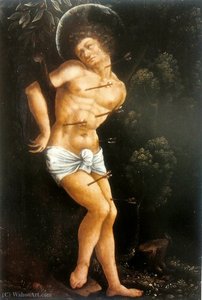
Saint Sebastian (1525) avtorja Wolf Huber

Saint Sebastian

1525 · Oil On Panel · Narodni muzej v Varšavi, Varšava

A young man with pale skin is positioned slightly off-center, tied to a dark tree trunk within a wooded setting. His body is pierced by several arrows, and his torso shows defined musculature. He wears a white loincloth that contrasts with the deep, earthy tones of the background. The lighting originates from the upper left, casting soft shadows across his chest and abdomen to create a sense of three-dimensional volume.…

5
Epitaph of the Perger Family (1516) avtorja Wolf Huber

Epitaph of the Perger Family

1516 · Oil On Panel · Bavarske državne slikopisne zbirke, München

Wolf Huber’s Epitaph of the Perger Family, executed about 1516, presents a dense assembly of figures within a somber funerary or religious setting. The composition is structured through several layers of subjects that create a sense of depth despite a relatively flat perspective, a hallmark of the early 16th-century Northern Renaissance style. On the left, a cluster of men dressed in period-appropriate Renaissance attire occupies the foreground and middle ground,…

6
Christ on the Mount of Olives (1527) avtorja Wolf Huber

Christ on the Mount of Olives

1527 · Oil On Panel · Bavarske državne slikopisne zbirke, München

The scene unfolds in Christ on the Mount of Olives, a work by the Austrian-German artist Wolf Huber. Born in Feldkirch, Austria, Huber moves through the history of the Northern Renaissance as a versatile creator, working as a painter, printmaker, and architect. This specific composition captures a moment of profound spiritual tension, rendered with the expressive intensity that defines his hand.

7
Portrait of a (35-year-old) Man with Black Hat and Fur-Trimmed Coat (1528) avtorja Wolf Huber

Portrait of a (35-year-old) Man with Black Hat and Fur-Trimmed Coat

1528 · Oil

In this 1528 portrait, we encounter a man caught in a moment of quiet contemplation. He is positioned slightly off-center, his gaze directed away from us, as if lost in a thought that we are not permitted to share. The composition is a medium close-up, focusing on the upper body and the heavy textures that define his status. There is a profound sense of stillness here. The monochromatic palette, rendered…

8
Crucifixion of Christ (1522) avtorja Wolf Huber

Crucifixion of Christ

1522 · Oil · Kunsthistorisches Museum, Dunaj

The painting titled Crucifixion of Christ was executed by the artist Wolf Huber. This work dates to 1522. The composition depicts the central figure of Jesus on a cross, surrounded by a dense assembly of onlookers, soldiers, and mourners. The scene is framed within an arched structure, presenting a crowded arrangement of human figures against a dark, turbulent sky.

9
The Flight into Egypt (1525) avtorja Wolf Huber

The Flight into Egypt

1525 · Oil On Panel · Staatliche Museen zu Berlin, Berlin

The painting depicts the biblical story of the flight into Egypt, featuring Mary, Joseph, and baby Jesus traveling on a donkey. The scene is set against an expansive backdrop of mountains, which provides a sense of scale to the landscape. Within the composition, several other figures are present, including one man holding a staff and another individual carrying a bowl. Two cows can be seen in the background, with one…

10
The Lamentation of Christ (1524) avtorja Wolf Huber

The Lamentation of Christ

1524 · Oil On Panel · Louvre, Pariz

The painting depicts a religious scene centered on the body of Jesus, who lies horizontally across the middle of the frame. He is surrounded by a group of at least twelve figures, some of whom are kneeling while others stand in various states of mourning. The figures are positioned around the central form, their bodies oriented toward the deceased man. In the background, a landscape of mountains rises, providing a…

Slikarska dela umetnika Wolf Huber, uvrščena od 11 do 20

Motivi, ki so očarali Wolf Huber

Četiri teme, ki se v teh originalih najpogosteje ponavljajo, vsaka z svojim vrhunskim primerom.

Muzeji, ki hranijo originala umetnika Wolf Huber

8 muzejev, ki vsebujo največ slik na tej strani.

Muzej Mesto Sloga Wolf Huber Slike iz tega seznama
Kunsthistorisches Museum, DunajKunsthistorisches Museum Dunaj 4 Christ taking leave of his Mother., Allegory of Redemption, Crucifixion of Christ
Bavarske državne slikopisne zbirke, MünchenBavarske državne slikopisne zbirke München 2 Epitaph of the Perger Family, Christ on the Mount of Olives
Ducal Graphic Collection, EggenfeldDucal Graphic Collection Eggenfeld 1 Landscape with Castle
Narodni muzej v Varšavi, VaršavaNarodni muzej v Varšavi Varšava 1 Saint Sebastian
Staatliche Museen zu Berlin, BerlinStaatliche Museen zu Berlin Berlin 1 The Flight into Egypt
Louvre, ParizLouvre Pariz 1 The Lamentation of Christ
Staatliche Graphische Sammlung, MunichStaatliche Graphische Sammlung Munich 1 Landscape near Feldkirch
National Gallery, LondonNational Gallery London 1 Christ taking leave of his Mother

Wolf Huber, ena značilna slika na desetletje

Delo po desetletjih

Izberite desetletje, da si ogledate original, ki ga opredeljuje.

Slike umetnika Wolf Huber: odgovori galerije

Katero sliko avtorja Wolf Huber je najbolj znana med vsemi?Razkriti odgovor

Landscape with Castle (1545), Ducal Graphic Collection, Eggenfeld. Zatem sledeta Christ taking leave of his Mother. (1519) in Saint Sebastian (1525).

Koliko je bil Wolf Huber let, ko je dokončal Landscape with Castle?Razkriti odgovor

60 let: delo Landscape with Castle iz leta 1545, Wolf Huber pa je bil/a rojen/a leta 1485.

Katera je 10 najboljjših slik umetnika Wolf Huber?Razkriti odgovor

Landscape with Castle, Christ taking leave of his Mother., Saint Sebastian, Allegory of Redemption, Epitaph of the Perger Family, Christ on the Mount of Olives, Portrait of a (35-year-old) Man with Black Hat and Fur-Trimmed Coat, Crucifixion of Christ, The Flight into Egypt in The Lamentation of Christ. Zgornja lestica prikazuje leto nastanka in muzej za vsako delo.

Koliko dzieł stworzył Wolf Huber?Razkriti odgovor

Naš katalog vsebuje 21 del avtorja Wolf Huber, datiranih od 1516 do 1545.

Kje so razpostavljena najbolj znana originala umetnika Wolf Huber?Razkriti odgovor

Večini v Kunsthistorisches Museum (Dunaj), Bavarske državne slikopisne zbirke (München) in Ducal Graphic Collection (Eggenfeld). Zgoraj navedena tabela muzejev vsebuje njihov celoten seznam.

Kdaj je Wolf Huber ustvaril svoja najbolj znana slika?Razkriti odgovor

V obdobju 1520s: 8 od 20 del na tej strani je bilo izdelovanih takrat, med njimi pa Saint Sebastian.

Kateri so najstarejši in najmlajši znanii dela umetnika Wolf Huber?Razkriti odgovor

Na tej strani je najstarejše delo iz Epitaph of the Perger Family (1516) in najstarejše iz Landscape with Castle (1545).

Kateri motivi so bili za Wolf Huber najbolj značilni?Razkriti odgovor

Trees (4), Clouds (4) in People (4), na 20 delih na tej strani.

Pri katerem medijem je Wolf Huber delal največ?Razkriti odgovor

Oil On Panel, za 8 od 20 del na tej strani.

S katerim umetnostnim slogom je povezan Wolf Huber?Razkriti odgovor

Northern renaissance in Renaissance, glede na originala na tej strani.

Katera originalna dela umetnika Wolf Huber ima v svoji zbirki Kunsthistorisches Museum?Razkriti odgovor

Christ taking leave of his Mother., Allegory of Redemption in Crucifixion of Christ: v muzeju Kunsthistorisches Museum, Dunaj se nahaja 4 del z te strani.

Wolf Huber: umetnik

A Master of the Danube School

In the vibrant tapestry of the Northern Renaissance, few threads are as intricately woven as those belonging to Wolf Huber. An Austrian-German painter, printmaker, and architect, Huber emerged as a leading figure of the Danube School, a movement that revolutionized the role of landscape in European art. While much of the Italian Renaissance focused on the perfection of human form and classical idealism, Huber and his contemporaries turned their gaze toward the untamed beauty of the natural world. His work captures the soul of the landscape, transforming dense forests, misty valleys, and dramatic mountain peaks from mere backdrops into profound, living subjects that resonate with spiritual depth.

Born in Feldkirch, Austria, Huber’s early life remains somewhat shrouded in the mists of history, though his presence in the artistic landscape becomes clearly established by the early sixteenth century. By 1515, he was living and working in Passau, Germany, a city that would serve as the primary stage for much of his illustrious career. Though the specifics of his formal training are unknown, it is believed he may have honed his skills within a family workshop. His artistic language suggests a sophisticated understanding of the Italian Renaissance, likely gained through travels to northern Italy, allowing him to blend the meticulous detail of the North with the masterful use of chiaroscuro and atmospheric perspective found in the South.

The Intersection of Spirit and Nature

Huber’s oeuvre is characterized by a remarkable ability to weave human narrative into the very fabric of the earth. In his religious compositions, such as The Flight into Egypt or Christ Taking Leave of His Mother, the landscape does not simply surround the figures; it participates in their emotional journey. He possessed a rare sensitivity to the lyrical qualities of nature, using expansive mountains and verdant trees to act as emotional extensions of his subjects' internal struggles and divine destinies. This technique allowed him to elevate biblical narratives into cosmic events, where the majesty of the terrain mirrors the weight of the spiritual moment.

Beyond his religious works, Huber’s mastery extended to the intimate realm of portraiture. In pieces like the Portrait of Jacob Ziegler, he demonstrates a profound command over light and texture. Through a meticulous layering of pigments, he achieved a velvety depth that brings the sitter to life, capturing the intellectual fervor and introspective thought of his subjects. His portraits often utilize a soft, frontal illumination that lends a sculptural quality to the human face, creating a dialogue between the individual and the atmospheric world unfolding behind them.

Architectural Legacy and Historical Significance

The versatility of Wolf Huber extended far beyond the easel and the printing press. He was a man of multifaceted talent, serving not only as a painter but also as an architect. His architectural contributions are evidenced by his work for local nobility, most notably his commission from Count Niklas II von Salm to rebuild the Neuberg Palace on the Inn River. The surviving fragments of this project reveal his ability to integrate the grander, decorative styles of the Italian Renaissance into the regional landscape, complete with rich, ornamental paintings.

As a court painter to the Duke of Bavaria, Ernst, Huber occupied a position of significant prestige, further cementing his role as a pillar of the German-Austrian artistic community. His legacy lies in his ability to bridge the gap between the human and the divine, the intimate and the expansive. Through his contributions to the Danube School, he helped establish a new way of seeing—one where the landscape is not just a setting for man, but a profound reflection of the eternal.