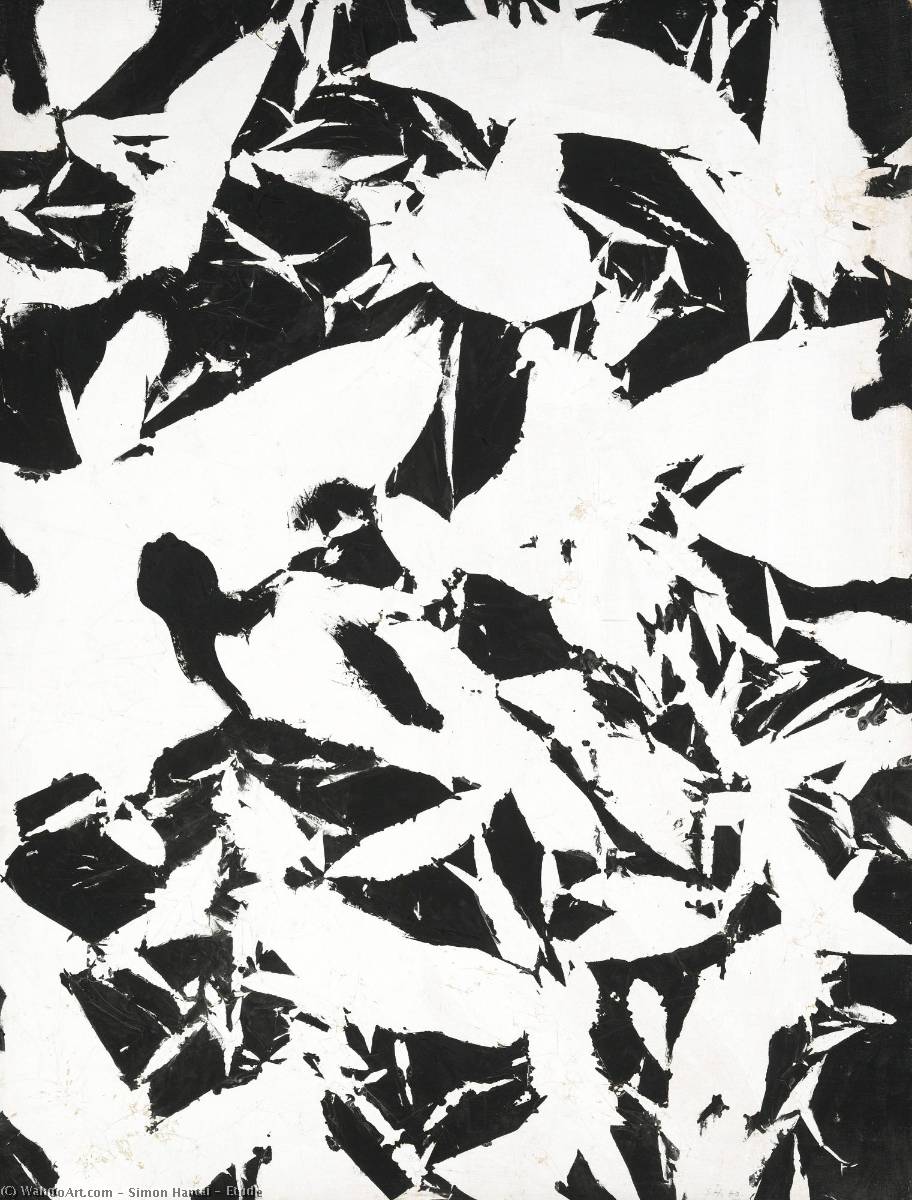
The Architect of Folds: The Life and Legacy of Simon Hantaï
In the grand tapestry of twentieth-century abstraction, few threads are as intricate or as physically tactile as those woven by Simon Hantaï. Born in 1922 in Biatorbágy, Hungary, Hantaï’s early life was marked by the profound shifts of a continent in flux. His artistic soul began to take shape at the Budapest School of Fine Art, but it was a solitary, transformative pilgrimage through Italy on foot that would forever alter his perception of space, movement, and the very essence of the landscape. This nomadic spirit eventually led him to France in 1948, where he would become a central, albeit often reclusive, figure in the Parisian avant-garde.
Hantaï’s early career was inextricably linked to the giants of his era. The legendary Surrealist leader André Breton recognized his burgeoning talent, even providing the preface for his debut exhibition catalogue in Paris. Yet, Hantaï was a man of deep intellectual independence. While he drew from the subconscious depths of Surrealism, he famously broke with the movement in 1955. He found himself unable to reconcile Breton’s rigid adherence to automatic writing with the visceral, physical energy of Jackson Pollock’s action painting. This rupture was not merely a professional disagreement but a profound artistic evolution; Hantaï sought a method that married the spontaneous gesture with a structural, almost architectural, manipulation of the medium itself.
The Alchemy of Pliage
The true revelation of Hantaï’s career arrived in 1960 with the invention of his signature pliage technique. This was not merely a way of painting, but a way of sculpting with the canvas itself. Inspired by the rhythmic, accidental marks left by folds on his mother's apron, Hanta*ï began to treat the canvas as a living, breathing entity. The process was a mesmerizing dance of destruction and creation: he would fold the unprimed canvas into complex geometric or organic patterns, apply paint with vigorous, gestural strokes, and then—in a moment of breathtaking tension—unfold it.
The result was a masterpiece of duality. The unfolded canvas revealed a landscape of vibrant, spontaneous color interrupted by stark, white voids where the folds had protected the fabric from the brush. These "blank" sections were not absences, but rather profound statements on silence and memory. Through pliage, Hantaï achieved a unique synthesis of:
- Surrealist Automatism: The unpredictable, spontaneous application of pigment.
- Abstract Expressionism: The raw, physical energy of the artist's movement.
- Structural Geometry: The deliberate, calculated creation of creases and boundaries.
A Reclusive Master in the Modern Canon
As his reputation grew, so did his desire for solitude. Hantaï’s career was punctuated by periods of intense visibility followed by profound silences. He represented France with great distinction at the Venice Biennale in 1982 and was honored with a major retrospective at the Centre Pompidou in 1976. However, during the 1980s and 1990s, he famously withdrew from the public eye, a period of "ethical obstinacy" that many critics viewed as an extension of his art—a literal embodiment of the themes of absence and disappearance that permeated his work.
Today, Simon Hantaï is remembered not just as a painter, but as a pioneer who redefined the boundaries of the canvas. His works are held in the most prestigious institutions in the world, including the Musée national d'art moderne at the Centre Georges Pompidou and the Musée d’art moderne de la Ville de Paris. He left behind a legacy that challenges us to look closer at the spaces between things, teaching us that even in the folds of a canvas, there is a profound and vibrant truth waiting to be unfolded.