Portret Nicolas Tarkhoff

Slike avtorja Nicolas Tarkhoff: 42 najbolj znanih del skozi oči galerije

Posodobljeno november 2026 · uvrščeno glede na naš skoraj priljubljenosti (iskanja, obiske in naročila za vsako delo) · 42 del v našem katalogu avtorja Nicolas Tarkhoff

Kratek opis

Izpostavljeno v galeriji je najbolj znano sliko umetnika Nicolas Tarkhoff, ki je Madame Tarkhoff with Her Two Children Jean and Boris (1907). Madame Tarkhoff and Her Child (1906) in La Place du Maine, Paris dopolnjujeta trijo, ki jo prepozna vsak pogled. Od 42 del avtorja Nicolas Tarkhoff v našem katalogu galerija spodaj predstavlja 42 najbolj znanih; vsako je original z letom nastanka, pripadajočim mu muzejem in opisom tistega, kar ga dela edinstavnim.

1871 – 1930, Moskva Post-impressionism

Top 10 slik umetnika Nicolas Tarkhoff v galeriji

1
Madame Tarkhoff with Her Two Children Jean and Boris (1907) avtorja Nicolas Tarkhoff

Madame Tarkhoff with Her Two Children Jean and Boris

1907 · Oil

The composition centers on a woman reclining within the confines of a bed. She is positioned toward the left side of the frame, her body angled to accommodate two children. One child is situated more centrally, appearing awake, while the second child lies toward the right side of the bed in a state of sleep. The woman’s hand is visible in the lower portion of the scene, making contact with…

2
Madame Tarkhoff and Her Child (1906) avtorja Nicolas Tarkhoff

Madame Tarkhoff and Her Child

1906 · Oil

The room holds a heavy, peaceful stillness as a woman reclines upon a bed, her form draped in a deep blue dress. She cradles her infant close to her chest, the two of them sharing a private, soft space amidst the folds of bedding. Sunlight or perhaps a soft lamp filters through the room, catching the texture of the fabric and the gentle curve of a neck adorned with a…

3
La Place du Maine, Paris avtorja Nicolas Tarkhoff

La Place du Maine, Paris

Oil

The canvas depicts a street scene within La Place du Maine in Paris. A horse-drawn carriage occupies the right side of the composition, moving along a paved road. Two horses are positioned toward the left, one leading the other in a staggered formation. Several figures are scattered throughout the urban environment. Some individuals stand near the carriage, while others walk or remain stationary at varying distances from the center of…

4
Merry Go Round in Montmarnasse (1901) avtorja Nicolas Tarkhoff

Merry Go Round in Montmarnasse

1901 · Oil On Canvas

The scene unfolds in the bustling heart of Paris through the work titled Merry Go Round in Montmarnasse. Painted by Nicolas Tarkhoff in 1901, this piece captures a fleeting snapshot of Parisian daily life. The energy of the city pulses through the composition, freezing a moment of public spectacle amidst the urban rush. It is a glimpse into a bygone era, where the excitement of modern life gathers around the…

5
Goats in the Sunshine (1904) avtorja Nicolas Tarkhoff

Goats in the Sunshine

1904 · Oil On Canvas

The canvas presents a group of white goats gathered closely around a basket. This basket contains hay or grain, positioned at the center of the animals' activity. The goats are densely packed, their forms overlapping to create a sense of immediate movement within the frame. Sunlight hits the white coats of the animals, creating bright highlights that contrast against the darker shadows cast by their bodies. The background consists of…

6
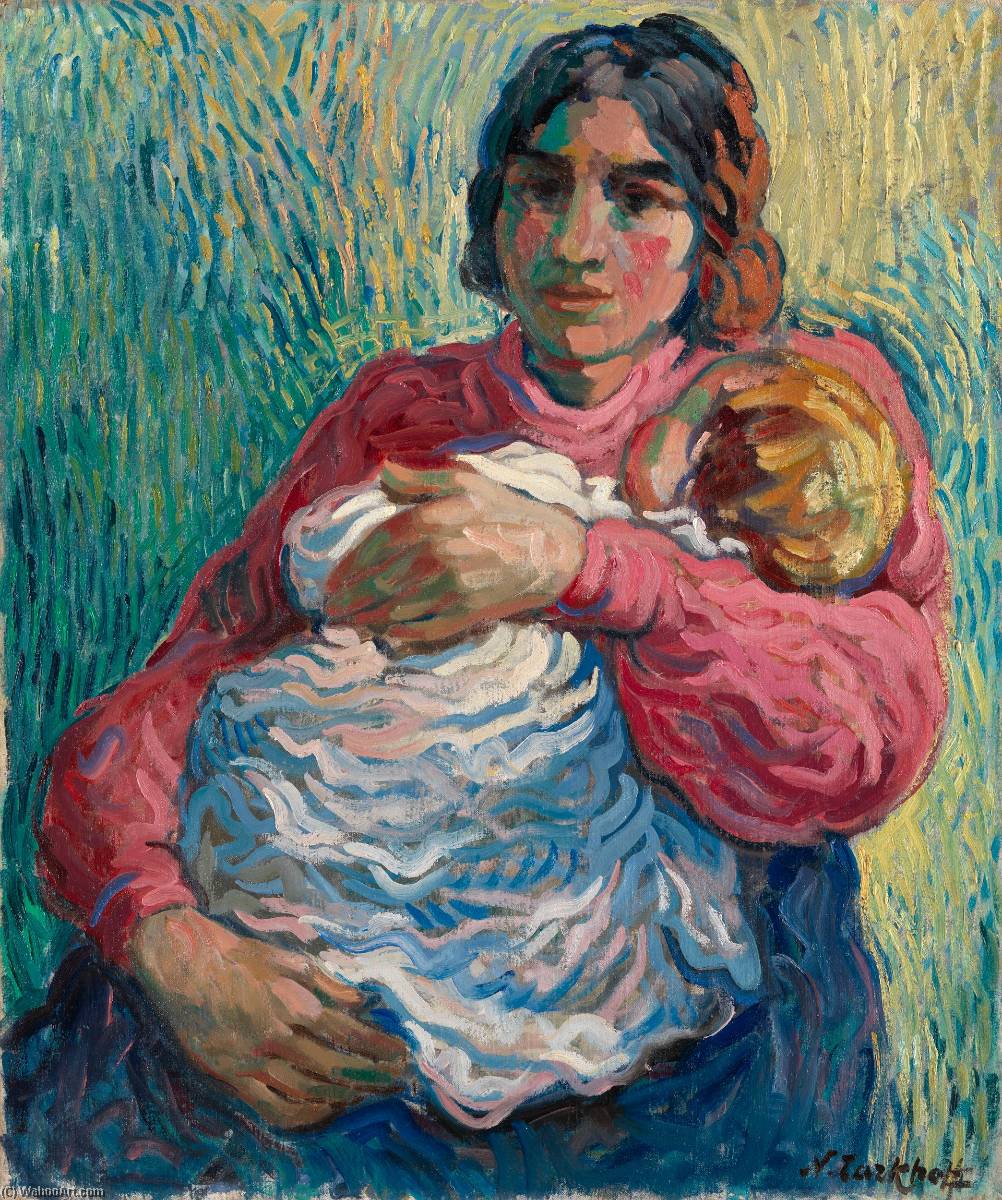
Motherhood (1906) avtorja Nicolas Tarkhoff

Motherhood

1906 · Oil On Canvas

A woman holds her infant child in this 1906 oil painting, creating an intimate connection through a centered, shallow composition. The figures emerge from a textured, vertical green field that provides a stark contrast to the organic forms of the subjects. Thick, visible brushstrokes define the contours of the mother and child, emphasizing movement and energy over precise realism. The impasto technique creates a tactile surface, where layers of paint…

7
The Kiss avtorja Nicolas Tarkhoff

The Kiss

Oil

The painting moves beyond mere depiction to capture a specific atmosphere. Through the use of bold color and varied brushwork, the artist imbues the scene with a sense of warmth and stillness. The interplay between the light hitting the mother and the shadows within the room creates a sense of movement within a frozen moment. It is a work that prioritizes the feeling of the encounter—the weight of the child,…

8
Street Carnival, Paris avtorja Nicolas Tarkhoff

Street Carnival, Paris

Oil

The bustling energy of a Parisian celebration finds its expression in Street Carnival, Paris, a work by the artist Nicolas Tarkhoff. This oil painting captures a moment of urban life, existing now in the public domain. The scene pulses with the movement of a city in flux, frozen in a way that invites the viewer to step directly into the crowd.

9
Faubourg Saint Antoine (1905) avtorja Nicolas Tarkhoff

Faubourg Saint Antoine

1905 · Oil

Painted in 1905, Faubourg Saint Antoine presents a vibrant street scene set within an urban environment. The composition is framed by buildings lining both sides of a road, their facades punctuated by numerous windows, some of which remain open to the street. The scene captures a bustling atmosphere where various elements of city life coexist in a single moment.

10
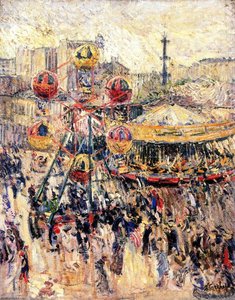
Fair (1905) avtorja Nicolas Tarkhoff

Fair

1905 · Oil

The canvas presents a crowded carnival scene centered around a large, multi-level Ferris wheel. This central structure dominates the composition, its circular frame populated by several figures seated at various heights. Around the base of the wheel, a collection of at least thirteen people are distributed throughout the space. Some individuals stand in close proximity to the machinery, while others are scattered toward the periphery of the scene. To the…

Slikarska dela umetnika Nicolas Tarkhoff, uvrščena od 11 do 42

Slavna platna umetnika Nicolas Tarkhoff, razdeljena po obdobjih

Motivi, ki so očarali Nicolas Tarkhoff

Četiri teme, ki se v teh originalih najpogosteje ponavljajo, vsaka z svojim vrhunskim primerom.

Nicolas Tarkhoff, ena značilna slika na desetletje

Slikorstva po desetletjih

Izberite desetletje, da si ogledate original, ki ga opredeljuje.

Slike umetnika Nicolas Tarkhoff: odgovori galerije

Katero sliko avtorja Nicolas Tarkhoff je najbolj znana med vsemi?Razkriti odgovor

Madame Tarkhoff with Her Two Children Jean and Boris (1907). Zatem sledeta Madame Tarkhoff and Her Child (1906) in La Place du Maine, Paris.

Koliko je bil Nicolas Tarkhoff let, ko je dokončal Madame Tarkhoff with Her Two Children Jean and Boris?Razkriti odgovor

36 let: delo Madame Tarkhoff with Her Two Children Jean and Boris iz leta 1907, Nicolas Tarkhoff pa je bil/a rojen/a leta 1871.

Katera je 10 najboljjših slik umetnika Nicolas Tarkhoff?Razkriti odgovor

Madame Tarkhoff with Her Two Children Jean and Boris, Madame Tarkhoff and Her Child, La Place du Maine, Paris, Merry Go Round in Montmarnasse, Goats in the Sunshine, Motherhood, The Kiss, Street Carnival, Paris, Faubourg Saint Antoine in Fair. Zgornja lestica prikazuje leto nastanka in muzej za vsako delo.

Koliko dzieł stworzył Nicolas Tarkhoff?Razkriti odgovor

Naš katalog vsebuje 42 del avtorja Nicolas Tarkhoff, datiranih od 1899 do 1912.

Kdaj je Nicolas Tarkhoff ustvaril svoja najbolj znana slika?Razkriti odgovor

V obdobju 1900s: 21 od 42 del na tej strani je bilo izdelovanih takrat, med njimi pa Madame Tarkhoff with Her Two Children Jean and Boris.

Kateri so najstarejši in najmlajši znanii dela umetnika Nicolas Tarkhoff?Razkriti odgovor

Na tej strani je najstarejše delo iz Landscape with Houses (1899) in najstarejše iz Landscape with Trees, Flowers and Peasant with Plough (1912).

Kateri motivi so bili za Nicolas Tarkhoff najbolj značilni?Razkriti odgovor

People (11), Woman (6) in Child (6), na 42 delih na tej strani.

Pri katerem medijem je Nicolas Tarkhoff delal največ?Razkriti odgovor

Oil, za 22 od 42 del na tej strani.

S katerim umetnostnim slogom je povezan Nicolas Tarkhoff?Razkriti odgovor

Post-impressionism, glede na originala na tej strani.

Nicolas Tarkhoff: umetnik

Early Life and Artistic Awakening

Nicolas Tarkhoff, born in Moscow on January 20, 1871, emerged from a family of prosperous merchants—a background that initially seemed destined for commerce rather than canvas. However, the young Tarkhoff possessed an innate artistic inclination, described as a “fervent desire to be a painter.” Tragedy marked his childhood; he lost his mother at age three and his father eight years later, experiences that perhaps fostered a sensitivity reflected in his later work. Despite this early loss, his passion for art persisted, though it faced initial resistance from his family who favored more conventional paths. He briefly fulfilled military obligations before finding employment with the Brest-Litovsk Railways—a period of deferment before fully embracing his artistic calling. In 1894, he bravely attempted entry into the School of Painting, Sculpture and Architecture in Moscow, but was rejected due to what was perceived as a “revolutionary temperament.” This rejection didn’t deter him; instead, it propelled him towards Konstantin Korovin's studio in 1897, where he found mentorship within Moscow’s vibrant artistic circles.

Pariški vplivi in objem postimpresionizma

Konec 1890-ih je przelil ključni preobrat, ko se je Nicolas Tarkhoff odločil za potovanje v Pariz, mesto, ki je že takrat vibriralo z avantgardno energijo. Najprej se je ustopil v Münchenu, preden se je v novembru 1898 dokončno preselil v francensko prestolnico. Pariz mu ni ponudil le spremembe okolja, temveč popolno potopitev v svet, ki je bil prepolnjen z umetniško inovativnostjo. Čeprav se je vpisal v Académie Julian pod mentorstvo Jean-Paul Laurens, je njegov neodvisni duh kmalu odmagil stroge akademske oklepe. Študiral je tudi pri Luc-Olivier Merson, vendar so bila to dela, ki so jih ustvarili Van Gogh, Gauguin in Cézanne, ki so resnično razžarila njegovo umetniško evolucijo. Ti mojstri so razkrili "skrite talente" in zastavili novo pot za Tarkhoffov slog—slog, ki ga odlikajo ekspresivne poteze č brush, drzne barvne palete in raziskovanje subjektivne izkušnje. Hitro je osvojil lekcije impresionizma, vendar se je premaknil dlje od njegovih zgolj optičnih vprašanj in sprejel bolj čustveno naložen pristop, ki bo definiral njegovo postimpresionistično identiteto.

Teme in tehnike: zajemanje svetlobe in čustev

Tarkhoffovo delo je izjemno raznoliko, obsegajoč pejzaže, žanrske scene, živna morda in portrete. Vendar pa se v njegovem umetniškem izrazu nenehno ponavljajo določene teme—živahno življenje Pariza, mir podeželskih okolij in intimni trenutki družinskih povezav. Njegove parizanske slike zajamejo energijo bulvarjev, karnevalov in hitrih taksistov, medtem ko pozitna dela odražajo mirno življenje v Orsuju, kjer je od leta 1911 prebival s svojo družino. S čuvnostjo je uporabljal oljno barvo, da bi prenesel ne le vizualno realnost, temveč tudi vzdušje in globoko čutenje. Teksturiran čoprasti poteh je postal značilnost njegovega sloga, ki je ustvarjala površine, ki soณะšile s svetlobą in gibanjem. On ni zgolj prikazoval scen; on je prevajal čustva na platno. Njegova uporaba barv je bila prav tako ključna—živahne barve so bile pogosto postavljene ena ob drugo, da bi ustvarile dinamične kontraste in vzbudile specifična vzdušja. Dela, kot je " Koze v sončni svetlobi ", najbolje ponazarjajo ta pristop in prikazujejo podeželsko idilo, ki je navlažena s toplo svetlobo in prepojena z občutkom miru. “Moja družina,” naslikana v njegovem ruskem postimpresionističnem obdobju, razkriva toplo nežnost skozi svoj ekspresiven slog in skrbno pozornost detajlov.

Prepoznavanje in dediščina

Nicolas Tarkhoff je skozi svoje življenje dosegel precejšnje priznanje, saj je sodeloval na številnih razstavah po vse Evropi. Njegovo del je resonatedo z gledalci, ki so cenili njegovo edinstveno zlitje impresionističnih tehnik in postimpresionistične senzibilnosti. Razstavil je na La Libre Esthétique v Parizu, kjer je ob drugih znamenitih umetnikih predstavil dela, kot sta “Un Jour de neige” in “Notre-Dame”. Čeprav ni bil tako široko prepoznan kot nekateri njegovi sodobniki, njegove slike še vedno očarjavajo gledalce s svojo evokativno močjo in čustveno globino. Njegovo del je zastopano v številnih zbirkah, vključno z Musée du Petit Palais, kar zagotavlja, da njegova umetniška vizija ostaja živa za prihajajoče generacije. Stoji kot dokaz nečasne privlačnosti postimpresionizma—stila, ki je predalprioriteto subjektivni izkušnji in pavedal pot za modernistične umetnostne gibanja. Njegova sposobnost zajema mirnih trenutkov in naravne lepote skozi edinstveno umetniško prizmo utrjuje njegov položaj v bogati tapiseriji prvega dela 20. stoletja in ekspresionizma, ter ponuja prepovedljivo pogled v srce in dušo umetnika, ki je bil globoko povezan tako z svetovom okoli sebe kot z notranjimi čustvi.