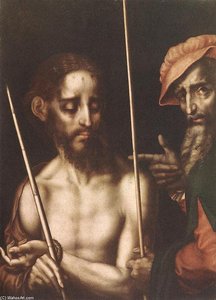
Portret Luis De Morales

50 najbolj znanih slik umetnika Luis De Morales, vsaka popolnoma edinstvena

Posodobljeno november 2026 · uvrščeno glede na naš skoraj priljubljenosti (iskanja, obiske in naročila za vsako delo) · 51 del v našem katalogu avtorja Luis De Morales

Kratek opis

Virgin and Child with the Infant St John the Baptist (1550) je slika avtorja Luis De Morales, ki pritegne največ pogledov; original se nahaja v muzeju Muzej Prado, Madrid. Nato se pogled smeri k The Crucifixion (1566) in The Annuncation (1565). Med 51 dela umetnika Luis De Morales v našem katalogu so ta 50 najbolj znana; vsako je edinstven original, predstavljen z letnico nastanka, muzejem in razlogom za njegovo nečasenost.

1509 – 1586, Badajoz Spanish renaissance Največ del: Muzej Prado

10 najboljjših slik umetnika Luis De Morales skozi oči galerije

1
Virgin and Child with the Infant St John the Baptist (1550) avtorja Luis De Morales

Virgin and Child with the Infant St John the Baptist

1550 · Oil On Canvas · Muzej Prado, Madrid

In this 1550 portrait, the Virgin Mary holds the infant Jesus in a close, physical embrace. The child is depicted nursing, a detail that grounds the religious scene in a moment of biological necessity and maternal intimacy. To the left and right of the central figures, two winged beings—angels or saints—occupy the periphery of the frame. These figures are positioned against a backdrop of dense trees, which provides a sense…

2
The Crucifixion (1566) avtorja Luis De Morales

The Crucifixion

1566 · Oil On Panel · Muzej Prado, Madrid

The heavy silence of the scene is held within The Crucifixion, a profound work of religious art created by the Spanish painter Luis de Morales. Dating to 1566, this piece captures a moment of intense spiritual weight. The central focus remains fixed upon the Crucifixion of Jesus Christ, a subject that demands the viewer's immediate and solemn attention.

3
The Annuncation (1565) avtorja Luis De Morales

The Annuncation

1565 · Oil On Panel · Muzej Prado, Madrid

The Annunciation by Luis de Morales captures a moment of divine stillness. Painted about 1565, the work presents a quiet encounter between the celestial and the earthly. The Archangel Gabriel and the Virgin Mary occupy a shared, intimate space, separated by a single white lily in a slender vase. A white dove descends through soft light, marking the presence of the Holy Spirit above the figures.

4
The Resurrection of Christ (1566) avtorja Luis De Morales

The Resurrection of Christ

1566 · Oil · Muzej Prado, Madrid

A sudden, vertical force breaks the stillness of the tomb. Christ rises from the heavy stone sarcophagus, his body caught in a moment of divine momentum. The light is not merely a glow; it is a weightless, golden flood that carves the musculature of his torso out of the surrounding shadows. Behind him, a shroud of reddish-pink fabric billows like a sudden flame, tracing the path of his upward movement.…

5
The Birth of the Virgin (1562) avtorja Luis De Morales

The Birth of the Virgin

1562 · Oil · Muzej Prado, Madrid

The air in the room feels heavy, thick with the quiet gravity of a life beginning. Within this shallow, intimate space, four women gather, their forms tightly grouped as if to shield the profound miracle unfolding before them. A woman reclines in the bed, her presence marked by the soft contours of her face and the weight of the linens surrounding her. Nearby, another figure holds a newborn infant, the…

6
The Virgin and Child with a Spindle (1566) avtorja Luis De Morales

The Virgin and Child with a Spindle

1566 · Oil · Muzej Prado, Madrid

The composition is a vertical portrait set against a dark, undifferentiated background. In the center, the Virgin Mary holds the Christ Child. She wears a red gown beneath a heavy blue mantle, while a translucent veil rests upon her head. The skin of both figures appears pale and luminous against the deep shadows. The child holds a wooden spindle, its straight, thin lines cutting through the soft folds of the…

7
Saint John the Baptist (1566) avtorja Luis De Morales

Saint John the Baptist

1566 · Oil On Panel · Muzej Prado, Madrid

The portrait presents a close-up, bust-length view of Saint John the Baptist, positioned slightly off-center. He gazes toward the left with an expression defined by weariness and contemplation. The composition utilizes a chiaroscuro technique, where a strong directional light source illuminates one side of the face, carving out the hollows of the eyes and the texture of the beard against deep, shadowy recesses. This interplay of light and dark creates…

8
Virgin and Child-Morales (1586) avtorja Luis De Morales

Virgin and Child-Morales

1586 · Oil On Canvas · Machado de Castro National Museum, Coimbra

The Virgin gently cradles her son within a space defined by shadow and soft light. A newborn hand tucks through the folds of a red gown, searching for milk. This small gesture anchors the composition, pulling the viewer into a quiet, domestic moment of care. The faces of mother and child lean toward one another, their gazes interlocking with a tender, silent weight. Behind them, a pitch-dark background swallows the…

9
Ecce Homo (1565) avtorja Luis De Morales

Ecce Homo

1565 · Oil On Canvas · Muzej Prado, Madrid

The shadows press closely against the figure, creating a void that seems to swallow everything but the man himself. In this vertical portrait, the upper torso and head of Jesus Christ emerge from a near-black background, caught in a heavy, dramatic chiaroscuro. A soft light descends from the upper left, catching the smooth, porcelain-like texture of his skin and casting gentle shadows across the musculature of his chest and arms.…

10
Pietà avtorja Luis De Morales

Pietà

Oil On Panel · Louvre, Pariz

In the quiet, somber depths of Luis de Morales’s Pietà, one encounters more than just a religious scene; one enters a profound meditation on human suffering and divine grace. Executed between 1565 and 1570, this masterpiece serves as a cornerstone of the Spanish Renaissance, capturing the exact moment when the weight of mortality meets the infinite strength of maternal love. The painting depicts the Virgin Mary cradling the lifeless, broken…

Slavna platna umetnika Luis De Morales, od številk 11 do 50

11Christ Justifying his Passion (1565) avtorja Luis De MoralesChrist Justifying his Passion1565 · Muzej Prado 12Christ, Man of Sorrows (1566) avtorja Luis De MoralesChrist, Man of Sorrows1566 · Muzej Prado 13Pietà (1567) avtorja Luis De MoralesPietà1567 · Muzej Prado 14Saint Juan de Ribera (1566) avtorja Luis De MoralesSaint Juan de Ribera1566 · Muzej Prado 15Ecce Homo (1547) avtorja Luis De MoralesEcce Homo1547 · Staatliche Kunstsammlungen Dresden 16The Adoration of the Shepherds (1567) avtorja Luis De MoralesThe Adoration of the Shepherds1567 · Muzej Prado 17Man of Sorrows (1560) avtorja Luis De MoralesMan of Sorrows1560 · Minneapolis Institute of Art 18The Lamentation (1560) avtorja Luis De MoralesThe Lamentation1560 · Metropolitanski muzej umetnosti 19The Purification of the Virgin or The Presentation in the Temple (1562) avtorja Luis De MoralesThe Purification of the Virgin or The Presentation in the Temple1562 · Muzej Prado 20Pietà (1560) avtorja Luis De MoralesPietà1560 · Kraljevska akademija belleza San Fernando 21Ecce Homo (1570) avtorja Luis De MoralesEcce Homo1570 · Narodni muzej umetnosti Katalonije 22The Virgin and Child with the Infant Saint John the Baptist (1570) avtorja Luis De MoralesThe Virgin and Child with the Infant Saint John the Baptist1570 · Muzej Prado 23The Virgin Dolorosa (1565) avtorja Luis De MoralesThe Virgin Dolorosa1565 · Muzej Prado 24The Adoration of the Magi (1567) avtorja Luis De MoralesThe Adoration of the Magi1567 · Muzej Prado 25Christ Carrying the Cross (1547) avtorja Luis De MoralesChrist Carrying the Cross1547 · Bavarske državne slikopisne zbirke 26Christ Carrying the Cro (1546) avtorja Luis De MoralesChrist Carrying the Cro1546 · Yale University Art Gallery 27Triptych of the Pietà, St John and St Mary Magdalene (1567) avtorja Luis De MoralesTriptych of the Pietà, St John and St Mary Magdalene1567 · Muzej Prado 28Holy Family (1557) avtorja Luis De MoralesHoly Family1557 · Hispanic Society Museum - Library 29Saint Jerome in the Wilderness (1570) avtorja Luis De MoralesSaint Jerome in the Wilderness1570 · National Gallery of Ireland 30Ecce Homo (1565) avtorja Luis De MoralesEcce Homo1565 · Fundación Banco Santander 31Christ before Pilate (1570) avtorja Luis De MoralesChrist before Pilate1570 · Kraljevska akademija belleza San Fernando 32Christ Carrying the Cross (1566) avtorja Luis De MoralesChrist Carrying the Cross1566 · Museo del Patriarca 33The Agony in the Garden (1545) avtorja Luis De MoralesThe Agony in the Garden1545 · Muzej Prado 34Madonna and Child avtorja Luis De MoralesMadonna and ChildBowes Museum 35The Virgin and Child (1567) avtorja Luis De MoralesThe Virgin and Child1567 · Muzej umetnosti in arheologije Ashmolean 36Virgin and Child (1520) avtorja Luis De MoralesVirgin and Child1520 · Museu do Caramulo 37Virgin and Child with a Spindle (1567) avtorja Luis De MoralesVirgin and Child with a Spindle1567 · Staatliche Museen zu Berlin 38Christ at the Column avtorja Luis De MoralesChrist at the ColumnNational Museum of Fine Arts 39Virgin and Child avtorja Luis De MoralesVirgin and ChildMuzej fine arts 40Madonna and Child avtorja Luis De MoralesMadonna and ChildCampion Hall 41Pietà 1724 avtorja Luis De MoralesPietà 1724 42Christ at the Column avtorja Luis De MoralesChrist at the ColumnKingston Lacy 43Triptych of Bishop Juan de Ribera avtorja Luis De MoralesTriptych of Bishop Juan de RiberaMuzej v Cádizu 44The Virgin and Child avtorja Luis De MoralesThe Virgin and ChildNational Gallery 45Ecce Homo avtorja Luis De MoralesEcce HomoHispanic Society Museum - Library 46Christ as the Man of Sorrows avtorja Luis De MoralesChrist as the Man of Sorrows 47St Stephen avtorja Luis De MoralesSt StephenMuzej Prado 48Madonna with the Child (1570) avtorja Luis De MoralesMadonna with the Child1570 · Muzej Prado 49Mater Dolorosa (1570) avtorja Luis De MoralesMater Dolorosa1570 · Ermitaž 50Madonna with the Child (1570) avtorja Luis De MoralesMadonna with the Child1570 · Ermitaž

Slavna platna umetnika Luis De Morales, razdeljena po obdobjih

Motivi, ki so očarali Luis De Morales

Četiri teme, ki se v teh originalih najpogosteje ponavljajo, vsaka z svojim vrhunskim primerom.

Muzeji, ki hranijo originala umetnika Luis De Morales

8 muzejev, ki vsebujo največ slik na tej strani.

Muzeji Mesto Sloga Luis De Morales Slike iz tega seznama
Muzej Prado, MadridMuzej Prado Madrid 21 Virgin and Child with the Infant St John the Baptist, The Crucifixion, The Annuncation
Kraljevska akademija belleza San Fernando, MadridKraljevska akademija belleza San Fernando Madrid 2 Pietà, Christ before Pilate
Hispanic Society Museum - Library, New YorkHispanic Society Museum - Library New York 2 Holy Family, Ecce Homo
Ermitaž, Sankt PeterburgErmitaž Sankt Peterburg 2 Mater Dolorosa, Madonna with the Child
Machado de Castro National Museum, CoimbraMachado de Castro National Museum Coimbra 1 Virgin and Child-Morales
Louvre, ParizLouvre Pariz 1 Pietà
Staatliche Kunstsammlungen Dresden, DresdenStaatliche Kunstsammlungen Dresden Dresden 1 Ecce Homo
Minneapolis Institute of Art, MinneapolisMinneapolis Institute of Art Minneapolis 1 Man of Sorrows

Luis De Morales skozi desetetja: vsak unikatni original za vsako obdobje

Slikorstva po desetletjih

Izberite desetletje, da si ogledate original, ki ga opredeljuje.

Slike umetnika Luis De Morales: vprašanja za galerijo

Katero je najbolj znano delo umetnika Luis De Morales?Razkriti odgovor

Virgin and Child with the Infant St John the Baptist (1550), Muzej Prado, Madrid. Zatem sledeta The Crucifixion (1566) in The Annuncation (1565).

Pri kateri dobe je Luis De Morales ustvaril Virgin and Child with the Infant St John the Baptist?Razkriti odgovor

41 let: delo Virgin and Child with the Infant St John the Baptist iz leta 1550, Luis De Morales pa je bil/a rojen/a leta 1509.

Katera desetina slik avtorja Luis De Morales je najbolj znana?Razkriti odgovor

Virgin and Child with the Infant St John the Baptist, The Crucifixion, The Annuncation, The Resurrection of Christ, The Birth of the Virgin, The Virgin and Child with a Spindle, Saint John the Baptist, Virgin and Child-Morales, Ecce Homo in Pietà. Zgornja lestica prikazuje leto nastanka in muzej za vsako delo.

Koliko je znanih del avtorja Luis De Morales?Razkriti odgovor

Naš katalog vsebuje 51 del avtorja Luis De Morales, datiranih od 1520 do 1586.

Kje si lahko ogledate najslavnejše originale umetnika Luis De Morales?Razkriti odgovor

Večini v Muzej Prado (Madrid), Kraljevska akademija belleza San Fernando (Madrid) in Hispanic Society Museum - Library (New York). Zgoraj navedena tabela muzejev vsebuje njihov celoten seznam.

V katerem obdobju je Luis De Morales ustvaril svoja najbolj znana dela?Razkriti odgovor

V obdobju 1560s: 23 od 50 del na tej strani je bilo izdelovanih takrat, med njimi pa The Crucifixion.

Katero znano sliko je naslikal Luis De Morales najprej in katero najpozdneje?Razkriti odgovor

Na tej strani je najstarejše delo iz Virgin and Child (1520) in najstarejše iz Virgin and Child-Morales (1586).

Katere teme je Luis De Morales najprej ravnate?Razkriti odgovor

Man (22), Woman (20) in Dark background (18), na 50 delih na tej strani.

S katerimi materiali je Luis De Morales najpogosteje slikal?Razkriti odgovor

Oil On Panel, za 27 od 50 del na tej strani.

Kateri umetniški slog predstavlja delo umetnika Luis De Morales?Razkriti odgovor

Spanish renaissance, glede na originala na tej strani.

Katere originale Luis De Morales lahko vidim v muzeju Muzej Prado?Razkriti odgovor

Virgin and Child with the Infant St John the Baptist, The Crucifixion in The Annuncation: v muzeju Muzej Prado, Madrid se nahaja 21 del z te strani.

Luis De Morales: portret umetnika

Luis de Morales: Božji slikar iz Badajoz

Luis de Morales (okoli leta 1509 – 9. maj 1586), ljubkovno znan kot „El Divino“, predstavlja eno najbolj spoštovanih osebnosti španskega renesansko umetniškega sveta – slikar, čija je globoka duhovnost in osupljiv realizem osvabljala občinstvo skozi njegovo življenje in še danes nam edina navdihuje divljenje stoletja kasneje. Rojen v Badajozu, Ekstremadura, se je Moralesova umetniška pot razvijala na ozadju vzburjajočih humanističnih idej in religioznega žara, kar ga je oblikovalo v nepreklicnega majstra devocionalne slike in cementiralo njegovo dediščino kot arhetipsko umetnika svoje epohalnosti.
  • Rano življenje in vplivi: Malo je definitivno znano o Moralesovih formativnih letih, razen dokumentiranih zapisov, ki kažejo, da je bil rojen v Badajozu okoli leta 1509. Njegovo umetniško usposabljanje najverjetneje začne pod mentorstvom Hernando Sturmioja, flamanskega slikarja, ki se je namestil v Badajozu, in morda Pedro de Campaña, izjemnega umetnika z Seville – mest, znanih po svojih živahnih umetniških tradicijah v renesansi.
  • Lombardska šola in florentinske eho: Moralesove zgodnje delo nosi neprepoznavne znamke lombardske šole Leonardoja da Vinci – ki se kažejo v subtilnem sfumato (razmazani konturi) in atmosferski perspektivi. Hkrati pa je absorbiral vplive Michelangeloja, čigove monumentalne skulpture v njem vzgojevaljo majstersko razumevanje anatomije in izrazitega gesta. Ta formativna izkušnja je močno vplivala na njegovo umetniško občutljivost.

Period, definiran z anatomsko precejjo in duhovno globino

Moralesov umetniški output ga lahko širše razdelimo v dva različna obdobja, ki odražata razvijajoče se stilistične trende in intelektualne tekučine. Prvo faza, ki pokriva čas od približno leta 1539 do 1560, je bila značilna za nadaljnjo angažiranost v florentinskih esteti •kih – zlasti anatomsko oskrbnitev Michelangeloja – kar je prvelo do slikarjev, napolnjenih očitno čutilno in dramsko napetostjo. Dela kot so La Virgen del Pajarito kažejo na ta začetni stil, predstavljajoči minutično podrobnost in prenašajočo globoko duhovno razmišljanje.
  • Drugo cvutje: Po branju z Leonor de Chaves in kasnijem premestitvi v Alcántara je Morales doživetal izjemno umetniško renesanso. To obdobje ga je spodbodovalo k ustvarjanju majstorjevskih del, ki so potrcali meje renesanske tehnike – zlasti glede anatomskočne natančnosti – in se je navdihoval z nemškimi in flamanskimi slikarji, ki so zagovarjali chiaroscuro (kontrast med svetlobo in temno) in minutično preobservacijo narave.
  • Značilni dosevki: Med njegovimi najbolj slavnimi slikarji sta La Piedad (1560), ki je v katedrale Badajoz, osupljiv prikaz Marije, ki žaluje nad smrtjo Jezusa – dokaz Moralesove nepreklicne sposobnosti prenošanja žalostnega čutja; San Juan de Ribera (1564), ki se nahaja v Prado muzejju v Madridu; in Ecce Homo, izpostavljen v Hispanske družbi Amerike. Ta dela stojijo kot trajni simboli renesanske pobožnosti in umetniške odličnosti.

Dedišče in priznanje

Vpliv Luis de Moralesa je šel mnogo čeprav njegovega življenja, saj ga je ustanovil kot kamen temelja španskega renesansa in mu zagotovil mesto med največjšimi slikarji svoje generacije. Njegova nepromišljena predanost religioznym temam – izražena z osupljivim realizmem in napolnjena očitno čutilnostjo – je močno odmevala pri občinstvu po celotni Evropi. Danes so njegove sliki v prestižnih institucijih po vsej sveti – vključno z Prado muzejjem v Madridu in Kingston Lacy Hišo v Dorsetu – kar potrjuje njihovo trajno umetniško zaslužnost in zgodovinsko pomembnost. Moralesovo dedišče nadaljuje navdihovati umetnike in znanstvenike, zagotavljajoč, da „El Divino“ ostane svetilo duhovne umetnosti za prihodnje generacije.

Izbrane dela

  • La Virgen del Pajarito (Devica z ptička) (1546), ohranjeno v cerkvi San Agustín v Madridu.
  • La Piedad (1560), ohranjena v katedrali Badajoz.
  • San Juan de Ribera (1564), v Prado muzejju, Madrid.
  • Ecce Homo, v Kingston Lacy Hiši (Narodni zaupnik), Dorset, Veliko Britanijo.
  • Virgen de la leche (Devica z dojenjem) (Breastfeeding Virgin), v Prado muzejju.
  • St. Jerome in the Wilderness, v Nacionalni galeriji na Irski, Dublin.