Portret Ludwig Knaus

47 najbolj znanih slik umetnika Ludwig Knaus, vsaka popolnoma edinstvena

Posodobljeno november 2026 · uvrščeno glede na naš skoraj priljubljenosti (iskanja, obiske in naročila za vsako delo) · 51 del v našem katalogu avtorja Ludwig Knaus

Kratek opis

Portrait of Mrs. Müller (1848) je slika avtorja Ludwig Knaus, ki pritegne največ pogledov; original se nahaja v muzeju Alte Nationalgalerie, Berlin. Nato se pogled smeri k Head of a Peasant Woman (1872) in Solomonic Wisdom (1878). Med 51 dela umetnika Ludwig Knaus v našem katalogu so ta 47 najbolj znana; vsako je edinstven original, predstavljen z letnico nastanka, muzejem in razlogom za njegovo nečasenost.

1829 – 1910, Wiesbaden Realism Največ del: Alte Nationalgalerie

10 najboljjših slik umetnika Ludwig Knaus skozi oči galerije

1
Portrait of Mrs. Müller (1848) avtorja Ludwig Knaus

Portrait of Mrs. Müller

1848 · Oil On Canvas · Alte Nationalgalerie, Berlin

The room feels still, held in a heavy, respectful silence. Mrs. Müller sits before us, her presence steady and unmoving against a dark, indistinct background that offers no distractions from her character. The light enters from the upper left, a soft, singular glow that brushes against her forehead and the curve of her cheek, leaving the other side of her face in a gentle, thoughtful shadow. There is a profound…

2
Head of a Peasant Woman (1872) avtorja Ludwig Knaus

Head of a Peasant Woman

1872 · Oil On Canvas · Ermitaž, Sankt Peterburg

In this 1872 oil portrait, we find ourselves in a moment of profound stillness. The subject, a young peasant woman, is presented in a close-up bust view, her head turned slightly toward us as if caught in a fleeting thought. There is a certain gravity to her expression, a quiet melancholy that draws the viewer into her private world. The lighting, appearing to descend from the upper left, casts soft…

3
Solomonic Wisdom (1878) avtorja Ludwig Knaus

Solomonic Wisdom

1878 · Oil On Canvas · Alte Nationalgalerie, Berlin

Solomonic Wisdom is an oil on canvas painting executed by Ludwig Knaus in 1878. The work belongs to the tradition of German genre painting, focusing on a specific moment of domestic instruction. The scene captures an elderly Jewish man initiating his grandchild into the secrets of the second-hand trade.

4
Portrait of the Physicist Hermann von Helmholtz (1881) avtorja Ludwig Knaus

Portrait of the Physicist Hermann von Helmholtz

1881 · Oil On Panel · Alte Nationalgalerie, Berlin

In this 1881 oil on wood portrait, Ludwig Knaus captures the likeness of the German physicist and physiologist Hermann von Helmholtz. The work was originally commissioned for the National Gallery's portrait collection, a purpose that underscores the significance of the sitter during this period. Knaus, a prominent figure in nineteenth-century German art, brings a sense of quiet dignity to the subject, presenting him not merely as a scientist, but as…

5
The Hunter (1845) avtorja Ludwig Knaus

The Hunter

1845 · Oil On Canvas · Alte Nationalgalerie, Berlin

In "The Hunter" by Ludwig Knaus, a solitary man occupies a vast, breathing landscape. The composition is vertically oriented, drawing the eye upward through a rugged terrain toward a distant horizon. Positioned slightly off-center to the left, the full-length figure of the hunter commands the space, his presence felt through the weight of his gear and his sudden, alert movement. He carries a long rifle and a shoulder bag, tools…

6
Walk in the Tuileries (1855) avtorja Ludwig Knaus

Walk in the Tuileries

1855 · Oil On Canvas · Bavarske državne slikopisne zbirke, München

In "Walk in the Tuileries" by Ludwig Knaus, a quiet afternoon unfolds within the confines of a park, likely the Tuileries Garden. The composition centers on a trio of figures moving through the space. A woman leads the way, her long, light-colored dress contrasted by the weight of a dark shawl. Beside her, a small child in a white frock moves in rhythm with the group, accompanied by a young…

7
August Cappelen (1850) avtorja Ludwig Knaus

August Cappelen

1850 · Oil On Canvas

The composition focuses entirely on the upper shoulders and the head, removing any sense of place or time. This isolation forces a direct connection between the viewer and the subject. There is a sense of dignity in the simplicity of the presentation. The darkness surrounding him does not feel empty; it feels like a quiet room where the only thing that matters is the breath of the sitter. The portrait…

8
Peasant in Hessian costume (1852) avtorja Ludwig Knaus

Peasant in Hessian costume

1852 · Oil On Canvas · New Gallery, Kassel

In "Peasant in Hessian costume" by Ludwig Knaus, a single figure occupies the center of a vertical, full-length portrait. The man sits in a moment of stillness, dressed in the traditional attire of a Hessian peasant. His clothing is a study in muted, naturalistic tones; creams and whites define the fabric of his garments, while deep blacks and blues anchor the waistcoat and stockings. The subject is positioned at eye-level,…

9
Portrait of a young girl (1852) avtorja Ludwig Knaus

Portrait of a young girl

1852 · Oil · Moravska galerija v Brnu, Brno

Ludwig Knaus presents a bust-length portrait in Portrait of a young girl, dating from about 1852. The subject is positioned slightly off-center, facing the viewer with a gentle, contemplative expression. Her dark hair is parted in the middle, framing a face characterized by luminous skin tones. This central focus is emphasized by a dark, indistinct background that lacks specific detail, ensuring the viewer's attention remains fixed upon the sitter.

10
The cheater (1851) avtorja Ludwig Knaus

The cheater

1851 · Oil · Alte Nationalgalerie, Berlin

Step into the dim, amber-lit atmosphere of this 1851 oil painting. We find ourselves in a rustic interior, perhaps a tavern, where the air feels heavy with unspoken tension. A group of men is gathered around a wooden table, their bodies leaning inward, caught in a singular moment of intense concentration. The light, striking from the upper left, carves their features out of the darkness, casting deep shadows that swallow…

Slavna platna umetnika Ludwig Knaus, od številk 11 do 47

Slavna platna umetnika Ludwig Knaus, razdeljena po obdobjih

Motivi, ki so očarali Ludwig Knaus

Četiri teme, ki se v teh originalih najpogosteje ponavljajo, vsaka z svojim vrhunskim primerom.

Muzeji, ki hranijo originala umetnika Ludwig Knaus

8 muzejev, ki vsebujo največ slik na tej strani.

Muzej Mesto Sloga Ludwig Knaus Slike iz tega seznama
Alte Nationalgalerie, BerlinAlte Nationalgalerie Berlin 7 Portrait of Mrs. Müller, Solomonic Wisdom, Portrait of the Physicist Hermann von Helmholtz
Ermitaž, Sankt PeterburgErmitaž Sankt Peterburg 3 Head of a Peasant Woman, First Earnings, A Young Girl In A Field
Bavarske državne slikopisne zbirke, MünchenBavarske državne slikopisne zbirke München 2 Walk in the Tuileries, The Hurdy-Gurdy Man
New Gallery, KasselNew Gallery Kassel 2 Peasant in Hessian costume, Interior with green ceramic stove
Walters Art Museum, BaltimoreWalters Art Museum Baltimore 2 The Truant, Mud Pies
Grohmann Museum, MilwaukeeGrohmann Museum Milwaukee 2 Potato Harvest, The Magician in the Barn
Moravska galerija v Brnu, BrnoMoravska galerija v Brnu Brno 1 Portrait of a young girl
Staatliche Kunstsammlungen Dresden, DresdenStaatliche Kunstsammlungen Dresden Dresden 1 Behind the curtain

Ludwig Knaus skozi desetetja: vsak unikatni original za vsako obdobje

Delo po desetletjih

Izberite desetletje, da si ogledate original, ki ga opredeljuje.

Slike umetnika Ludwig Knaus: vprašanja za galerijo

Katero je najbolj znano delo umetnika Ludwig Knaus?Razkriti odgovor

Portrait of Mrs. Müller (1848), Alte Nationalgalerie, Berlin. Zatem sledeta Head of a Peasant Woman (1872) in Solomonic Wisdom (1878).

Pri kateri dobe je Ludwig Knaus ustvaril Portrait of Mrs. Müller?Razkriti odgovor

19 let: delo Portrait of Mrs. Müller iz leta 1848, Ludwig Knaus pa je bil/a rojen/a leta 1829.

Katera desetina slik avtorja Ludwig Knaus je najbolj znana?Razkriti odgovor

Portrait of Mrs. Müller, Head of a Peasant Woman, Solomonic Wisdom, Portrait of the Physicist Hermann von Helmholtz, The Hunter, Walk in the Tuileries, August Cappelen, Peasant in Hessian costume, Portrait of a young girl in The cheater. Zgornja lestica prikazuje leto nastanka in muzej za vsako delo.

Koliko je znanih del avtorja Ludwig Knaus?Razkriti odgovor

Naš katalog vsebuje 51 del avtorja Ludwig Knaus, datiranih od 1845 do 1897.

Kje si lahko ogledate najslavnejše originale umetnika Ludwig Knaus?Razkriti odgovor

Večini v Alte Nationalgalerie (Berlin), Ermitaž (Sankt Peterburg) in Bavarske državne slikopisne zbirke (München). Zgoraj navedena tabela muzejev vsebuje njihov celoten seznam.

V katerem obdobju je Ludwig Knaus ustvaril svoja najbolj znana dela?Razkriti odgovor

V obdobju 1850s: 8 od 47 del na tej strani je bilo izdelovanih takrat, med njimi pa Walk in the Tuileries.

Katero znano sliko je naslikal Ludwig Knaus najprej in katero najpozdneje?Razkriti odgovor

Na tej strani je najstarejše delo iz The Hunter (1845) in najstarejše iz Tyrolean Farm Boy (1897).

Katere teme je Ludwig Knaus najprej ravnate?Razkriti odgovor

Man (9), Children (8) in Woman (7), na 47 delih na tej strani.

S katerimi materiali je Ludwig Knaus najpogosteje slikal?Razkriti odgovor

Oil On Canvas, za 19 od 47 del na tej strani.

Kateri umetniški slog predstavlja delo umetnika Ludwig Knaus?Razkriti odgovor

Realism, glede na originala na tej strani.

Katere originale Ludwig Knaus lahko vidim v muzeju Alte Nationalgalerie?Razkriti odgovor

Portrait of Mrs. Müller, Solomonic Wisdom in Portrait of the Physicist Hermann von Helmholtz: v muzeju Alte Nationalgalerie, Berlin se nahaja 7 del z te strani.

Ludwig Knaus: portret umetnika

The Master of German Genre Painting

Ludwig Knaus stands as a preeminent figure in the history of nineteenth-century German art, a painter whose brush captured the very heartbeat of rural and domestic life. Born in Wiesbaden, Germany, Knaus emerged from the prestigious younger Düsseldorf school of painting, an environment that initially shaped his early aesthetic. His formative years were spent under the tutelage of masters such as Sohn and Schadow, where he developed a foundation characterized by a certain gravity and heavy use of color. However, the true evolution of his artistic soul occurred when he ventured to Paris in 1852. Enrolling as a pupil of Thomas Couture, Knaus underwent a profound transformation, refining his technique and moving away from the darker, more somber tones of his youth toward a more luminous and nuanced approach to light and character.

This period of Parisian study was instrumental in his ascent to international acclaim. By 1853, his work Morning after the Kermess had earned him the second gold Medal of the Salon, signaling his arrival as a celebrated talent on the European stage. His ability to blend the precision of academic training with an emotive, narrative depth allowed him to become a master of genre painting—a style dedicated to portraying everyday scenes with unwavering accuracy and emotional resonance. Whether depicting the quiet companionship of a huntsman in Ein Försterheim or the communal enchantment found in The Magician in the Barn, Knaus possessed a rare ability to turn the mundane into the monumental.

A Tapestry of Human Connection and Tradition

The essence of Knaus’s oeuvre lies in his profound empathy for his subjects. He did not merely observe the peasantry or the working classes; he immortalized their dignity, their toil, and their shared joys. His works often function as windows into a bygone era, capturing the rhythmic, communal life of the nineteenth-century German landscape. In masterpieces such as Potato Harvest, one sees a symphony of labor where the boundaries between individual effort and family unity dissolve into a singular, shared purpose. He had a remarkable gift for weaving diverse figures into a single, breathless moment, creating compositions that feel less like static images and more like living tapestries of human connection.

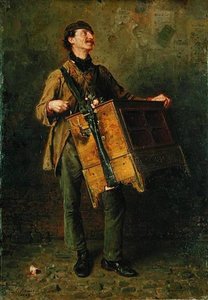
Beyond the grand communal scenes, Knaus excelled in capturing the intimate and the somber. His ability to depict poverty with dignity is evident in works like The Hurdy-gurdy Man, where captivating detail and thoughtful tones evoke a sense of respect for the struggles of the street musician. This mastery of atmosphere—using a palette rich in browns, ochres, and reds—allowed him to create interiors that feel warm, inviting, and deeply lived-in. His later works also explored more classical themes, including a series of "Idyls" featuring nudes in a classical style, demonstrating the breadth of his technical range and his ability to navigate between the gritty realism of contemporary life and the idealized beauty of classical tradition.

Legacy and Academic Eminence

As his career progressed, Knaus’s influence extended far beyond the canvas and into the very institutions that shaped future generations of artists. His professional journey took him through Berlin, where he practiced for several years, and eventually led to his appointment as a professor at the Royal Prussian Academy in Berlin. This position solidified his status not just as a creator of beautiful images, but as a pillar of the academic art world. His later period produced some of his most enduring works, including The Holy Family and The Road to Ruin, both of which are now held in prestigious collections such as the Metropolitan Museum of Art in New York.

The historical significance of Ludwig Knaus resides in his role as a bridge between eras. While he emerged from the traditions of the Düsseldorf school, his work resonated with the rising tide of Realism and Naturalism—movements that sought to reject the dreamlike haze of Romanticism in favor of unvarnished truth. Through his meticulous attention to detail and his profound respect for the subject matter, Knaus provided a visual record of the cultural values of his time: the dignity of labor, the warmth of domesticity, and an enduring connection to the natural world. His legacy remains etched in the vibrant, lifelike quality of his paintings, which continue to offer viewers a poignant glimpse into the soul of nineteenth-century Europe.