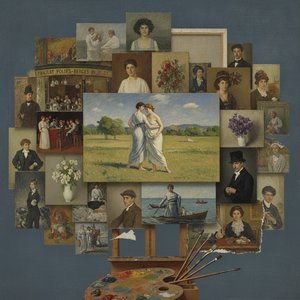
The Quiet Observer of Dijon
Born in 1847 in Dijon, France, Louis Mettling grew up in a household with English parents. His early years in the Côte-d'Or region provided a foundation for a life spent observing the subtle shifts of light and shadow. He eventually moved toward formal training, studying at the École des Beaux-Arts in Lyons. It was there that he became a pupil of Alexandre Cabanel, a connection that helped shape his approach to the human form and the structure of his compositions. His hands were often stained with oil as he worked in studios located in Neuilly-sur-Seine and Paris, focusing on the textures of wood and paper.
His work often looks backward to the techniques of the old Dutch Masters. He had a way of handling oil on wood and oil on paper laid down on panel that felt grounded and heavy. He did not seek the fleeting trends of his era, preferring instead the steady weight of classical style. His subjects were often found in the quiet corners of life:
Recognition and Technique
Mettling’s presence in the Parisian art scene became established through the Salon. He first exhibited there in 1880. His ability to handle light and subject matter earned him recognition from the institutions of the time. He received an honorable mention at the 1888 Salon and another at the 1889 Exposition Universelle in Paris. These were not mere accolades; they were markers of a painter who had mastered the technical demands of his chosen subjects, from the delicate skin of a young lady contemplating in a garden to the rugged features of a bearded man.
There is a specific way he approached his materials. He often worked on small scales, such as pieces measuring only 5 5/8 x 4 1/4 inches, where every brushstroke had to be deliberate. Whether he was painting a woman cooking at a stove or a boy's head, he maintained a focus on the physical reality of the scene. He died in Neuilly-sur-Seine, France, in 1904, leaving behind a body of work that remains rooted in the traditions of the masters he admired.
Vprašanja in odgovori
Kje lahko vidim barvni profil del Louis Mettling?
Barvni profil del opusov umetnika Louis Mettling je prikazan na njegovi strani Genom palete.
Koliko umetnin umetnika Louis Mettling je na voljo za ogled?
Na strani Vsi umetniški slogi si lahko ogledate 5 umetnin del umetnika Louis Mettling.
Ali lahko raziskujem dela umetnika Louis Mettling po barvnem spektru?
Stran Spektralni pregled razvršča dela umetnika Louis Mettling po barvah.
Koliko so priljubljena dela umetnika Louis Mettling?
Statistika o delih umetnika Louis Mettling je na njegovi strani Statistika.