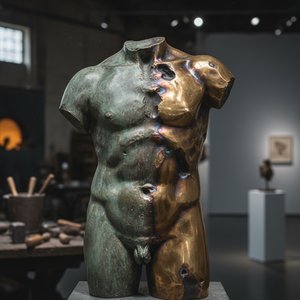
The Bronze Legacy of Jim Brothers: Sculpting the American Spirit
In the quiet landscapes of the Kansas Flint Hills, where the prairie winds whisper through ancient roots, the artistic soul of Jim Brothers began to take shape. Born on August 15, 1941, in Eureka, Kansas, Brothers was a man whose life and work were deeply intertwined with the textures of the American experience. His journey was one of profound connection—to the land, to history, and to the heavy, silent weight of memory. While his early years were spent exploring the natural world, his creative path was guided by an intellectual curiosity that sought to find the eternal within the ephemeral. Through his mastery of bronze, he did not merely create figures; he breathed life into the very concept of remembrance, transforming cold metal into vessels of courage and sacrifice.
The development of Brothers’ technique was a meticulous evolution of skill and sentiment. After pursuing studies at Phillips University and later honing his craft through a Master’s program at the University of Kansas, he moved beyond the boundaries of commercial illustration to embrace the monumental. He found himself deeply moved by the expressive power of Auguste Rodin, particularly the way the master could convey internal psychological struggle through textured surfaces and dynamic forms. This influence became a cornerstone of his sculptural language. Brothers learned to manipulate bronze so that it could capture not just the physical likeness of a hero, but the invisible tension of a moment—the breath held before a charge, or the solemn stillness of a soldier in repose.
Monuments of Memory and National Significance
The true magnitude of Jim Brothers’ contribution to American art is best understood through his public commissions, which serve as permanent anchors for national reflection. His work transcends the boundaries of a gallery, existing instead in the shared spaces of civic life where history is honored. Perhaps his most poignant achievement lies in the National D-Day Memorial in Bedford, Virginia. Here, a series of six bronze sculptures—including evocative pieces such as Across The Beach and Death On The Shore—recreate the harrowing intensity of the Normandy landings. These works do not merely depict battle; they invite the viewer to witness the visceral reality of heroism and the heavy cost of freedom.
His reach extended into the very heart of the nation's capital, where his sculptures stand as silent sentinels in Washington D.C. At the VFW Centennial Plaza, his work captures the dignified essence of citizenship, while his life-sized depiction of Dwight D. Eisenhower in the U.S. Capitol Rotunda commands a profound respect for leadership and duty. His ability to navigate various historical scales—from the intimate tribute to the playwright William Inge to the sweeping narratives of military valor—demonstrates a rare versatility. Whether sculpting the legendary Mark Twain in Connecticut or honoring the pioneers of his native Kansas, Brothers possessed an uncanny ability to bridge the gap between the individual human story and the grand tapestry of American history.
A Life Defined by Connection and Craft
Beyond the bronze and the pedestal, Jim Brothers lived a life characterized by a deep-seated passion for tradition and community. He was a man of many layers: a teacher who inspired young minds in Midwestern schools, a commercial illustrator, and even a founding member of the Alferd Packer Memorial String Band, reflecting his enduring love for old-time American music. This connection to cultural roots provided the emotional reservoir from which his art flowed. Even as he faced his final days in Lawrence, Kansas, his dedication to his craft remained unbroken, completing a tribute to William Inge just days before his passing in 2013.
The legacy of Jim Brothers remains etched in the landscapes he helped immortalize. His sculptures continue to serve as:
- Touchstones of History: Providing physical locations for the world to congregate and remember pivotal moments like D-Day.
- Embodiments of Emotion: Using the rugged texture of bronze to communicate the complexities of human grief, bravery, and triumph.
- Cultural Anchors: Linking the local heritage of the Kansas plains to the national identity of the United States through monumental public art.
Vprašanja in odgovori
Ali je na voljo 3D virtualni ogled del Jim Brothers?
3D muzej umetnika Jim Brothers je stran, ki v virtualni trodimenzionalni galeriji prikazuje umetnikova dela.
Kako lahko spremljam dela umetnika Jim Brothers po letih?
Raziskati lahko dela umetnika Jim Brothers v kronološkem vrstnem redu na njegovi strani Zgodovinski pregled del.
V katerem zgodovinskem obdobju je delal/a Jim Brothers?
Jim Brothers je delal v obdobju Modern. To obdobje umetnikovo dejavnost umešča v zgodovinski okvir.
Kje so dela umetnika Jim Brothers razvrščena po umetniškem slogu?
Umetnostne smernice, v katerih je delal Jim Brothers, si lahko ogledate na strani Vsi umetnostni slogi umetnika, ki dela dela razvrščena po umetnostnim smernicam.
Kje so dela umetnika Jim Brothers razvrščena po barvni paleti?
Stran Po barvnih paletah grupirá dela umetnika Jim Brothers po njihovih barvnih paletah.
Kje so dela umetnika Jim Brothers, razvrščena po tematikah?
Delo umetnika Jim Brothers lahko raziskujete po temah na njegovi strani Atlas motivov.
Katera dela umetnika Jim Brothers so najbolj obiskovana?
Statistika o delih umetnika Jim Brothers je na njegovi strani Statistika.
Kje lahko ogledam vse umetniške dela umetnika Jim Brothers?
Vsa dela umetnika Jim Brothers na platformi ta spletna stran si lahko ogledate na njegovi strani Vsi umetniški slogi.