A Life of Lines and Architecture
Jerzy Gelbard lived a life defined by the structural and the graphic. Born in Warsaw, Poland, he moved through the early decades of the twentieth century as a man of many disciplines: an architect, painter, graphic designer, and illustrator. His education was rooted in the rigorous traditions of both the Faculty of Architecture at the Warsaw University of Technology and the École des Beaux-Arts in Paris. This dual training allowed him to navigate the space between the permanence of stone and the fleeting impact of a printed poster.
In the 1920s, his professional focus expanded into the realm of visual communication. Alongside Tadeusz Gronowski and Antoni Borman, he operated the Plakat advertising studio, an atelier that brought fresh energy to Polish graphic design. His work during this era was not limited to paper; he contributed to the preparation of the Polish pavilion for the 1925 International Exhibition of Modern and Industrial Decorative Arts in Paris. This period marked a high point of creative collaboration, as he worked with a new generation of designers to shape the visual identity of a modernizing nation.
The Built Environment
Beyond the ephemeral nature of posters, Gelbard sought to leave a physical mark on Warsaw. Alongside Roman Sigalin, he established the architectural bureau Biuro Projektów Jerzy Gelbard i Roman Sigalin – Architekci SARP. Their partnership focused on the practical and the aesthetic, producing industrial buildings, villas, and modernist houses. They were particularly noted for designing luxury tenement houses characterized by distinctive bay facades that altered the streetscapes of the city.
His architectural practice was deeply intertwined with the social fabric of Warsaw. The work produced in his studio reflected the shifting urban landscape of the interwar period, a time of significant growth and stylistic experimentation. His ability to balance the functional requirements of industrial design with the elegance of residential architecture demonstrated a versatile technical command.
A Final Chapter
The trajectory of Gelbard’s life was abruptly altered by the onset of war. A participant in the Polish-Bolshevik war and a volunteer in the First Heavy Artillery Regiment of the Polish Legions, his later years were marked by the profound hardships of occupation. From 1940, he lived within the Warsaw ghetto, later attempting to survive on the "Aryan side" of the city.
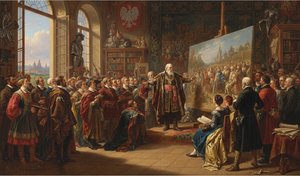
The end of his life was as heavy as the history he inhabited. Following his arrest by German forces, he was held in both the Pawiak and Majdanek concentration camps. He died in 1944, a casualty of the era's violence. While much of his physical work remains tied to the vanished streets of pre-war Warsaw, pieces such as The Great Annual Concert, held now in the Warsaw National Museum, remain as fragments of a lost professional world.
Vprašanja in odgovori
Kje se je rodil/a Jerzy Gelbard in v kateri državi?
Jerzy Gelbard se je rodil/a v mestu Warsaw v državi Poland.
Kakšna čustva izražajo dela umetnika Jerzy Gelbard?
Na strani Soba razpoloženj umetnika Jerzy Gelbard so umetniška dela razvrščena glede na vzdušje.
V katerem zgodovinskem obdobju je delal/a Jerzy Gelbard?
Jerzy Gelbard je deloval v obdobju Modern. To obdobje umetnikovo dejavnost umešča v zgodovinski okvir.