The Quiet Precision of the Hague School
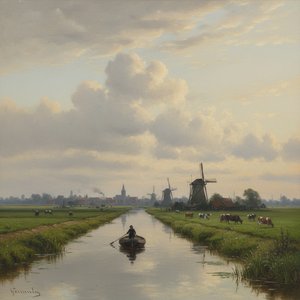
Herman Johannes van der Weele did not merely observe the Dutch landscape; he documented its functional reality. Born in Middelburg, Netherlands, his early life was split between the technical demands of his role as a special inspector of the sea and harbor works in Zeeland and the disciplined study of art. This dual existence gave his work a grounded, structural quality that many of his contemporaries lacked. He moved to The Hague at age twenty to study at the Art Academy, a move that placed him directly in the orbit of the second generation of the Hague School. His compositions possess a deliberate simplicity, a trait that suggests a mind more interested in the mechanics of a scene than in unnecessary ornamentation.
His technical repertoire was broad, moving between oil on canvas, watercolor, and etching. He was not a specialist in a single medium but a practitioner who used the right tool for the specific light or texture he encountered. His subjects were the repetitive, essential rhythms of rural life:
This focus on the mundane was not a lack of ambition. It was a choice of subject matter that prioritized the weight of the landscape over the drama of the individual. He found his most consistent inspiration in the Veluwe, specifically around Nunspeet, where the heathlands provided a stark, honest backdrop for his studies of wood carts and grazing animals.
A Network of Influence and Industry
Van der Weele’s position in the Dutch art scene was defined by his proximity to the heavyweights of his era. He was a member of Pulchri Studio and maintained a social circle that included George Hendrik Breitner and Pieter ter Meulen. His relationship with Breitner was significant enough that Breitner dedicated his Self-portrait With Lorgnette to him. Even the broader connections of his time, including contacts with Van Gogh, suggest a man deeply embedded in the professional fabric of the Netherlands. He was not an isolated figure but a central node in a network of painters and graphic artists.
His work achieved a level of commercial success that extended far beyond the borders of the Netherlands. He earned significant income from the sale of his paintings in Canada and the United States, proving that his depictions of Dutch pastoral life had a market that transcended local sentiment. While he was a painter, his output as a draftsperson and watercolorist ensured he remained a constant presence in the visual culture of the late nineteenth and early twentieth centuries. He died in The Hague in 1930, leaving behind a body of work that remains a concrete record of a specific, disappearing way of life.
Vprašanja in odgovori
Ali lahko dela umetnika Herman Johannes van der Weele pregledam po umetnostnim smernicam?
Umetnostne smernice, v katerih je deloval Herman Johannes van der Weele, si lahko ogledate na strani Vsi umetnostni slogi umetnika, kjer so njegova dela razvrščena po umetnostnim smernicam.
Kje lahko najdem podatke o delih umetnika Herman Johannes van der Weele?
Za umetnika Herman Johannes van der Weele je na voljo stran Statistika, ki prikazuje statistiko o njegovih umetniških delih na platformi ta spletna stran.
Ali lahko dela umetnika Herman Johannes van der Weele pregledam po tehniki?
Vsa dela umetnika Herman Johannes van der Weele v določeni tehniki si lahko ogledate na njegovi strani Vse tehnike.