Portret Giulio Romano

100 najbolj znanih slik umetnika Giulio Romano, vsaka popolnoma edinstvena

Posodobljeno november 2026 · uvrščeno glede na naš skoraj priljubljenosti (iskanja, obiske in naročila za vsako delo) · 114 del v našem katalogu avtorja Giulio Romano

Kratek opis

Svod: Zbor bogov okoli Jupiterjevega prestola (1532) je slika umetnika Giulio Romano, ki pritegne največ pogledov. Nato se pogled smeri k View of the Sala dei Giganti (vault and south wall) (1526) in Tapestry with Playing Putti (1545). Med 114 dela umetnika Giulio Romano v našem katalogu so ta 100 najbolj znana; vsako je edinstven original, predstavljen z letnico nastanka, muzejem in razlogom za njegovo nečasenost.

1499 – 1546, Rim Manierizem Največ del: Palazzo del Tè

10 najboljjših slik umetnika Giulio Romano skozi oči galerije

2
View of the Sala dei Giganti (vault and south wall) (1526) avtorja Giulio Romano

View of the Sala dei Giganti (vault and south wall)

1526 · Fresco · Palazzo del Tè, Mantova

To gaze upon this magnificent fresco, View of the Sala dei Giganti (vault and south wall), is to step directly into the vibrant heart of the High Renaissance. Painted in 1526 by the masterful hand of Giulio Romano, this work transcends mere decoration; it is a profound narrative tapestry woven from human drama, natural vitality, and divine symbolism. The scene explodes with life, drawing the viewer into a monumental gathering…

3
Tapestry with Playing Putti (1545) avtorja Giulio Romano

Tapestry with Playing Putti

1545 · Tapestry · Museo Poldi Pezzoli, Milano

To gaze upon this depiction of a tapestry with playing putti is to step directly into an idealized moment plucked from the heart of the Italian Renaissance. It is more than just a painting; it is a captured breath of youthful exuberance, rendered with the masterful touch characteristic of Giulio Romano. The scene unfolds as a vibrant pastoral tableau, where several cherubic figures—the beloved putti—engage in playful revelry. Their presence…

4
Allegory of the Virtues of Federico II Gonzaga (1531) avtorja Giulio Romano

Allegory of the Virtues of Federico II Gonzaga

1531 · Fresco · J. Paul Getty Museum, Los Angeles

To stand before an image like the Allegory of the Virtues of Federico II Gonzaga is to step directly into the vibrant, intellectual heart of the Italian High Renaissance transitioning into Mannerism. This monumental work, executed in 1531 by Giulio Romano, is far more than a mere depiction of figures; it is a carefully orchestrated philosophical statement rendered in pigment and plaster. The scene unfolds with an almost theatrical richness,…

5
The Lovers (1525) avtorja Giulio Romano

The Lovers

1525 · Oil On Canvas · Ermitaž, Sankt Peterburg

Giulio Romano’s “The Lovers,” painted around 1525, isn't merely a depiction of intimacy; it’s a meticulously crafted tableau brimming with symbolism and echoing the complex currents of the High Renaissance. Born Giulio Pippi in Rome around 1499, Romano swiftly ascended through the ranks of Raphael’s studio, absorbing the master’s classical ideals while simultaneously forging his own distinctive Mannerist style – a style characterized by heightened emotion, distorted forms, and an…

6
Adoration of the Shepherds (detail) (1535) avtorja Giulio Romano

Adoration of the Shepherds (detail)

1535 · Oil · Louvre, Pariz

This detail from 1535 captures a fragment of a larger religious narrative, focusing on the human response to a divine presence. A central figure, distinguished by a large staff topped with a cross, anchors the composition. The arrangement of figures creates a sense of depth through overlapping forms and varying scales, drawing the eye from the immediate foreground into a complex, crowded space. The composition avoids the static balance of…

7
The Birth of Bacchus (1533) avtorja Giulio Romano

The Birth of Bacchus

1533 · Acrylic On Canvas · J. Paul Getty Museum, Los Angeles

Giulio Romano's "The Birth of Bacchus," a monumental charcoal and chalk drawing from 1533, isn’t merely a depiction of a mythological scene; it’s a visceral exploration of human drama, a raw sketch brimming with energy and symbolic weight. Born Giulio Pippi in Rome around 1499, Romano emerged as a pivotal figure within the waning embers of the High Renaissance, swiftly absorbing the influence of Raphael while forging his own distinctive…

8
Flaying of Marsyas (1525) avtorja Giulio Romano

Flaying of Marsyas

1525 · Oil On Canvas · Louvre, Pariz

Giulio Romano’s “Flaying of Marsyas” isn't merely a depiction of a mythological punishment; it’s a visceral embodiment of struggle, humiliation, and the brutal intersection of divine power and mortal defiance. Painted in 1525-35 during his tenure as court artist for Duke Federico Gonzaga of Mantua, this monumental fresco – now meticulously reproduced on canvas – plunges the viewer directly into the heart of Ovid’s *Metamorphoses*. The story itself is a…

9
Victory, Janus, Chronos, and Gaea (1532) avtorja Giulio Romano

Victory, Janus, Chronos, and Gaea

1532 · Acrylic On Canvas · J. Paul Getty Museum, Los Angeles

A Tapestry of Time and Transformation: Giulio Romano’s “Victory, Janus, Chronos, and Gaea” Giulio Romano's "Victory, Janus, Chronos, and Gaea," painted in 1532-1534 during his illustrious tenure as court artist for Federico II Gonzaga of Mantua, is more than just a visually arresting fresco; it’s a profound meditation on the cyclical nature of time, the duality of existence, and the very essence of Roman mythology. Born Giulio Pippi in Rome…

10
View of the Palazzo del Tè (1526) avtorja Giulio Romano

View of the Palazzo del Tè

1526 · Acrylic On Canvas · Palazzo del Tè, Mantova

A Vision of Renaissance Grandeur: Exploring Giulio Romano’s Palazzo del Té Giulio Romano's *View of the Palazzo del Té* stands as a testament to the zenith of Mannerist art and architectural ambition—a project conceived by Federico Gonzaga, Duke of Mantua, between 1526 and 1534. More than just a building, it embodies an entire worldview: a deliberate rejection of linear perspective and idealized beauty in favor of dramatic illusionism and psychological…

Slavna platna umetnika Giulio Romano, od številk 11 do 100

11Evangelist symbols (1522) avtorja Giulio RomanoEvangelist symbols1522 · Kunsthistorisches Museum 12View of the Salone dei Cavalli (1526) avtorja Giulio RomanoView of the Salone dei Cavalli1526 13The Old Woman and Vulcan, Tribute to Apollo (1526) avtorja Giulio RomanoThe Old Woman and Vulcan, Tribute to Apollo1526 14Nude Child with Open Arms avtorja Giulio RomanoNude Child with Open ArmsGalleria degli Uffizi 15The Holy Family (1520) avtorja Giulio RomanoThe Holy Family1520 · J. Paul Getty Museum 16An Allegory of Immortality (1540) avtorja Giulio RomanoAn Allegory of Immortality1540 · Detroit Institute of Arts 17The Holy Family, St John with a small Bird in his Hand (1530) avtorja Giulio RomanoThe Holy Family, St John with a small Bird in his Hand1530 · Statens Museum For Kunst 18The Holy Family with the Infant Saint John the Baptist (1520) avtorja Giulio RomanoThe Holy Family with the Infant Saint John the Baptist1520 · Scottish National Gallery 19Madonna and Child with the Infant St. John (1516) avtorja Giulio RomanoMadonna and Child with the Infant St. John1516 20The Virgin and Child (1518) avtorja Giulio RomanoThe Virgin and Child1518 · Apsley House 21Tarquin and Lucretia (1536) avtorja Giulio RomanoTarquin and Lucretia1536 · Palazzo Ducale 22'The Horse ''Morel favorito''' (1526) avtorja Giulio Romano'The Horse ''Morel favorito'''1526 23St. John the Baptist in the Wilderness (1520) avtorja Giulio RomanoSt. John the Baptist in the Wilderness1520 24Nurture of Jupiter (1533) avtorja Giulio RomanoNurture of Jupiter1533 · Blickling Hall 25Group of three lictors (1530) avtorja Giulio RomanoGroup of three lictors1530 · Narodni muzej v Varšavi 26Tapestry Cartoon: Two Heads from the Massacre of the Innocents (1522) avtorja Giulio RomanoTapestry Cartoon: Two Heads from the Massacre of the Innocents1522 · Scottish National Gallery 27Bacchus and Ariadne (1530) avtorja Giulio RomanoBacchus and Ariadne1530 · Statens Museum For Kunst 28Vertumnus and Pomona (1530) avtorja Giulio RomanoVertumnus and Pomona1530 · Statens Museum For Kunst 29Female nude, half figure (1527) avtorja Giulio RomanoFemale nude, half figure1527 30Vaulted ceiling (8) (1526) avtorja Giulio RomanoVaulted ceiling (8)1526 31Fresco on the east wall (detail) (1532) avtorja Giulio RomanoFresco on the east wall (detail)1532 32View of the Sala di Psiche (west wall) (1526) avtorja Giulio RomanoView of the Sala di Psiche (west wall)1526 33Fresco on the south wall (detail) (9) (1532) avtorja Giulio RomanoFresco on the south wall (detail) (9)1532 34Jupiter Seducing Olympias (1526) avtorja Giulio RomanoJupiter Seducing Olympias1526 35Self-portrait (1540) avtorja Giulio RomanoSelf-portrait1540 36Tomb of Pietro Strozzi (1529) avtorja Giulio RomanoTomb of Pietro Strozzi1529 · Sant'Andrea 37Virgin and Child with the Infant St John (1523) avtorja Giulio RomanoVirgin and Child with the Infant St John1523 · Galerija Borghese 38Façade (1526) avtorja Giulio RomanoFaçade1526 · Palazzo del Tè 39The Madonna and Child with Saint John the Baptist (1522) avtorja Giulio RomanoThe Madonna and Child with Saint John the Baptist1522 · Walters Art Museum 40The Fall of the Gigants from Mount Olympus avtorja Giulio RomanoThe Fall of the Gigants from Mount Olympus 41Chariot of the Sun (1526) avtorja Giulio RomanoChariot of the Sun1526 42Frieze (detail) (1532) avtorja Giulio RomanoFrieze (detail)1532 43Hunting Scene (1527) avtorja Giulio RomanoHunting Scene1527 44Hunting Scene (1527) avtorja Giulio RomanoHunting Scene1527 45Polyphemus (1526) avtorja Giulio RomanoPolyphemus1526 46Ceiling decoration (detail) (12) (1527) avtorja Giulio RomanoCeiling decoration (detail) (12)1527 47View of the Sala di Psiche (north and east walls) (1526) avtorja Giulio RomanoView of the Sala di Psiche (north and east walls)1526 48View of the Sala di Psiche (south wall) (1526) avtorja Giulio RomanoView of the Sala di Psiche (south wall)1526 49Psyche's Second Task (River Deity) (1526) avtorja Giulio RomanoPsyche's Second Task (River Deity)1526 50Vaulted ceiling (detail) (10) (1526) avtorja Giulio RomanoVaulted ceiling (detail) (10)1526 51Vaulted ceiling (detail) (18) (1526) avtorja Giulio RomanoVaulted ceiling (detail) (18)1526 52Psyche Appealing in Vain to Juno (1526) avtorja Giulio RomanoPsyche Appealing in Vain to Juno1526 53Portrait of a Woman (detail) (1531) avtorja Giulio RomanoPortrait of a Woman (detail)1531 · Kraljeva zbirka 54View of the Sala dei Giganti (south and west walls) (1532) avtorja Giulio RomanoView of the Sala dei Giganti (south and west walls)1532 55View of the Sala dei Giganti (south wall) (1532) avtorja Giulio RomanoView of the Sala dei Giganti (south wall)1532 56The Prisoners (1527) avtorja Giulio RomanoThe Prisoners1527 57View of the Sala di Psiche (east wall) (1526) avtorja Giulio RomanoView of the Sala di Psiche (east wall)1526 58Vault: The Assembly of Gods around Jupiter's Throne (detail) (1532) avtorja Giulio RomanoVault: The Assembly of Gods around Jupiter's Throne (detail)1532 59Ceiling decoration (detail) (11) (1527) avtorja Giulio RomanoCeiling decoration (detail) (11)1527 60Fresco on the north wall (detail) (1532) avtorja Giulio RomanoFresco on the north wall (detail)1532 61Vaulted ceiling (detail) (17) (1526) avtorja Giulio RomanoVaulted ceiling (detail) (17)1526 62Vaulted ceiling (detail) (19) (1526) avtorja Giulio RomanoVaulted ceiling (detail) (19)1526 63Emperor Alexander (1532) avtorja Giulio RomanoEmperor Alexander1532 64Coat-of-arms (1532) avtorja Giulio RomanoCoat-of-arms1532 65View of the Sala dei Giganti (west wall) (1532) avtorja Giulio RomanoView of the Sala dei Giganti (west wall)1532 66River Landscape with Springs (1526) avtorja Giulio RomanoRiver Landscape with Springs1526 67View of the Salone dei Cavalli (1526) avtorja Giulio RomanoView of the Salone dei Cavalli1526 68Fresco on the south wall (detail) (1532) avtorja Giulio RomanoFresco on the south wall (detail)1532 69Vaulted ceiling (detail) (16) (1526) avtorja Giulio RomanoVaulted ceiling (detail) (16)1526 70Tribute to Apollo (1526) avtorja Giulio RomanoTribute to Apollo1526 71Vaulted ceiling (1526) avtorja Giulio RomanoVaulted ceiling1526 72View of the Sala dei Giganti (north wall) (1532) avtorja Giulio RomanoView of the Sala dei Giganti (north wall)1532 73View of the Sala dei Giganti (east wall) (1532) avtorja Giulio RomanoView of the Sala dei Giganti (east wall)1532 74Ceiling decoration (1527) avtorja Giulio RomanoCeiling decoration1527 75Cupid and Psyche (1526) avtorja Giulio RomanoCupid and Psyche1526 76Design for a Saltcellar (1524) avtorja Giulio RomanoDesign for a Saltcellar1524 77Fresco on the south wall (detail) (12) (1532) avtorja Giulio RomanoFresco on the south wall (detail) (12)1532 78Fresco on the north wall (detail) (1532) avtorja Giulio RomanoFresco on the north wall (detail)1532 79Mars Chasing Adonis from Venus's Pavilion (1526) avtorja Giulio RomanoMars Chasing Adonis from Venus's Pavilion1526 80Vault: The Assembly of Gods around Jupiter's Throne (detail) (1532) avtorja Giulio RomanoVault: The Assembly of Gods around Jupiter's Throne (detail)1532 81Fresco on the south wall (detail) (10) (1532) avtorja Giulio RomanoFresco on the south wall (detail) (10)1532 82The Old Woman and Vulcan (1526) avtorja Giulio RomanoThe Old Woman and Vulcan1526 83Ceiling (detail) (1526) avtorja Giulio RomanoCeiling (detail)1526 84Tribute to Apollo (1526) avtorja Giulio RomanoTribute to Apollo1526 85Ajax Defends Patroclus's Corps (1538) avtorja Giulio RomanoAjax Defends Patroclus's Corps1538 · Palazzo Ducale 86View of the Sala di Troia (10) (1536) avtorja Giulio RomanoView of the Sala di Troia (10)1536 87View of the Sala di Troia (12) (1538) avtorja Giulio RomanoView of the Sala di Troia (12)1538 88Ajax Defends Patroclus's Corps (1538) avtorja Giulio RomanoAjax Defends Patroclus's Corps1538 89View of the Sala di Troia (11) (1536) avtorja Giulio RomanoView of the Sala di Troia (11)1536 90Façade and courtyard view (1526) avtorja Giulio RomanoFaçade and courtyard view1526 · Palazzo del Tè 91Monteluce madonna avtorja Giulio RomanoMonteluce madonna 92Venus and Vulcan avtorja Giulio RomanoVenus and Vulcan 93Satyr and Boy avtorja Giulio RomanoSatyr and Boy 94Copy after Giulio Romano (1536) avtorja Giulio RomanoCopy after Giulio Romano1536 · Cleveland Museum of Art 95Virgin with the Child (1520) avtorja Giulio RomanoVirgin with the Child1520 · Galleria degli Uffizi 96Triumph of Titus and Vespasian (1537) avtorja Giulio RomanoTriumph of Titus and Vespasian1537 · Louvre 97Study for the Holy Family (1518) avtorja Giulio RomanoStudy for the Holy Family1518 · Louvre 98Banquet of Cupid and Psyche avtorja Giulio RomanoBanquet of Cupid and PsychePalazzo del Tè 99Saint Mary Magdalene borne by Angels avtorja Giulio RomanoSaint Mary Magdalene borne by AngelsNational Gallery 100The Circumcision avtorja Giulio RomanoThe CircumcisionLouvre

Slavna platna umetnika Giulio Romano, razdeljena po obdobjih

Motivi, ki so očarali Giulio Romano

Četiri teme, ki se v teh originalih najpogosteje ponavljajo, vsaka z svojim vrhunskim primerom.

Muzeji, ki hranijo originala umetnika Giulio Romano

8 muzejev, ki vsebujo največ slik na tej strani.

Muzej Mesto Sloga Giulio Romano Slike iz tega seznama
Palazzo del Tè, MantovaPalazzo del Tè Mantova 6 View of the Sala dei Giganti (vault and south wall), View of the Palazzo del Tè, Façade
Louvre, ParizLouvre Pariz 6 Adoration of the Shepherds (detail), Flaying of Marsyas, Triumph of Titus and Vespasian
J. Paul Getty Museum, Los AngelesJ. Paul Getty Museum Los Angeles 5 Allegory of the Virtues of Federico II Gonzaga, The Birth of Bacchus, Victory, Janus, Chronos, and Gaea
Statens Museum For Kunst, KopenhagenStatens Museum For Kunst Kopenhagen 3 The Holy Family, St John with a small Bird in his Hand, Bacchus and Ariadne, Vertumnus and Pomona
Galleria degli Uffizi, FireneGalleria degli Uffizi Firene 2 Nude Child with Open Arms, Virgin with the Child
Scottish National Gallery, EdinburghScottish National Gallery Edinburgh 2 The Holy Family with the Infant Saint John the Baptist, Tapestry Cartoon: Two Heads from the Massacre of the Innocents
Palazzo Ducale, MantuaPalazzo Ducale Mantua 2 Tarquin and Lucretia, Ajax Defends Patroclus's Corps
Kraljeva zbirka, LondonKraljeva zbirka London 2 Portrait of a Woman (detail)

Giulio Romano skozi desetetja: vsak unikatni original za vsako obdobje

Delo po desetletjih

Izberite desetletje, da si ogledate original, ki ga opredeljuje.

Slike umetnika Giulio Romano: vprašanja za galerijo

Katero je najbolj znano delo umetnika Giulio Romano?Razkriti odgovor

Svod: Zbor bogov okoli Jupiterjevega prestola (1532). Zatem sledeta View of the Sala dei Giganti (vault and south wall) (1526) in Tapestry with Playing Putti (1545).

Pri kateri dobe je Giulio Romano ustvaril Svod: Zbor bogov okoli Jupiterjevega prestola?Razkriti odgovor

33 let: delo Svod: Zbor bogov okoli Jupiterjevega prestola iz leta 1532, Giulio Romano pa je bil/a rojen/a leta 1499.

Katera desetina slik avtorja Giulio Romano je najbolj znana?Razkriti odgovor

Svod: Zbor bogov okoli Jupiterjevega prestola, View of the Sala dei Giganti (vault and south wall), Tapestry with Playing Putti, Allegory of the Virtues of Federico II Gonzaga, The Lovers, Adoration of the Shepherds (detail), The Birth of Bacchus, Flaying of Marsyas, Victory, Janus, Chronos, and Gaea in View of the Palazzo del Tè. Zgornja lestica prikazuje leto nastanka in muzej za vsako delo.

Koliko je znanih del avtorja Giulio Romano?Razkriti odgovor

Naš katalog vsebuje 114 del avtorja Giulio Romano, datiranih od 1516 do 1545.

Kje si lahko ogledate najslavnejše originale umetnika Giulio Romano?Razkriti odgovor

Večini v Palazzo del Tè (Mantova), Louvre (Pariz) in J. Paul Getty Museum (Los Angeles). Zgoraj navedena tabela muzejev vsebuje njihov celoten seznam.

V katerem obdobju je Giulio Romano ustvaril svoja najbolj znana dela?Razkriti odgovor

V obdobju 1520s: 50 od 100 del na tej strani je bilo izdelovanih takrat, med njimi pa View of the Sala dei Giganti (vault and south wall).

Katero znano sliko je naslikal Giulio Romano najprej in katero najpozdneje?Razkriti odgovor

Na tej strani je najstarejše delo iz Madonna and Child with the Infant St. John (1516) in najstarejše iz Tapestry with Playing Putti (1545).

Katere teme je Giulio Romano najprej ravnate?Razkriti odgovor

Buildings (20), Woman (13) in Scenes (12), na 100 delih na tej strani.

S katerimi materiali je Giulio Romano najpogosteje slikal?Razkriti odgovor

Fresco, za 10 od 100 del na tej strani.

Kateri umetniški slog predstavlja delo umetnika Giulio Romano?Razkriti odgovor

Manierizem, glede na originala na tej strani.

Katere originale Giulio Romano lahko vidim v muzeju Palazzo del Tè?Razkriti odgovor

View of the Sala dei Giganti (vault and south wall), View of the Palazzo del Tè in Façade: v muzeju Palazzo del Tè, Mantova se nahaja 5 del z te strani.

Giulio Romano: portret umetnika

Rimski začetki in vajništvo pri mojstru

Giulio Romano, rojen Giulio Pippi okoli leta 1499 v Rimu, se je pojavil v obdobju izjemne umetniške fermentacije. Podrobnosti o njegovem zgodnjem življenju ostajajo nekoliko nejasne, vendar je znano, da je hitro zašel v krog Rafaela, nedvomno najbolj slavnega slikarja visokega renesansa. To vajništvo se je izkazalo za ključno, saj je oblikovalo ne le njegove tehnične spretnosti, ampak tudi postavilo temelje za njegovo prihodnje stilistične raziskave. Ni bil zgolj studijski pomočnik; Giulio je hitro postal nepogrešljiv sodelavec, prispeval k pomembnim projektom, kot je dekoracija vatikanskih sob – veličastnih prostorov, naročenih s strani papežev Julija II. in Leona X. Njegova roka je prepoznavna na monumentalni freski *Požar v Borgu*, kjer je Rafaelu pomagal upodobiti dramatičen prizor čudežnega posredovanja. Po Rafaelovi prezgodnji smrti leta 1520 je Giulio prevzel odgovornost za dokončanje številnih nedokončanih naročil, vključno z ambiciozno dekoracijo Ville Madama za kardinala Giuliana de' Medicija. Ta zgodnja izpostavljenost velikoprostorskim projektom in zahtevam aristokratskega mecenstva mu je vlila samozavest in ambicije, ki bodo definirale njegovo kasnejšo kariero.

Rojstvo manirizma: Odstop od klasične harmonije

Čeprav globoko ukoreninjen v renesančni tradiciji, se je umetniška pot Giulia Romana kmalu oddaljila od prevladujočega poudarka klasičnega ravnovesja in harmonije. Postal je ključna figura v razvoju manirizma – sloga, za katerega so značilne umetenost, eleganca in pogosto nemirni izkrivljanja oblike. Globoko ga je vplival Michelangelov močan lik in dinamične kompozicije ter splošno umetnostno eksperimentiranje. Giulio se je začel sprejemati asimetrijo, napetost in čustveno intenzivnost v svojem delu. To ni bilo zavrnitev renesančnih idealov toliko kot namerna raziskava njihovih meja, ki presega omejitve naturalizma, da bi ustvaril dela, ki so bila bolj ekspresivna in intelektualno spodbudna. Vedno več je spreminjal Rafaelove načrte in v rimsko umetnost vlival novo občutljivost – izjavo manirizma v velikem merilu. Ta premik je jasno razviden v njegovih risbah, ki odlikujejo izjemna svoboda linije in naklon k dramatičnemu skrajševanju perspektive.

Mojster Mantove: Palazzo Te in arhitektonska inovacija

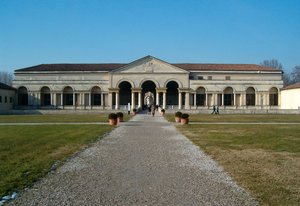
Leta 1524 je Giulio sprejel povabilo Federica Gonzage, vojvode mantovskega, da postane dvorni slikar in arhitekt. To je zaznamovalo prelomnico v njegovi karieri, saj mu je zagotovilo brez primere ustvarjalno svobodo in vire. Postal je odgovoren za vse umetniške dejavnosti znotraj vojvodstva, nadzoroval ne le slike in freske, ampak tudi arhitektonske projekte, vrtove in celo gledališke predstave. Njegov najbolj znan dosežek v tem obdobju je nedvomno Palazzo Te, izjemna podeželska vila, ki je dokaz njegove inovativne genialnosti. Notranjost palače krasijo iluzionistične freske osupljive kompleksnosti in psihološke globine. *Sala dei Giganti* (Dvorana velikanov) na primer prikazuje kaotičen boj med bogovi in velikani, ki potopi gledalca v vrtinec figur in arhitektonskih fragmentov. Ta mojstrska manipulacija prostora in perspektive ustvari poglobljeno izkušnjo, ki je hkrati osupljiva in nemirna. Poleg Palazzo Te se je Giulio lotil tudi pomembnih prenov dvorske palače in katedrale v Mantovi ter pustil neizbrisen pečat na mestni pokrajini.

Zapuščina in trajni vpliv

Giulio Romano je umrl v Mantovi leta 1546 in za seboj pustil zapuščino, ki se je razprostirala daleč onkraj meja Italije. Njegove risbe so bile zelo cenjene med zbiralci, gravure pa, ki temeljijo na njegovem delu – zlasti tiste Marcantonia Raimondija – so igrale ključno vlogo pri širjenju italijanskega umetniškega sloga po Evropi. Bil je tako znan po smrti, da ga William Shakespeare omenja kot edinega "sodobnega" umetnika v drami - dokaz njegove široke slave. Njegov vpliv je mogoče videti v delih številnih naslednjih umetnikov, ki so sprejeli njegove dinamične kompozicije, podolgovate figure in ekspresivno uporabo barv. Čeprav je manirizem sčasoma popustil drugim stilskim gibanjem, ostajajo prispevki Giulia Romana bistveni za razumevanje evolucije zahodne umetnosti. Predstavlja ključni trenutek – prehod od harmoničnih idealov visokega renesansa do bolj kompleksne in čustveno nabojene estetike poznih 16. stoletja. *Njegovo delo še danes očara in izziva gledalce, kar nas opominja na moč umetnosti, da ne samo odraža, ampak tudi oblikuje naše razumevanje sveta.*