Early Life, Family and Training
Cuthbert Edmund Swan entered the world on June 26th, 1870, in Ballyragget, Co Kilkenny, Ireland. He was born into a lineage where the brush and the chisel were the primary languages of the household. His father, John Macallan Swan, R.A., was a celebrated painter and sculptor who had already made his mark through evocative depictions of wildlife and the Scottish landscapes. This familial connection meant that the study of form and the observation of nature were woven into the very fabric of Cuthbert Edmund Swan's upbringing. From his earliest years, he displayed a natural affinity for the creatures of the earth, demonstrating an exceptional talent for drawing and painting animals that suggested a destiny tied to the natural world.
As he grew, his education took him away from the familiar surroundings of Ireland to Seaford College in Sussex. It was during these formative years that he began to refine the raw talent of his youth, honing the technical skills required to translate life into pigment. His ambition eventually led him across the channel to the Académie Julien in Paris. This period of study was transformative, exposing him to the shifting currents of the art world and the nuances of light and color. The lessons learned in the studios of Paris would remain with him, shaping the way he approached the anatomy and spirit of the animals he so dearly loved.
Artistic Career and Style
Swan’s path as a painter took him from the academic rigor of Paris to the bustling art circles of London. During his time in France, he absorbed the influence of the Impressionist movement, which left a lasting mark on his technique. He began to favor luminous color palettes and a sense of atmospheric perspective, seeking to capture the way light and air interact within a scene. This approach allowed him to move beyond mere anatomical sketches, instead focusing on the mood of the natural world. His brushwork became increasingly loose, yet he never lost the ability to ground his subjects in reality through meticulous detail.
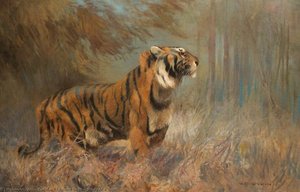
His dedication to the essence of animal behavior led him to join the Feline School, a group of artists including Walter Sickert, Lucien Pissarro, and Robert Bevan. Within this circle, Swan found a community that shared his fascination with the physical presence and movement of animals. His work often balanced the precision of a scientific observer with the expressive energy of a fine artist. He sought to portray the weight of a predator or the quiet stillness of a creature in its habitat, using his brush to convey both the texture of fur and the spirit of the living being.
His ability to blend these elements made him a distinctive voice in the Victorian art landscape. He did not merely paint animals; he studied their character. This focus on the soul of the subject was evident in his various studies of large cats and other wildlife, where the interplay of light and shadow defined the form.
Key Works and Exhibitions
Swan’s presence in the London art scene was marked by a remarkable consistency, evidenced by his frequent appearances at the Royal Academy. He exhibited there approximately 66 times, a feat that speaks to his enduring relevance during the Victorian era. His canvases often sought to capture the raw essence of the wild, moving beyond mere illustration to find the spirit within his subjects. He possessed a particular talent for portraying the heavy, muscular grace of large predators, a skill that earned him a dedicated following among those who sought to see the natural world through a more expressive lens.
His paintings often focused on the quiet tension or the sudden movement of animals in their natural habitats. In works such as "Duke - a study of a lion" and "Jaguars at Play," he explored the character of the great cats, while "Puma and cubs" allowed him to touch upon the more tender, familial aspects of wildlife. He was equally drawn to the drama of the hunt and the struggle for survival, as seen in the striking "Elephant with Dead Tiger" and the intense "Tiger with Prey." Even in his more observational studies, such as "The Old Lion" or "A Leopard," his brushwork remained purposeful and alive.
Beyond the galleries of London, his influence reached into significant collections. His work "On the Watch" finds a home in the Te Whare O Rehua Sarjeant Gallery, while other pieces have been preserved in the Birmingham Museum and Art Gallery and the Llandudno Museum. These collections ensure that his specific vision of the animal kingdom remains accessible to those who study the history of zoological art.
Later Years, Death and Legacy
In his later years, Swan turned his attention toward the instruction of others, finding a steady vocation at the Central School of Arts and Crafts. He spent many years there, dedicating his expertise to the specific study of animal drawing. Through this teaching, he helped shape the technical skills of a new generation of artists, passing on the precision required to render the natural world. His presence in the classroom ensured that his specialized knowledge of zoological forms would persist through his students.
The artist eventually passed away in Hampstead, London, on November 2nd, 1931. His death marked the end of a long career that had spanned over six decades of constant creation and exhibition. Though he left the physical world, his depictions of the animal kingdom remained held in significant collections. His works can still be found within the Birmingham Museum and Art Gallery and the Llandudno Museum, where they continue to represent his specific contribution to the history of British animal painting.