Early Life and Family Background
Aleksey Stepanov was born on 6 May 1858 in Simferopol. His lineage was tied to the military aristocracy; his father belonged to a noble family and served as an officer during the Crimean War. This background provided a specific social standing, yet his early years were defined by sudden instability. His mother died shortly after his birth, leaving the family unit fractured before it had truly established itself.
The loss of his father in 1863 removed the final pillar of his domestic life. At only six years old, Aleksey Stepanov was sent to the Moscow Orphanage for Children from Military Families. This institution, situated on an estate formerly owned by Count Alexey Razumovsky, provided the structure that his biological family could no longer offer. This transition from a noble household to a specialized orphanage shaped the early reality of his existence.
Academic Training and Early Career
Stepanov’s technical foundation was built on precision rather than pure aesthetics. Before committing to fine arts, he entered the Konstantin Surveying Institute, graduating as an official surveyor in 1879. This background in surveying provided a disciplined, observational framework that would later define his approach to the landscape. He moved from technical drafting to formal art training between 1880 and 1883, when he studied at the Moscow School of Painting, Sculpture and Architecture. Under the instruction of Illarion Pryanishnikov and Evgraf Sorokin, he transitioned from the rigid lines of a surveyor to the nuanced demands of academic painting.
His early professional identity was shaped by significant social and editorial connections. During his time at the Moscow School, he met Leonid Sabaneyev, a connection that proved essential for his visibility in the Russian art scene. Between 1883 and 1895, Stepanov provided over a hundred drawings for the magazine Природа и охота. This period of prolific illustration allowed him to experiment with various styles while establishing a presence in the public eye. His work during these years was not merely decorative; it was a rigorous exercise in capturing the natural world through a lens of realism.
Association with the Peredvizhniki
Stepanov’s entry into the Peredvizhniki in 1888 marked a definitive shift toward the realist movement. This group functioned by organizing traveling exhibitions across Russia, a strategy designed to bring art directly to the public rather than confining it to elite academic circles. His presence within this circle aligned him with a specific mission: depicting Russian life through a lens of unflinching realism. His ability to capture the natural world through careful observation earned him immediate recognition, including the acquisition of his work by Pavel Tretyakov shortly after he joined the group.
The trajectory of his career eventually diverged from the Peredvizhniki's core structure. In 1903, Stepanov was part of the group that defected from the movement to establish the Union of Russian Artists. This was not a mere transition but a foundational act, as he became a founder of this new organization. This move signaled a shift in the internal dynamics of Russian art, moving away from the established Peredvizhniki framework toward new collective identities.
- Moose Herd (1888)
Technique and Artistic Style
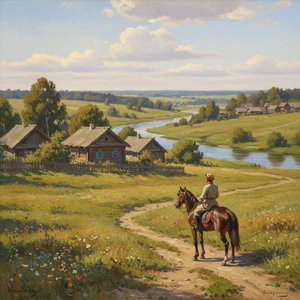
Stepanov’s mature style is defined by a successful synthesis of realism and Impressionist aesthetics. His 1903 trip to Europe, where he encountered the works of Claude Monet and Pierre-Auguste Renoir, fundamentally altered his approach to light and color. He moved away from rigid academicism toward a method that emphasized luminous palettes and the capture of fleeting atmospheric moments. This shift allowed him to depict the Russian landscape not as a static backdrop, but as a living, changing environment. His canvases often blend lyricism with a grounded realism, avoiding sentimentality in favor of a direct, observational truth.
The artist possessed a particular technical command over animal subjects and rural topography. He was especially noted for his skill in painting horses, capturing their form and movement with a precision that satisfied the realist tradition while utilizing Impressionist brushwork. This ability to balance anatomical accuracy with atmospheric texture is evident in his depictions of the countryside. Rather than focusing on grand historical narratives, he concentrated on the quiet dignity of everyday life and the natural world. His work remains significant because it avoids the heavy-handedness of some of his contemporaries, opting instead for a clarity of vision that emphasizes the subtle interplay of light and shadow in rural settings.
Teaching and Academic Career
Stepanov’s influence extended far beyond the canvas and into the institutional structures of Russian art education. His transition from practitioner to educator began when he accepted a position as a lecturer at the School of Fine Arts, an institution operated by Anatoly Gunst. This period established his reputation as a formal instructor capable of translating technical observation into pedagogical method. His ability to communicate the nuances of landscape and genre painting eventually led to a significant appointment at the Moscow School of Painting, following an invitation from Valentin Serov.
His tenure at the Moscow School of Painting was marked by a rise in academic status, culminating in his appointment as a Professor. He held this academic position until 1918, maintaining a consistent presence in the classroom through decades of shifting political and social landscapes. This long-term commitment to the academy ensured that his specific approach to light and rural realism was passed down to a subsequent generation of painters. His students included several notable figures who would go on to define the next era of Russian art, such as Sergey Gerasimov, Boris Ioganson, Pavel Korin, and Leonard Turzhansky.
Where to See His Works Today
Stepanov’s physical legacy is distributed across several significant regional collections, making his presence felt in various corners of the former Russian Empire. In the Stavropol Art Museum, one can find his 1910 work Maslenitsa. The Vladikavkaz Art Museum maintains a notable presence of his output, holding both An Inn from 1912 and Elks from 1919. These works represent the tangible remains of his commitment to capturing specific moments of rural life and natural observation.
The geographic reach of his influence extends further into the Irkutsk Regional Art Museum, which houses Hunter with Dogs and In the Boat. His depictions of pastoral movement and animal subjects are also preserved in the Dagestan Fine Arts Museum in Makhachkala, where A Flock of Sheep and The Horse Sleigh are held. These collections provide the necessary evidence of his technical development and his ability to translate the atmosphere of the countryside into permanent oil paintings.
Vprašanja in odgovori
Katere barve je Aleksey Stepanov najpogosteje uporabljal/a?
Uporabo barv v delih umetnika Aleksey Stepanov, navedenih na ta spletna stran, lahko raziskujete na njegovi strani Genom palete.
Kako se je umetnost umetnika Aleksey Stepanov skozi čas razvijala?
Kariera umetnika Aleksey Stepanov se razprezeta obdobje po obdobju na njegovi strani Zgodovina umetnosti: kot vodoravna časovna linija umetnin, razvrščena v poglavja glede na obdobja njegove kariere.
Ali obstaja časovni prikaz del umetnika Aleksey Stepanov?
Na voljo je časovnica del umetnika Aleksey Stepanov: stran Kronologija del razvršča dela po datumu nastanka.