Predogled v realnem okolju
 Pošlji
 Deli
Deli
 Podrobnosti o delu
 Priročnik

 Prenesi sliko
 Podobni izdelki
 Rentgenski posnetek
 Predvajaj diaporama
 Vprašanja in odgovori
 Statistika
Complex-Simple


 Preberi več
Giclée tisk / Umetniški tisk
Giclée ali platnati odtis muzejske kakovosti z hitro proizvodnjo in prilagodljivimi možnostmi končne obdelave. ( Kupite ročno slikano delo Preklop na digitalno sliko)




P118B €10

P118H €10

P118W €10

P438Z €10

P508JH €12

P508YH €12

P805H €10

P805Z €10

P919BZ €10

P919G €10

P919XJ €10

P959ZH €10

P968JZ €12

W106C €8

W218G €10

W218JH €8

W218Y €10

W307PJ €10

W316G €10

W316PJ €8

W316Y €10

W398PJ €8

W4111J €10

W500HY €15

W500JH €15

W692G €12

W849H €8

W940BG €15

W953PJ €8




Izberite eno od naših vnaprej določenih velikosti, ki ustrezajo prvotnim proporcijam umetničkega dela.

Vnesite širino in višino, ki jih potrebujete za svoj okvir ali steno. Tiskanje se lahko le odreže, vendar ga ni mogoče narediti večjega od slike, zato format z drugačno obliko pomeni izgubo dela slike. Pred tiskanjem vam pošljemo digitalni predogled za potrditev. Slika, prikazana na tej strani, ne prikazuje dejanskega izrezka — le predogled to omogoča.
Globalna dostava () v 2 tednih namesto standardnih 4/5 tednov. (10 november)

Brezplačna ekspresna dostava po vsem svetu

Visokokakovostno laneno platno

Popolno zavarovanje pošiljke

Garancija povračila carine in uvoznih davkov

Garancija popolnega barvnega ujemanja

100-dnevna politika vračil (le v primeru okvar)

Garancija 100% povračila denarja

Popust pri večjem naročilu
 Možnost stekla je na voljo le za velikosti pod 110 cm

Complex-Simple
Giclée tisk / Umetniški tisk
Velikost reprodukcije
-


Skupna cena
€ 73
Introduction to Neo-Minimalism and Wassily Kandinsky
Neo-Minimalism is a contemporary art movement that emerged as an evolution of minimalism, incorporating new technologies and ethical values. Wassily Kandinsky, a pioneer of abstract art, significantly contributed to the development of Neo-Minimalism. His work, including Complex-Simple, paved the way for future generations of artists to explore the emotional power of abstract art.Complex-Simple: An Abstract Masterpiece
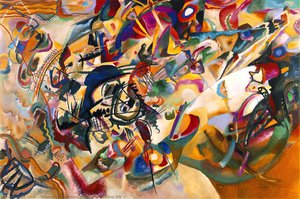
Complex-Simple, painted by Kandinsky in 1939, is a prime example of Neo-Minimalism. The painting features geometric forms, bold colors, and a unique composition that invites viewers to explore their emotional responses. As seen on OriginalUniqueArt.com, this masterpiece is a testament to Kandinsky's innovative style.Kandinsky's Influence on Neo-Minimalism
Kandinsky's influence on Neo-Minimalism is evident in his use of geometric forms and bold colors. His work has inspired countless artists to create their own Neo-Minimalist masterpieces. The Centre Pompidou museum has an extensive collection of Kandinsky's works, including Complex-Simple, which showcases his contribution to the development of abstract art.- Visit OriginalUniqueArt.com to explore hand-made oil painting reproductions of Kandinsky's works, including Complex-Simple.
- Learn more about Neo-Minimalism and its key artists on Wikipedia.
- Discover the Musée de Grenoble's collection of modern art, featuring works by Kandinsky and other prominent artists.
The legacy of Kandinsky continues to inspire artists and art enthusiasts alike, with his innovative style and contribution to Neo-Minimalism remaining unparalleled.
Vprašanja in odgovori
Ali lahko "Complex-Simple" pregledam podrobneje?
Delo "Complex-Simple" lahko raziščete plast za plast na strani Rentgenski pregled, ki vključuje preglednik navdihnjen s svetilno mizo konservatorja z enajstimi optičnimi odtisi slike.
Ali je "Complex-Simple" tipično za dela, ki jih je Vasiliy Vasil'Evič Kandinskij običajno ustvarjal?
Vasiliy Vasil'Evič Kandinskijove ponavljajoče se teme vključujejo monet’s impressionism, wagnerian music”, “theosophical ideas” ], cultural, religious, political themes": [ "spiritual expression, emotional resonance, abstraction's power; "Complex-Simple" se osredotoča na geometric forms, bold colors, abstraction, kandinsky, composition, emotional response, 1939, circles.
Na katero državo izvira Neo-Minimalism dela "Complex-Simple"?
"Complex-Simple" je ustvaril/a Vasiliy Vasil'Evič Kandinskij, rojen/a v državi Rusija, v okviru gibanja Neo-Minimalism. Umetnikova izhodno točka povezuje del z Neo-Minimalism, kot ga je praticiral/a umetniki iz države Rusija.
Biografija umetnika
A Life Immersed in Color and Spirit
Wassily Wassilyevich Kandinsky, born December 4, 1866, in Moscow, Russia, was a revolutionary figure who irrevocably altered the course of modern art. His journey wasn’t one of immediate artistic calling; initially destined for a career in law and economics at the University of Moscow, it was a profound encounter with Impressionist painting – specifically Claude Monet's “Haystacks” – and a deeply moving experience witnessing Wagner’s opera "Lohengrin" that ignited within him an irrepressible desire to pursue art. This pivotal moment, occurring around age thirty, marked not merely a career change but a complete transformation of perspective, setting him on a path toward pioneering abstraction. He soon relocated to Munich, enrolling at the prestigious Academy of Fine Arts and studying under Franz von Stuck, though even within formal training, Kandinsky’s spirit yearned for exploration beyond conventional boundaries. Early influences included Russian folk art, gleaned from an ethnographic expedition to the Vologda region in 1889, which instilled a fascination with vibrant color palettes and symbolic imagery. This foundation would prove crucial as he began to develop his unique artistic language. These early explorations weren’t simply about aesthetic preference; they were rooted in a deep cultural connection and a burgeoning understanding of how art could communicate beyond the literal. He experimented with landscapes and portraits, demonstrating considerable skill but always feeling constrained by representational limitations.The Dawn of Abstraction: From Expressionism to Inner Necessity
Kandinsky’s early works reveal a strong expressionistic bent, characterized by bold colors and emotional intensity – pieces like “Papeln (Poplars)” from 1902 exemplify this period. However, he wasn't content with merely representing the external world; he sought to express inner realities, spiritual truths that transcended mere visual depiction. This quest led him gradually away from representational art and toward a revolutionary exploration of color, form, and their emotional resonance. He believed that colors possessed inherent psychological effects, capable of evoking specific feelings and sensations in the viewer. This conviction was deeply intertwined with his burgeoning interest in Theosophy, a spiritual movement emphasizing esoteric knowledge and universal brotherhood. As he delved deeper into these ideas, Kandinsky’s paintings became increasingly non-objective, shedding recognizable forms in favor of abstract compositions driven by an “inner necessity.” This wasn't simply about abandoning representation; it was about discovering a new visual language capable of expressing the intangible realms of emotion and spirituality. He sought to create a visual equivalent of music, where color and form harmonized to evoke profound emotional responses.- Notable Early Works: “Papeln (Poplars),” “Fruitful Tree,” “Moscow Landscape”
- Influences: Impressionism (Monet), Russian Folk Art
Geometric Harmony and Spiritual Resonance
The period following his involvement with the influential artist group Der Blaue Reiter (The Blue Rider), which he co-founded in Munich in 1911, saw a further evolution in Kandinsky’s style. While earlier works often featured fluid, organic shapes, he began to explore geometric abstraction, focusing on the interplay of circles, triangles, and squares. “Several Circles” (140 x 140 cm) stands as a prime example of this phase – a dynamic composition where color and form interact in a harmonious yet energetic dance. He theorized extensively about the relationship between art and spirituality, arguing that true artistic expression required overcoming the limitations of visual perception and accessing realms beyond the observable world.- The Blaue Reiter Group: Collaboration with Franz Marc and other artists
- Theoretical Writings: “Concerning the Spiritual in Art” (1911)
Bauhaus Influence and Lasting Legacy
The outbreak of World War I forced Kandinsky's return to Russia in 1914, but following the Russian Revolution, he found himself increasingly at odds with the prevailing artistic climate. In 1920, he accepted a teaching position at the Bauhaus school in Germany, where he profoundly influenced generations of artists with his theories on color, form, and abstraction. The Bauhaus provided an ideal environment for Kandinsky to further develop his ideas and explore new creative avenues. He continued to experiment with geometric forms and vibrant colors, often incorporating layered impasto techniques to create textured surfaces that added depth and complexity to his compositions – as seen in later works like “An Intimate Party” (1942). After the closure of the Bauhaus by the Nazi regime in 1933, Kandinsky moved to France, where he remained for the rest of his life. His impact on modern art is immeasurable; he is widely recognized as a pioneer of abstract expressionism and a key figure in the development of non-representational painting. His works are held in major museums worldwide, including the Tretyakov Gallery in Moscow, which houses his monumental “Composition VII,” a testament to his artistic vision and enduring legacy. He died December 13, 1944, in Neuilly-sur-Seine, France.- Major Achievements: Bauhaus Teaching Position, Development of Geometric Abstraction
- Notable Later Works: “Composition VII,” “An Intimate Party”

Vasiliy Vasil'Evič Kandinskij
1866 - 1944 , Rusija
Hitri podatki
- Artistic Movement Or Style: Abstraktna umetnost, Ekspresionizem
- Artists Or Movements Influenced By This Artist: ['Abstraktna ekspresija']
- Artists Who Influenced This Artist:
- Claude Monet
- Richard Wagner
- Date Of Birth: 1866
- Full Name: Wassily Wassilyevich Kandinsky
- Nationality: Ruski
- Notable Artworks: ['Kompozicija VII']
- Place Of Birth: Moscow, Russia
Sorodni članki

Geometrična Abstraktna Umetnost: 10 Mojstrovin za Vaš Dom | OriginalUniqueArt.com
Odkrijte 10 mojstrovin geometrične abstrakcije! Mondrian, Malevich, Kandinsky in drugi. Zgodbe umetnikov, tehnike ter navdih za vaš dom. Kvalitetne reprodukcije slik na OriginalUniqueArt.com. Raziskajte celotno zbirko online!

Neo-Abstract Art: The High-Impact Evolution of Modern Visual Energy and Geometric Sophistication
Discover the power of Neo-Abstract art. Explore how bold geometric forms and high-impact visual energy are redefining modern design. Learn to curate sophisticated, high-energy spaces with the latest trends in contemporary abstraction and structural color.

Fernand Léger: 25 Mojstrovin Modernizma za Vaš Dom | OriginalUniqueArt
Odkrijte 25 mojstrovin Fernanda Légerja – pionirja kubizma in tubizma. Raziskajte zgodbe, tehnike in navdih za ikonične slike tega modernističnega umetnika. Kvalitetne reprodukcije slik na OriginalUniqueArt.com.

Mastering Abstraction: The 25 Most Iconic Works by Wassily Kandinsky
Explore 25 iconic Kandinsky masterpieces and the birth of abstraction. Discover the full collection online at OriginalUniqueArt.com.

The Power of Less: A Definitive Guide to the Minimalism Movement and Geometric Abstraction
Explore the profound impact of Minimalism and Geometric Abstraction. From Mondrian to Malevich, discover how stripping art to its essential forms revolutionized modern aesthetics through our expert-led historical guide.