Preverite v realnem okolju
 Pošlji kot čestitko
 Deli
Deli
 Podrobnosti
 Priročnik

 Prenesi
 Podobni artefakti
 Rentgenski posnetek
 Predvajaj diaporama
 Statistika
An Intimate Party


 Preberi več
Ročno izdelana oljna reprodukcija
Ročno slikano olje na platnu v vaši izbiri velikosti in okvirja, izdelano po naročilu naših umetnikov. ( Preklop na tiskanine Preklop na digitalno sliko)




P118B $10

P118H $10

P118W $10

P438Z $10

P508JH $12

P508YH $12

P805H $10

P805Z $10

P919BZ $10

P919G $10

P919XJ $10

P959ZH $10

P968JZ $12

W106C $8

W218G $10

W218JH $8

W218Y $10

W307PJ $10

W316G $10

W316PJ $8

W316Y $10

W398PJ $8

W4111J $10

W500HY $15

W500JH $15

W692G $12

W849H $8

W940BG $15

W953PJ $8




Izberite eno od naših vnaprej določenih velikosti, ki ustrezajo prvotnim proporcijam umetničkega dela.

Svoje dimenzije lahko vnesete tako, da se prilagodite določenemu okvirju ali prostoru. Če izbrana velikost ne ustreza razmerjem originalne slike, bomo umetniško delo obrezali ali sliko dopolnili z dodatnimi ročno naslikanimi elementi. Pred začetkom proizvodnje vam bo poslan digitalni osnutek v odobritev.
Upoštevajte, da predogled na zaslonu ne odraža dejanskega obrezovanja ali podaljšanja. Le osnutek bo natančno prikazal končno kompozicijo.
Čeprav so na voljo velikosti po meri, priporočamo izbiro dimenzije s preddefiniranega seznama, da ohranimo originalne razmere.
Po oddaji naročila bo ekipa OriginalUniqueArt.com stranki po e-pošti poslala navodila in predogled digitalnega predogleda.
Mednarodna dostava () v 3/4 tednih namesto običajnih 5 tednov. (25 september). Brez kompromisov pri kakovosti.

Brezplačna ekspresna dostava po vsem svetu

Visokokakovostno laneno platno

Popolno zavarovanje pošiljke

Garancija povračila carine in uvoznih davkov

Garancija popolnega barvnega ujemanja

Politika vračila v 100 dneh (le v primeru okvar)

Garancija 100% povračila denarja

Popust pri večjem naročilu
 Možnost stekla je na voljo le za velikosti pod 110 cm

An Intimate Party
Tehnika reprodukcije
Velikost reprodukcije
-


Skupna cena
$ 300
A Symphony of Geometric Spirit
In the vast landscape of modernism, few works capture the ethereal dance between structure and soul as poignantly as Wassily Kandinsky’s 1942 masterpiece, An Intimate Party. Created during a period of profound global transition, this painting serves as a vibrant window into the artist's late-period mastery, where the chaos of the external world is transmuted into a controlled, rhythmic abstraction. The composition immediately envelops the viewer in a sea of cool, contemplative blues—ranging from serene cerulean to deep, nocturnal indigo—which provides a breathtaking stage for the warmer, earthier accents of ochre, terracotta, and rich gold. At its heart lies a luminous, speckled golden circle, a celestial presence that anchors the swirling energy of the canvas, acting as both a sun and a moon in a private, cosmic celebration.
To gaze upon this work is to witness a deliberate rejection of the literal in favor of the emotional. Kandinsky, a pioneer who famously sought to unify the visual arts with the spiritual resonance of music, utilizes geometric forms not merely as shapes, but as notes in a visual symphony. The interplay of sharp triangles, sturdy rectangles, and delicate, sweeping lines creates a sense of perpetual motion, suggesting a festive gathering of pure energy. This is not a party of people, but a communion of forms, where every angular edge and curved conduit suggests a hidden connection between disparate elements of the universe.
The Legacy of Abstraction and Technique
The stylistic DNA of An Intimate Party is deeply rooted in the transformative movements of the early 20th century, specifically echoing the disciplined precision of Constructivism and the functional elegance of the Bauhaus school. By eschewing representational realism, Kandinsky invites the observer to engage in a more profound, psychological dialogue with the canvas. The technique itself is a testament to his command over texture and depth; through the use of mixed media and what appears to be a masterful application of impasto, the artist lends a palpable physicality to the abstract shapes. These thick, layered applications of paint create a surface that catches the light, offering a tactile dimension that makes the artwork feel alive and breathing.
For the discerning collector or interior designer, this piece offers an unparalleled opportunity to introduce a sense of sophisticated dynamism into a space. The balance between its structured geometric elements and its fluid, organic movements allows it to serve as a commanding focal point in both contemporary and classic settings. Whether placed in a minimalist gallery-style room or a richly textured study, An Intimate Party radiates an aura of intellectual depth and spiritual warmth. It is more than a mere decoration; it is an invitation to contemplate the harmony that exists within complexity, making it a timeless acquisition for those who seek art that speaks to the eternal.
Biografija umetnika
A Life Immersed in Color and Spirit
Wassily Wassilyevich Kandinsky, born December 4, 1866, in Moscow, Russia, was a revolutionary figure who irrevocably altered the course of modern art. His journey wasn’t one of immediate artistic calling; initially destined for a career in law and economics at the University of Moscow, it was a profound encounter with Impressionist painting – specifically Claude Monet's “Haystacks” – and a deeply moving experience witnessing Wagner’s opera "Lohengrin" that ignited within him an irrepressible desire to pursue art. This pivotal moment, occurring around age thirty, marked not merely a career change but a complete transformation of perspective, setting him on a path toward pioneering abstraction. He soon relocated to Munich, enrolling at the prestigious Academy of Fine Arts and studying under Franz von Stuck, though even within formal training, Kandinsky’s spirit yearned for exploration beyond conventional boundaries. Early influences included Russian folk art, gleaned from an ethnographic expedition to the Vologda region in 1889, which instilled a fascination with vibrant color palettes and symbolic imagery. This foundation would prove crucial as he began to develop his unique artistic language. These early explorations weren’t simply about aesthetic preference; they were rooted in a deep cultural connection and a burgeoning understanding of how art could communicate beyond the literal. He experimented with landscapes and portraits, demonstrating considerable skill but always feeling constrained by representational limitations.The Dawn of Abstraction: From Expressionism to Inner Necessity
Kandinsky’s early works reveal a strong expressionistic bent, characterized by bold colors and emotional intensity – pieces like “Papeln (Poplars)” from 1902 exemplify this period. However, he wasn't content with merely representing the external world; he sought to express inner realities, spiritual truths that transcended mere visual depiction. This quest led him gradually away from representational art and toward a revolutionary exploration of color, form, and their emotional resonance. He believed that colors possessed inherent psychological effects, capable of evoking specific feelings and sensations in the viewer. This conviction was deeply intertwined with his burgeoning interest in Theosophy, a spiritual movement emphasizing esoteric knowledge and universal brotherhood. As he delved deeper into these ideas, Kandinsky’s paintings became increasingly non-objective, shedding recognizable forms in favor of abstract compositions driven by an “inner necessity.” This wasn't simply about abandoning representation; it was about discovering a new visual language capable of expressing the intangible realms of emotion and spirituality. He sought to create a visual equivalent of music, where color and form harmonized to evoke profound emotional responses.- Notable Early Works: “Papeln (Poplars),” “Fruitful Tree,” “Moscow Landscape”
- Influences: Impressionism (Monet), Russian Folk Art
Geometric Harmony and Spiritual Resonance
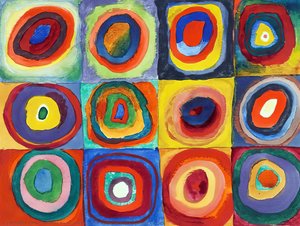
The period following his involvement with the influential artist group Der Blaue Reiter (The Blue Rider), which he co-founded in Munich in 1911, saw a further evolution in Kandinsky’s style. While earlier works often featured fluid, organic shapes, he began to explore geometric abstraction, focusing on the interplay of circles, triangles, and squares. “Several Circles” (140 x 140 cm) stands as a prime example of this phase – a dynamic composition where color and form interact in a harmonious yet energetic dance. He theorized extensively about the relationship between art and spirituality, arguing that true artistic expression required overcoming the limitations of visual perception and accessing realms beyond the observable world.- The Blaue Reiter Group: Collaboration with Franz Marc and other artists
- Theoretical Writings: “Concerning the Spiritual in Art” (1911)
Bauhaus Influence and Lasting Legacy
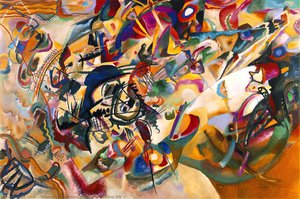
The outbreak of World War I forced Kandinsky's return to Russia in 1914, but following the Russian Revolution, he found himself increasingly at odds with the prevailing artistic climate. In 1920, he accepted a teaching position at the Bauhaus school in Germany, where he profoundly influenced generations of artists with his theories on color, form, and abstraction. The Bauhaus provided an ideal environment for Kandinsky to further develop his ideas and explore new creative avenues. He continued to experiment with geometric forms and vibrant colors, often incorporating layered impasto techniques to create textured surfaces that added depth and complexity to his compositions – as seen in later works like “An Intimate Party” (1942). After the closure of the Bauhaus by the Nazi regime in 1933, Kandinsky moved to France, where he remained for the rest of his life. His impact on modern art is immeasurable; he is widely recognized as a pioneer of abstract expressionism and a key figure in the development of non-representational painting. His works are held in major museums worldwide, including the Tretyakov Gallery in Moscow, which houses his monumental “Composition VII,” a testament to his artistic vision and enduring legacy. He died December 13, 1944, in Neuilly-sur-Seine, France.- Major Achievements: Bauhaus Teaching Position, Development of Geometric Abstraction
- Notable Later Works: “Composition VII,” “An Intimate Party”

Vasiliy Vasil'Evič Kandinskij
1866 - 1944 , Rusija
Ključne informacije
- Artistic Movement Or Style: Abstraktna umetnost, Ekspresionizem
- Artists Or Movements Influenced By This Artist: ['Abstraktna ekspresija']
- Artists Who Influenced This Artist:
- Claude Monet
- Richard Wagner
- Date Of Birth: 1866
- Full Name: Wassily Wassilyevich Kandinsky
- Nationality: Ruski
- Notable Artworks: ['Kompozicija VII']
- Place Of Birth: Moscow, Russia
Sorodni članki

Beyond Form & Color: Geometric Abstraction's Evolution in 20th/21st Century Art
Explore the evolution of geometric abstraction from Cubism to contemporary art. Discover key artists like Malevich & Mondrian, investment insights, and expert collecting advice at OriginalUniqueArt.

Absolutni Izrazi: 10 Mojstrin Del, Ki So Definirali Gibanje
Odkrijte 10 mojstrin del abstraktnega ekspresionizma! Pollock, Rothko & De Kooning - zgodbe za kulise ikoničnih umetnin. Inspirirajte se in poiščite reprodukcije na OriginalUniqueArt.com!

Geometrična Abstraktna Umetnost: 10 Mojstrovin za Vaš Dom | OriginalUniqueArt.com
Odkrijte 10 mojstrovin geometrične abstrakcije! Mondrian, Malevich, Kandinsky in drugi. Zgodbe umetnikov, tehnike ter navdih za vaš dom. Kvalitetne reprodukcije slik na OriginalUniqueArt.com. Raziskajte celotno zbirko online!

Kandinsky's Masterpieces: 25 Paintings That Define Abstract Art | OriginalUniqueArt
Journey through Wassily Kandinsky's 25 most iconic abstract paintings. Explore his revolutionary use of color, form & spiritual expressionism. Find museum-quality Kandinsky reproductions and elevate your home decor with OriginalUniqueArt.com. Discover all masterpieces on OriginalUniqueArt.com!

Neo-Abstract Art: The High-Impact Evolution of Modern Visual Energy and Geometric Sophistication
Discover the power of Neo-Abstract art. Explore how bold geometric forms and high-impact visual energy are redefining modern design. Learn to curate sophisticated, high-energy spaces with the latest trends in contemporary abstraction and structural color.