Predogled
 Pošlji
 Deli
Deli
 Podrobnosti o delu

 Prenesi
 Podobni izdelki
 Rentgenski posnetek
 Predvajaj diaporama
Longwood Store


 Razviljaj več
Ročno izdelana oljna reprodukcija
Ročno slikano olje na platnu v vaši izbiri velikosti in okvirja, izdelano po naročilu naših umetnikov. ( Kupi tisk Kupi digitalno sliko)




































Izberite eno od naših vnaprej določenih velikosti, ki ustrezajo prvotnim proporcijam umetničkega dela.

Svoje dimenzije lahko vnesete tako, da se prilagodite določenemu okvirju ali prostoru. Če izbrana velikost ne ustreza razmerjem originalne slike, bomo umetniško delo obrezali ali sliko dopolnili z dodatnimi ročno naslikanimi elementi. Pred začetkom proizvodnje vam bo poslan digitalni osnutek v odobritev.
Upoštevajte, da predogled na zaslonu ne odraža dejanskega obrezovanja ali podaljšanja. Le osnutek bo natančno prikazal končno kompozicijo.
Čeprav so na voljo velikosti po meri, priporočamo izbiro dimenzije s preddefiniranega seznama, da ohranimo originalne razmere.
Po oddaji naročila bo ekipa OriginalUniqueArt.com stranki po e-pošti poslala navodila in predogled digitalnega predogleda.
Svetska dostava () za 3/4 nedelje umesto uobičajenih 5 nedelja. (21 avgust). Bez kompromisa po pitanju kvaliteta.

Brezplačna ekspresna dostava po vsem svetu

Visokokakovostno laneno platno

Popolno zavarovanje pošiljke

Garancija povračila carine in uvoznih davkov

Garancija popolnega ujemanja barv

60-dnevna politika vračanja (le v primeru napak)

Garancija 100% povračila denarja

Popust pri večjem naročilu
 Možnost stekla je na voljo le za velikosti pod 110 cm

Longwood Store
Tehnika reprodukcije
Velikost reprodukcije
-


Skupna končna cena
$ 300
Biografija umetnika
The Master of Miniature Pleasures
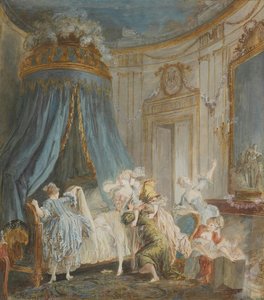
In the shimmering, decadent atmosphere of mid-18th century Paris, few artists captured the ephemeral essence of Rococo intimacy quite like Pierre-Antoine Baudouin. Born in 1723 to an engraver, Baudouin emerged not merely as a painter, but as a chronicler of the era's most private and whispered moments. His life was deeply entwined with the very fabric of French high society and its artistic elite; through his marriage to Marie-Elisabeth, the daughter of the legendary François Boucher, he became more than just a pupil of the Rococo master—he became an extension of Boucher’s own aesthetic legacy. This connection granted him access to the most refined circles of the French court, where the boundaries between art and life were often blurred by grace, wit, and a touch of scandal.
Baudouin’s artistic development was characterized by a remarkable mastery of delicate mediums. While many of his contemporaries sought the permanence of oil on canvas, Baudouin found his true voice in the ephemeral textures of watercolors, gouache, and crayons. His technique allowed for a luminous, almost translucent quality that perfectly suited his subject matter: idyllic landscapes, soft boudoir scenes, and the playful, often erotic, encounters of the aristocracy. There is a certain breathlessness to his work, a sense that one is catching a fleeting glimpse through a silk curtain. His ability to render the softness of skin, the sheen of satin, and the gentle light of a Parisian afternoon made him a favorite among collectors who sought art that felt as much like a secret as a possession.
A Controversial Legacy of Light and Shadow
Despite his technical brilliance and his prestigious election to the Académie Royale in 1763, Baudouin’s reputation was never without its shadows. He occupied a complex position in the cultural landscape of the 1760s, caught between the frivolous elegance of the Rococo and the rising tide of moralistic scrutiny. The famous critic Denis Diderot, known for his biting assessments of the Salons, famously cast Baudouin in a harsh light. While acknowledging his talent, Diderot condemned him as a "painter-preacher of bad morals," contrasting him unfavorably with Jean-Baptiste Greuze, whom he viewed as a moralizing force. To Diderot, Baudouin’s work—with its focus on rakes and houses of ill repute—represented the decadent decay of a society losing its ethical compass.
This tension between aesthetic pleasure and moral judgment defines much of Baudouin's historical significance. His oeuvre serves as a vital, if controversial, window into the libertine culture of pre-revolutionary France. Whether he was painting a historical subject like his reception piece, Hyperides pleading the cause of Phryne before the Areopagus, or a more intimate miniature, there was always an underlying pulse of worldly sophistication. His life ended prematurely in 1769, amidst rumors that linked his early death to the very lifestyle of pleasure he so exquisitely depicted. Today, Baudouin is remembered not just as a follower of Boucher, but as a singular artist who dared to elevate the miniature and the erotic to a level of profound, delicate artistry, leaving behind a legacy that remains as captivating as it is provocative.

pierre-antoine baudouin
1723 - 1769 , France
Hitri podatki
- Artistic Movement Or Style: Neoclassical history painter
- Artists Or Movements Influenced By This Artist:
- Jacques-Louis David
- Thomas Blackwell
- Artists Who Influenced This Artist:
- Agostino Masucci
- Sir Joshua Reynolds
- Date Of Birth: 1723
- Date Of Death: 1798
- Full Name: Gavin Hamilton
- Nationality: Scottish
- Notable Artworks:
- Death of Lucretia
- Homer's Iliad cycle
- Place Of Birth: Lanarkshire, Scotland
Sorodni članki

Alfred East: Pioneering Plein Air & Evoking Atmospheric Landscapes
Explore the life & work of Alfred East, a pioneer of British plein air painting. Discover his techniques for capturing atmospheric landscapes, Barbizon influences, and lasting legacy. Learn more at OriginalUniqueArt.
Serenity on Canvas: A Guide to the Timeless Beauty of Japanese Landscape Painting
Discover the serene beauty of Japanese landscape painting. From Hokusai's iconic woodblock prints to meditative sumi-e ink washes, explore a visual journey through the 'floating world' and learn how to bring this timeless Zen aesthetic into your modern home decor.
Japonisme: How Japanese Woodblock Prints Revolutionized Western Art
Explore the profound impact of Japonisme on Western art. Discover how Japanese ukiyo-e woodblock prints revolutionized perspective, color, and composition for masters like Monet and Van Gogh, forever changing the course of modern art history.

Beyond the Great Wave: The High-Impact Visual Revolution of Japanese Landscape Art
Go beyond Hokusai's Great Wave. Explore the high-impact, graphic world of Japanese Ukiyo-e landscapes and urban prints. Discover how these bold, vibrant woodblock masterpieces continue to shape modern pop culture and contemporary design aesthetics.

Timeless Elegance: Capturing the Spirit of Japanese Culture Through the Lens of Ukiyo-e Fine Art
Explore the profound beauty of Japanese Ukiyo-e art. Discover the legacy of Hokusai and the Utagawa school through an expert exploration of Edo-period aesthetics, seasonal motifs, and the enduring global influence of Japan's 'Floating World' on fine art history.