

 Preverite v realnem okolju
 Pošlji kot čestitko
 Deli
Deli
 Podrobnosti
 Priročnik

 Prenesi
 Podobni artefakti
 Rentgenski posnetek
 Predvajaj diaporama
 Statistika
Cello


 Preberi več
Umetniška dela, prikazana na tej strani, so zaščitena z avtorskimi pravicami, kar pomeni, da po zakonu ne moremo ustvarjati ali prodajati identičnih reprodukcij. Ta zaščita se izvaja v skladu z mednarodnimi sporazumi, kot so Bernska konvencija in po nacionalnih zakonih, vključno s tistimi, ki jih določa Zakon o avtorskih pravicah ZDA – naslov 17.
Kot spoštljiva in zakonita alternativa ponujamo prilagojena, ročno slikana umetniška dela, navzornena na original. Naši sposobni in profesionalni umetniki skrbno preučijo stil, vzdušje in umetniško bistvo originala, da ustvarijo novo, edinstveno delo, ki vzbudi enak občutek – pri čemer ostaja popolnoma nova, samostojna izvirna stvar.
Ta način v celoti upošteva zakonodajo o avtorskih pravicah, saj ne vključuje kopiranja ali podvajanja zaščitena umetniškega dela. Namesto tega gre za kreativno preinterpretacijo – novo sliko, ki je navdihnjen rezultat originala, vendar ni z njim identična.
Ročno izdelana oljna reprodukcija
Ročno slikano olje na platnu v vaši izbiri velikosti in okvirja, izdelano po naročilu naših umetnikov. ( Preklop na tiskanine Preklop na digitalno sliko)




P118B €10

P118H €10

P118W €10

P438Z €10

P508JH €12

P508YH €12

P805H €10

P805Z €10

P919BZ €10

P919G €10

P919XJ €10

P959ZH €10

P968JZ €12

W106C €8

W218G €10

W218JH €8

W218Y €10

W307PJ €10

W316G €10

W316PJ €8

W316Y €10

W398PJ €8

W4111J €10

W500HY €15

W500JH €15

W692G €12

W849H €8

W940BG €15

W953PJ €8




Izberite eno od naših vnaprej določenih velikosti, ki ustrezajo prvotnim proporcijam umetničkega dela.

Vnesite širino in višino, ki jih potrebujete, da se slika prilega vašemu okviru ali steni. Ker je delo ročno slikano, lahko umetnik pri različnih oblikih slik pri robovih doda malo več barve ali pa jih malo odreže — izberite sami. Pred začetkom slikanja vam pošljemo digitalni predogled za potrditev. Slika, prikazana na tej strani, ni končni rezultat — le predogled prikazuje dejansko podobo.
Po oddaji naročila bo ekipa OriginalUniqueArt.com stranki po e-pošti poslala navodila in predogled digitalnega predogleda.
Mednarodna dostava () v 3/4 tednih namesto običajnih 5 tednov. (22 oktober). Brez kompromisov pri kakovosti.

Brezplačna ekspresna dostava po vsem svetu

Visokokakovostno laneno platno

Popolno zavarovanje pošiljke

Garancija povračila carine in uvoznih davkov

Garancija popolnega barvnega ujemanja

Politika vračila v 100 dneh (le v primeru okvar)

Garancija 100% povračila denarja

Popust pri večjem naročilu
 Možnost stekla je na voljo le za velikosti pod 110 cm

Cello
Tehnika reprodukcije
Velikost reprodukcije
-


Skupna cena
€ 262
A Testament to Craftsmanship: Piero Parravicini’s Cello – A Reflection of Italian Violin Making Tradition
The cello, an instrument steeped in history and revered for its soulful resonance, stands as a testament to the enduring legacy of Italian violin making. This particular cello, crafted by Piero Parravicini in 1922, embodies the meticulous artistry that flourished during the early 20th century – a period marked by both artistic innovation and unwavering adherence to established techniques. Examining its construction reveals not only exceptional craftsmanship but also a profound connection to the traditions of Cremona, Italy, where violin making has been practiced for centuries.- Material Composition: The instrument’s body is constructed primarily from maple, chosen for its density and tonal qualities. Complementing this core material are spruce boards – two carefully selected pieces – forming the soundboard. Spruce, renowned for its stiffness and ability to transmit vibrations efficiently, remains a cornerstone of violin construction globally.
- Purfling & Decoration: Adding visual elegance and structural integrity is white maple and black walnut purfling—thin strips inlaid around the edges of the cello’s body and neck. Purfling serves not only as decorative embellishment but also protects the wood from cracking during handling and contributes to the instrument's overall acoustic performance.
- Historical Context: Piero Parravicini operated within a vibrant artistic milieu, influenced by figures like Romeo Antoniazzi, who himself studied under Giuseppe Stradivari—the undisputed master of violin making. This lineage underscores the importance of preserving traditional methods and honoring the legacy of legendary craftsmen.
Artist Biography: Piero Parravicini – A Maestro Rooted in Tradition
Born in Bovisa, Italy, in 1889, Piero Parravicini was more than just a violin maker; he was an educator and innovator who championed the revival of classical violin making. He honed his skills at Monzino, Milan, absorbing knowledge from Romeo Antoniazzi (1862-1925), whose own approach to instrument construction drew inspiration from Stradivari’s groundbreaking methods.
Parravicini's dedication extended beyond production; he established a workshop where he imparted his expertise to aspiring artisans. His instruments garnered recognition at prestigious competitions—the National Lute-Making Competition in Rome (1925 & 1929), the International Contemporary Lute-Making Competition in Cremona (1949), and the National Exhibition in Florence (1951)—demonstrating his commitment to upholding the highest standards of craftsmanship.
The Instrument’s Aesthetic Appeal: Visual Elements & Sonic Character
The cello's appearance speaks volumes about its maker’s vision. Its maple body exudes warmth and stability, while the spruce soundboard radiates luminosity—a characteristic achieved through meticulous polishing and varnish application. The white maple and black walnut purfling adds subtle textural contrast, enhancing both visual beauty and acoustic projection.
Beyond its physical form, the cello possesses a distinctive sonic character – a rich, resonant timbre capable of conveying profound emotion. This quality is attributable to Parravicini’s careful selection of materials and his meticulous attention to detail during construction—a testament to the enduring power of tradition in shaping artistic expression.
Symbolism & Emotional Resonance
Like all great instruments, the cello transcends mere functionality; it embodies a deeper symbolic significance. Its elongated shape evokes contemplation and introspection – qualities that align perfectly with its expressive capabilities. When played skillfully, it can evoke feelings of melancholy, joy, and spiritual transcendence—connecting musicians and listeners alike to universal human experiences.
Concluding Remarks: A Legacy Preserved
Piero Parravicini’s cello stands as a beacon of Italian violin making tradition – a symbol of unwavering dedication to craftsmanship and artistic excellence. Its enduring beauty and sonic power continue to inspire musicians and collectors worldwide, ensuring that the legacy of this remarkable instrument—and its maker—will endure for generations to come.
Vprašanja in odgovori
Kateri umetniški slog zastopa "Cello" avtorja Piero Parravicini?
Umetnostni smer, povezana z delom "Cello" avtorja Piero Parravicini, je Contemporary Realism. Ta klasifikacija delo uvršča med sorodne umetnike in umetniška dela.
Ali obstaja informativni list o delu "Cello" avtorja Piero Parravicini za študente?
Za delo "Cello" avtorja Piero Parravicini je na voljo stran Vodnik: natisljiv informativni list o umetninah, zasnovan za uporabo v šolskih prostorih in za učence.
Koliko so harmonizirane barve dela "Cello" avtorja Piero Parravicini?
Barve v delu "Cello" avtorja Piero Parravicini prikazujejo Strong Color Unity harmonijo. Harmonija opisuje odnos barv med seboj.
Sorodni članki

10 Iconic Masterpieces That Capture the Soul of Italy
Journey through Italy's soul with 10 iconic masterpieces. From Renaissance legends to romantic landscapes, explore the stories behind these timeless works. Find museum-quality art reproductions and curated decor inspiration at OriginalUniqueArt.com. Discover all masterpieces online.

10 Iconic Artworks That Capture the Magic of Italy
Journey through Italy via its most iconic masterpieces. From Renaissance classics to romantic landscapes, explore the stories behind these timeless works. Find museum-quality art reproductions and curated decor inspiration at OriginalUniqueArt.com. Discover all masterpieces online.
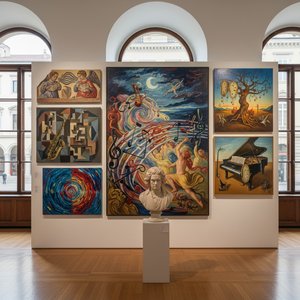
Harmonies on Canvas: Exploring the Visual Representation of Music in Art History
Explore the fascinating history of music's visual representation in art! From ancient symbolism to modern abstraction, discover how artists have captured sound and emotion on canvas. Expert insights & stunning examples.

The Symphony of Canvas: Capturing the Timeless Resonance of Musical Instruments in Fine Art Masterpieces
Explore the profound connection between music and fine art. From ancient iconography to Impressionist masterpieces, discover how legendary instruments are captured on canvas with unparalleled artistry and historical depth for the discerning collector.

10 Iconic Masterpieces That Capture the Magic of Italy
Journey through Italy's soul with 10 iconic masterpieces. From Renaissance classics to romantic landscapes, explore the stories behind these timeless works and find museum-quality art reproductions for your decor. Discover all masterpieces on OriginalUniqueArt.com.