

 Predogled
 Pošlji
 Deli
Deli
 Podrobnosti o delu

 Prenesi
 Podobni izdelki
 Rentgenski posnetek
 Predvajaj diaporama
Granada


 Razviljaj več
Ročno izdelana oljna reprodukcija
Ročno slikano olje na platnu v vaši izbiri velikosti in okvirja, izdelano po naročilu naših umetnikov. ( Kupi tisk Kupi digitalno sliko)




P118B $10

P118H $10

P118W $10

P438Z $10

P508JH $12

P508YH $12

P805H $10

P805Z $10

P919BZ $10

P919G $10

P919XJ $10

P959ZH $10

P968JZ $12

W106C $8

W218G $10

W218JH $8

W218Y $10

W307PJ $10

W316G $10

W316PJ $8

W316Y $10

W398PJ $8

W4111J $10

W500HY $15

W500JH $15

W692G $12

W849H $8

W940BG $15

W953PJ $8




Izberite eno od naših vnaprej določenih velikosti, ki ustrezajo prvotnim proporcijam umetničkega dela.

Svoje dimenzije lahko vnesete tako, da se prilagodite določenemu okvirju ali prostoru. Če izbrana velikost ne ustreza razmerjem originalne slike, bomo umetniško delo obrezali ali sliko dopolnili z dodatnimi ročno naslikanimi elementi. Pred začetkom proizvodnje vam bo poslan digitalni osnutek v odobritev.
Upoštevajte, da predogled na zaslonu ne odraža dejanskega obrezovanja ali podaljšanja. Le osnutek bo natančno prikazal končno kompozicijo.
Čeprav so na voljo velikosti po meri, priporočamo izbiro dimenzije s preddefiniranega seznama, da ohranimo originalne razmere.
Po oddaji naročila bo ekipa OriginalUniqueArt.com stranki po e-pošti poslala navodila in predogled digitalnega predogleda.
Svetska dostava () za 3/4 nedelje umesto uobičajenih 5 nedelja. (31 avgust). Bez kompromisa po pitanju kvaliteta.

Brezplačna ekspresna dostava po vsem svetu

Visokokakovostno laneno platno

Popolno zavarovanje pošiljke

Garancija povračila carine in uvoznih davkov

Garancija popolnega ujemanja barv

60-dnevna politika vračanja (le v primeru napak)

Garancija 100% povračila denarja

Popust pri večjem naročilu
 Možnost stekla je na voljo le za velikosti pod 110 cm

Granada
Tehnika reprodukcije
Velikost reprodukcije
-


Skupna končna cena
$ 300
A Symphony of Light and Life: Exploring Joaquín Sorolla’s *Granada*
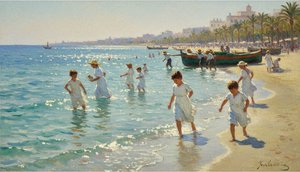
Joaquín Sorolla y Bastida's *Granada* is more than just a depiction of a Spanish landscape; it’s an immersive experience, a testament to the artist’s masterful command of light and his profound connection to the vibrant spirit of his homeland. Painted during a period of immense artistic flourishing in Spain – the late 19th and early 20th centuries – this work embodies the *luminismo*, a style characterized by its intense use of sunlight, creating an almost palpable sense of warmth and energy. The scene unfolds with remarkable clarity, capturing a bustling town nestled within a valley, framed by majestic mountains that seem to breathe with the very essence of Spain.
- Subject Matter: The painting’s subject is deceptively simple – a typical Spanish townscape – yet Sorolla elevates it through his meticulous observation and skillful rendering. The focus isn't on grand architectural monuments, but rather on the everyday life of its inhabitants, their interactions, and their connection to the surrounding landscape.
- Technique: Sorolla’s technique is instantly recognizable. He employs loose, broken brushstrokes – a hallmark of his style – to capture the shimmering effect of sunlight on surfaces. The paint appears almost translucent in places, allowing the light itself to contribute to the image's luminosity. This layering of color and texture creates a remarkable sense of depth and movement.
The Luminismo: Sorolla’s Embrace of Light
Sorolla was deeply influenced by the Impressionists, particularly their exploration of light and atmosphere. However, unlike his European counterparts, he translated this influence into a distinctly Spanish idiom. The *luminismo*, as it became known, wasn't simply about depicting bright colors; it was about capturing the way sunlight transforms the world – its ability to evoke emotion, create drama, and reveal the beauty of ordinary moments. Notice how the light dances across the buildings, illuminating the figures and creating a sense of warmth and vitality. This technique is particularly evident in the reflections shimmering on the valley floor.
- Color Palette: Sorolla’s palette is dominated by warm tones – ochres, yellows, and oranges – reflecting the intense sunlight characteristic of the Valencia region. He skillfully uses complementary colors (blues and greens) to create contrast and enhance the sense of depth.
- Brushwork: The artist's signature broken brushstrokes are not haphazard; they are carefully controlled to achieve a specific effect—a shimmering, vibrating quality that mimics the way light interacts with surfaces.
Symbolism and Emotional Impact
*Granada* is rich in subtle symbolism. The presence of people engaged in everyday activities – perhaps a market scene or a gathering of friends – suggests a celebration of life and community. The two dogs, casually integrated into the composition, add to the painting’s sense of realism and spontaneity. More than just a picturesque landscape, *Granada* evokes a powerful emotional response—a feeling of warmth, joy, and connection to nature. It's a scene brimming with optimism and a celebration of the simple pleasures of life, reflecting Sorolla’s own zest for living and his deep appreciation for the beauty of Spain.
A Legacy of Light
Joaquín Sorolla’s *Granada* stands as a quintessential example of Spanish landscape painting at its finest. Its enduring appeal lies in its masterful use of light, its vibrant colors, and its ability to capture the essence of a moment in time. A hand-painted reproduction offers an unparalleled opportunity to experience this remarkable artwork firsthand, bringing a touch of Sorolla’s luminous vision into your home or office.
Biografija umetnika
Joaquín Sorolla y Bastida - A Life Bathed in Light
Joaquín Sorolla y Bastida, a name synonymous with the radiant light and vibrant energy of Spain, was more than just a painter; he was a chronicler of his nation’s soul. Born in Valencia in 1863, Sorolla's early life was marked by tragedy. Orphaned at the tender age of two following a cholera epidemic that claimed both parents, young Joaquín and his sister were raised by their maternal aunt and uncle. This early experience with loss perhaps instilled within him a profound appreciation for the fleeting beauty of life – a sentiment that would permeate his art. Though hardship shadowed his beginnings, it did not dim the spark of artistic talent that quickly became apparent. He received initial instruction in Valencia, demonstrating an aptitude that led to studies under established artists like Cayetano Capuz and José Benlliure, eventually culminating in a four-year grant to study in Rome. It was there, amidst the classical grandeur of Italy, that Sorolla began to forge his unique artistic path, absorbing influences while simultaneously developing a style distinctly his own.Early Life and Influences
Joaquín Sorolla’s formative years were shaped by profound loss and circumstance. Born on February 27th, 1863, in Valencia, Spain, he descended from a modest family – his father was a tradesman, and his wife Concepción Bastida. Tragically, both parents succumbed to cholera just two years later, leaving Joaquín and his sister under the care of their maternal aunt and uncle. This early exposure to grief undoubtedly instilled within him an awareness of mortality and a deep sensitivity to human emotion—themes that would recur throughout his oeuvre. Recognizing Sorolla’s exceptional talent from a young age, he commenced formal artistic training at Valencia's School of Artisans, where he honed his skills under the tutelage of prominent Valencian painters. Subsequently, he pursued further studies in Madrid with Salustiano Asenjo, immersing himself in the artistic traditions of Spain’s capital. His fascination with Velázquez—particularly the masterful use of light and shadow—became a cornerstone of his artistic vision. This admiration for the Old Master profoundly impacted Sorolla's technique and compositional choices.Rome and Impressionistic Exploration
At eighteen, Sorolla embarked on a transformative journey to Rome, Italy, securing a prestigious scholarship from the Valencian government. During his four-year residency, he absorbed the influence of Italian Renaissance art while simultaneously encountering the burgeoning currents of Impressionism—a movement that would revolutionize European painting. He found inspiration in artists such as Francisco Pradilla Ortiz, the director of the Spanish Academy in Rome, who championed Sorolla’s artistic ambitions and encouraged him to experiment with innovative approaches. Exposure to Parisian exhibitions featuring Jules Bastien-Lepage and Adolph von Menzel further broadened his horizons, introducing him to new stylistic ideas and techniques. Sorolla skillfully blended these influences into a distinctive style characterized by loose brushstrokes, vibrant color palettes, and an unwavering dedication to capturing the ephemeral effects of sunlight—a hallmark of Luminism, as championed by artists like Claude Monet and Frederic Bazille.The Valencian Coast: A Celebration of Light
Sorolla’s artistic focus shifted decisively upon his return to Valencia in 1888, where he married Clotilde García del Castillo, daughter of Antonio García Peris—a supporter who recognized Sorolla's prodigious talent and championed his endeavors. Together they established a family in Madrid, relocating there in 1890, and Sorolla dedicated the subsequent decade to producing monumental canvases depicting scenes from the Valencian coast—a region he adored for its dazzling sunlight and expansive horizon. He became renowned for his depictions of bathing children and adolescents, meticulously studying the interplay between light and color as it illuminated skin and reflected on water surfaces. Paintings like *Children on the Seashore* exemplify Sorolla’s unparalleled ability to convey atmosphere and emotion with breathtaking immediacy—a testament to his unwavering commitment to plein air painting and Luminist principles. His meticulous observation of nature served not merely as subject matter but as a catalyst for artistic innovation, propelling him to the forefront of Spanish Impressionism.Major Achievements and Legacy
Sorolla’s career blossomed throughout the late 1890s and early 20th century, marked by prolific exhibitions in Madrid, Paris, Venice, Munich, Berlin, and Chicago—each showcasing his mastery of technique and capturing the spirit of his time. He garnered considerable acclaim for *The Return from Fishing*, acquired by the Musée du Luxembourg, cementing his reputation as a leading figure on the international stage. Sorolla’s artistic prowess was recognized with numerous honors and commissions, including the Grand Prix and medal of honor at the Universal Exhibition in Paris for *Sad Inheritance*. His monumental mural cycle commissioned by the Hispanic Society of America—*Vision of Spain*, completed posthumously—stands as an enduring symbol of his artistic vision and technical brilliance. Sorolla’s influence extended far beyond his lifetime, inspiring generations of artists who embraced Luminism and sought to emulate his distinctive style. Today, his paintings reside in prestigious museums worldwide—most notably the Museo Sorolla in Valencia—where they continue to captivate audiences with their luminous beauty and profound emotional resonance—a testament to Joaquín Sorolla y Bastida’s enduring legacy as one of Spain's greatest painters.
Joaquin Sorolla
1863 - 1923 , Španija
Hitri podatki
- Artistic Movement Or Style: Luminizem, Impresionizem
- Artists Or Movements Influenced By This Artist: ['Špansko impresionistično umetnost']
- Artists Who Influenced This Artist:
- Francisco Pradilla
- Jules Bastien-Lepage
- Date Of Birth: 27 februarja 1863
- Date Of Death: 10 avgusta 1923
- Full Name: Joaquín Sorolla y Bastida
- Nationality: Špansko
- Notable Artworks:
- Marguerite
- Povratek iz ribolova
- Ženska na plaži
- Place Of Birth: Valencia, Španija
Sorodni članki

Hokusai's Masterpieces: 25 Iconic Prints & Paintings for Art Lovers | OriginalUniqueArt
Journey through Katsushika Hokusai’s 25 most iconic artworks, including *The Great Wave*. Explore the ukiyo-e master's history, style & timeless Japanese woodblock prints. Find museum-quality reproductions for your home at OriginalUniqueArt.com.

Romantična pokrajina: 10 mojstrovin, ki so definirale gibanje | Umetnost za vaš dom z OriginalUniqueArt.com
Odkrijte 10 mojstrovin romantizma v slikarstvu! Caspar David Friedrich, Turner in drugi. Preučite zgodbe, tehnike in čustva teh ikoničnih krajinskih slik. Kvalitetne reprodukcije za vaš dom na OriginalUniqueArt.com
Joaquín Sorolla: Capturing Spanish Light & Life – A Legacy of Impressionism
Explore the luminous world of Joaquín Sorolla, Spanish master of Impressionism. Discover his life, techniques & legacy – a guide for art collectors and enthusiasts. Invest in timeless beauty.
Romantic Realism's Finest: 10 Masterpieces for Your Home | OriginalUniqueArt
Explore 10 defining masterpieces of Romantic Realism! Discover Courbet, Millet & Daumier's powerful paintings—capturing emotion and social realities. Find museum-quality reproductions for your home at OriginalUniqueArt.com.

John Constable: 25 Mojstrovskih Del Angelskega Krajinarja | OriginalUniqueArt.com
Odkrijte 25 mojstrovskih del Johna Constabla, angleškega slikarja romantizma. Preučite zgodbe za ikoničnimi krajinami, tehniko in lepoto narave. Kvalitetne reprodukcije slik na OriginalUniqueArt.com – idealno za dekoracijo doma!



