
() ·
Slika, izdelana ročno posebej zanj
Ročno izdelana oljna reprodukcija
Ročno slikano olje na platnu v vaši izbiri velikosti in okvirja, izdelano po naročilu naših umetnikov. ( Preklop na tiskanine Preklop na digitalno sliko)
Opis zbirateljskega predmeta
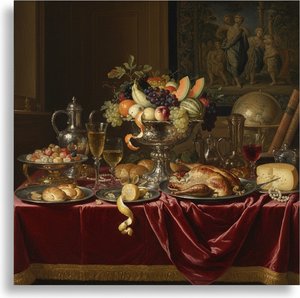
Explore Jan Jansz. Treck’s exquisite Vanitas still-life! A Baroque masterpiece showcasing wealth & mortality through meticulous detail & dramatic lighting. Discover Dutch Golden Age art.
Biografija umetnika
Discover Jan Jansz. Treck, a Dutch Golden Age still-life painter known for economical compositions & subtle vanitas themes. Explore his influence on Anraedt & Kalf.
 Preberi več
od ·
Poglavje 1
Katere velikosti naj bi bila?
Drleč po drslenici spremenite velikost; slika na levi strani prikazuje okvir v njegovi dejanski širini. Razmerja originala so ohranjena.
Izberite eno od naših vnaprej določenih velikosti, ki ustrezajo prvotnim proporcijam umetničkega dela.

Vnesite širino in višino, ki jih potrebujete, da se slika prilega vašemu okviru ali steni. Ker je delo ročno slikano, lahko umetnik pri različnih oblikih slik pri robovih doda malo več barve ali pa jih malo odreže — izberite sami. Pred začetkom slikanja vam pošljemo digitalni predogled za potrditev. Slika, prikazana na tej strani, ni končni rezultat — le predogled prikazuje dejansko podobo.
Poglavje 2
Na kakšen način naj bo dostavljeno?
Izberite robove platna
Izberite svoj okvir

Beli rob €1

zamegljen rob €1

Razširjen rob €1

P118B €10

P118H €10

P118W €10

P438Z €10

P508JH €12

P508YH €12

P805H €10

P805Z €10

P919BZ €10

P919G €10

P919XJ €10

P959ZH €10

P968JZ €12

W106C €8

W218G €10

W218JH €8

W218Y €10

W307PJ €10

W316G €10

W316PJ €8

W316Y €10

W398PJ €8

W4111J €10

W500HY €15

W500JH €15

W692G €12

W849H €8

W940BG €15

W953PJ €8

H24-GOLD €30

H24-SILVER €30

H36-GOLD €45

H36-SILVER €45
V okviru
Okvirni rob: . Celotna velikost z okvirjem: .
Poglavje 3
Kdo to slika in ali bi se moralo kaj spremeniti?
Po oddaji naročila bo ekipa OriginalUniqueArt.com stranki po e-pošti poslala navodila in zagotovila predogled makete
Mednarodna dostava () v 3/4 tednih namesto običajnih 5 tednov. (6 november). Brez kompromisov pri kakovosti.
Poglavje 4
Zadnji dotiki
Zvešča, kot v muzeju?
Podrobnosti o gravirani bronasti plošči
This elegant plaque features the artist's name and the title of the artwork, finely engraved for a timeless presentation.
It is made from bronze with a refined, elegant finish. The text is precisely laser-engraved for a sharp and permanent result. Measuring 9x2 cm, the plaque is compact yet easy to read. It's built to be durable and scratch-resistant, offering a professional, museum-quality look. Mounting is simple thanks to the included adhesive backing.
Podrobnosti o transparentni akrilni plošči
The plaque includes essential engraved details such as the artist's name, the title of the artwork, the date it was created, the type of media used-like oil on canvas or watercolor-a brief description of the piece, and a QR code that links to the complete artwork information.
It is crafted from clear acrylic, offering a sleek, modern appearance. The text is UV-engraved in black to ensure strong visual contrast. With a size of 10x15 cm, it ensures optimal readability. It comes equipped with two metal hooks for secure wall mounting. The plaque is designed to be weather-resistant, making it suitable for various environments, and it includes interactive features that work seamlessly with smartphone scanning.
Podrobnosti o črni akrilni plošči
This elegant plaque includes engraved information such as the artist's name, the title of the artwork, the date it was created, the type of media used (like oil on canvas or watercolor), a short description of the artwork, and a QR code for quick access to more information.
The plaque itself is made from refined black acrylic with a premium finish. The text is laser-engraved in white for high contrast and readability. Its size is 10x15 cm, designed to be easy to read. It comes with two metal hooks for professional mounting. The design is sleek and fits any interior style. It is also weather-resistant and durable, with built-in digital integration for mobile compatibility.
Zaščitni lak?
Kdaj jo potrebujete?
Poglavje 5
Vaša slika, natako kot ste jo naročili

Vanitas Still-life
Tehnik reprodukcije
Velikost reprodukcije
-

Izbor vrhunskih umetnikov
Več podrobnosti, dovršenosti in dodatnega časa za izdelavo
-

Okvir za reprodukcijo
-
-
Za umetniška dela ali reprodukcije, ki so po katerikoli strani širše od 105 cm (približno 41 palč), bo okvir poslan v razstavljeni obliki kot komplet. Ta metoda zagotavlja varno dostavo in preprečuje poškodbe med transportom.
Potrebna je profesionalna montaža – to ni izdelek za DIY izdelavo.
Komplet mora sestaviti in platno napeti izkušen profesionalni okvirjest, pri čemer bo uporabil lepil za les (ni vključeno), klešče za napetje platna in spone, da bi ohranil pravokotnost letev med sušenjem lepila. Nepravilna montaža ali neenakomerna napetost platna lahko trajno poškoduje umetniško del in
 Za umetniška dela ali reprodukcije, ki so po katerikoli strani širše od 105 cm (približno 41 palč), bo okvir poslan v razstavljeni obliki kot komplet. Ta metoda zagotavlja varno dostavo in preprečuje poškodbe med transportom.
Vključene so vse letve iz masivnega lesa, natančno izrezane po meri.
Montaža poteka s priloženimi vijaki, vendar je za kotiče potrebna lepil za les, ki ga ni v kompletu in ga mora zagotoviti vaš okvirnik.
Za uporabo so potrebna profesionalna orodja, ki niso vključena: klešče za napinjanje platna (napetnik) in sponke za ohranjanje pravokotnosti letev med sušenjem lepila.
Pomembno:
Za stike v kotih potrebujete lepil za les, nosilce je treba z

Značka z imenom
-
-

Zaščitni lak
Sijajni lak (poudarja barve ter zagotavlja zaščito pred svetlobo in vlago)
-

Prilagodi svoje umetniško delo
Primeri možnih prilagoditev: zamenjava obraza s fotografijo kupca; dodajanje hišnega ljubljenčka (npr. zamenjava mačke s psom); vključitev skritega sporočila v ozadje; sprememba krajšave ali elementov ozadja.
-

Hitra dostava
Mednarodna dostava () v 3/4 tednih namesto običajnih 5 tednov. (6 november). Brez kompromisov pri kakovosti.
-
Hitra dostava
Globalna dostava () v 5 tednih. (13 november).
Vključeno v ceno
Skupna cena
€ 268
Možnost stekla je na voljo le za velikosti pod 110 cm
Vključeno v vsako naročilo
- Brezplačna ekspresna dostava po vsem svetu
- Visokokakovostno laneno platno
- Popolno zavarovanje pošiljke
- Garancija povračila carine in uvoznih davkov
- Garancija popolnega barvnega ujemanja
- 100-dnevna politika vračil (le v primeru okvar)
- Garancija 100% povračila denarja
- Popust pri večjem naročilu


 Predogled v realnem okolju
 Pošlji
 Deli
Deli
 Podrobnosti o delu
 Priročnik

 Prenesi sliko
 Podobni izdelki
 Rentgenski posnetek
 Predvajaj diaporama
 Vprašanja in odgovori
 Statistika
V številkah
- 29izbira okvirjev
- standardne velikosti, v svojih lastnih proporcijah
- 5teden dni za slikanje in dostavo
O originalnem delu


Jan Jansz. Treck
1606 - 1652, Netherlands
Kratek pregled o Jan Jansz. Treck
- Artistic Movement Or Style: Dutch Golden Age
- Artists Or Movements Influenced By This Artist:
- Pieter van Anraedt
- Willem Kalf
- Artists Who Influenced This Artist:
- Jan den Uyl
- Pieter Claesz
- Willem Kalf
- Full Name: Jan Jansz. Treck
- Place Of Birth: Amsterdam, Netherlands
- Date Of Birth: 1606
- Date Of Death: 1652
Biografija umetnika
Jan Jansz. Treck: A Master of Subtle Mortality
Born in Amsterdam around 1606 and tragically passing away in 1652, Jan Jansz. Treck remains a quietly significant figure within the Dutch Golden Age’s pantheon of still-life painters. While not as widely celebrated as contemporaries like Pieter Claesz or Willem Kalf, Treck’s work possesses a unique depth and understated elegance, characterized by economical compositions, meticulous detail, and a profound exploration of *vanitas* themes – reminders of mortality and the transience of earthly pleasures.
Treck's early artistic training was unconventional. He began his apprenticeship with Jan den Uyl, his brother-in-law, a connection that profoundly shaped his style. Den Uyl’s sudden death in 1640 proved pivotal; Treck subsequently assumed the role of guardian for the young children and executor of the estate, a responsibility that demanded both practicality and artistic skill. This period saw him not only managing the family's affairs but also absorbing and adapting Den Uyl’s techniques – a style marked by its careful observation of objects and a subtle use of light and shadow.
His apprenticeship with Abraham Jansz. for four guilders a week, though seemingly modest, reveals a dedication to his craft. Notably, Treck faced financial difficulties, requiring funds to construct a window that enhanced the lighting in his studio – a testament to his belief that adequate illumination was crucial for achieving the desired effects in his paintings. The fact that he had to pay for this window while struggling financially underscores the demanding nature of his profession and his commitment to artistic excellence.
Treck’s early signed and dated works, emerging around 1641 after Den Uyl's death, provide valuable insights into his development. There is even speculation that he may have completed some of Den Uyl’s unfinished paintings, a testament to the close relationship between the two artists. His work frequently featured objects associated with wealth and status – luxurious fabrics, exotic fruits, musical instruments, and scientific instruments – all arranged within carefully constructed still-life compositions. However, these symbols were always imbued with a sense of melancholy, prompting viewers to contemplate their fleeting nature.
The Influence of Pieter Claesz and Willem Kalf
Treck’s style demonstrates clear influences from two prominent Dutch still-life painters: Pieter Claesz and Willem Kalf. Like Claesz, Treck possessed an exceptional eye for detail and a mastery of light and shadow, creating remarkably realistic depictions of objects. However, unlike Kalf's often brightly lit and dramatically staged compositions, Treck’s works tend to be more subdued and contemplative, reflecting a deeper engagement with the *vanitas* theme.
Furthermore, Treck was influenced by Willem Kalf, particularly in his use of perspective and his ability to create a sense of depth within a relatively small format. However, Treck’s compositions are generally more restrained than Kalf's, emphasizing the objects themselves rather than creating elaborate theatrical arrangements.
A Legacy of Subtle Symbolism
Treck’s paintings are not merely decorative; they are imbued with symbolic meaning. The *vanitas* still-life genre, which flourished during the Dutch Golden Age, served as a moralistic reminder of human mortality and the futility of worldly pursuits. Treck skillfully employed objects such as decaying fruit, wilting flowers, extinguished candles, and hourglasses to convey this message. His arrangements are not overtly didactic but rather invite viewers to reflect on their own lives and contemplate the inevitability of death.
The fact that Simon Luttichuys, a renowned painter in his own right, was commissioned to repaint one of Treck’s *vanitas* paintings in 1661 speaks volumes about the quality and impact of his work. This commission suggests that Treck's compositions were not merely aesthetically pleasing but also intellectually stimulating, prompting viewers to engage with profound philosophical questions.
Personal Life and Artistic Inheritance
Beyond his artistic achievements, Treck’s personal life offers a glimpse into the realities of 17th-century Amsterdam. He was involved in managing his family's affairs, including selling his brother-in-law’s house on Singel. Following Abraham Jansz.’s death, he purchased his friend’s equipment – paint, brushes, and an easel – demonstrating a commitment to preserving his artistic practice. Upon his own demise in 1652, Treck's estate was divided among his brother, sister, nieces, and nephews, encompassing a modest house, furniture, clothing, coins, jewelry, prints, and paintings—a tangible representation of a life dedicated to art.
Treck’s influence can be seen in the work of later painters such as Pieter van Anraedt and Willem Kalf, suggesting that his subtle approach to still-life painting resonated with subsequent generations of artists. While he may not command the same level of recognition as some of his contemporaries, Jan Jansz. Treck remains a compelling figure in Dutch Golden Age art—a master of understated elegance and a poignant observer of human mortality.
Sorodni članki

Dutch Baroque Masters: 10 Paintings That Shaped an Era | OriginalUniqueArt
Journey through the Golden Age with our guide to the Top 10 Dutch Baroque masterpieces! Explore iconic paintings by Rembrandt, Vermeer & Frans Hals. Find museum-quality art reproductions and elevate your home decor at OriginalUniqueArt.com.

Golden Age Reflections: Dutch Baroque Painting & Cultural Innovation
Explore the Dutch Golden Age of painting! Discover key artists like Vermeer & ter Borch, their innovative techniques, and the rich cultural context behind these Baroque masterpieces. Learn about collecting & appreciating this iconic art period.

10 Mojstrovin Nizozemske Zlate dobe: Umjetnost, ki je definirala svojo dobo
Odkrijte 10 mojstrovin Nizozemske zlate dobe! Rembrandt, Vermeer & več – spoznajte zgodbe za temi ikoničnih umetnin. Inspirirajte se za notranji dizajn in poiščite reprodukcije na OriginalUniqueArt.com!
Abraham Hendricksz van Beyeren: Pioneering Dutch Still Life & the Banquet Tradition
Explore the captivating world of Dutch Golden Age still life with Abraham van Beyeren. Discover his innovative techniques, symbolic banquet scenes & lasting influence on art history. Learn about collecting these masterpieces.