
 Predogled v realnem okolju
 Pošlji
 Deli
Deli
 Podrobnosti o delu
 Priročnik

 Prenesi sliko
 Podobni izdelki
 Rentgenski posnetek
 Predvajaj diaporama
 Vprašanja in odgovori
 Statistika
Self-Portrait.

- 75.0 x 62.0 cm


 Preberi več
Giclée tisk / Umetniški tisk
Giclée ali platnati odtis muzejske kakovosti z hitro proizvodnjo in prilagodljivimi možnostmi končne obdelave. ( Kupite ročno slikano delo Preklop na digitalno sliko)




P118B €10

P118H €10

P118W €10

P438Z €10

P508JH €12

P508YH €12

P805H €10

P805Z €10

P919BZ €10

P919G €10

P919XJ €10

P959ZH €10

P968JZ €12

W106C €8

W218G €10

W218JH €8

W218Y €10

W307PJ €10

W316G €10

W316PJ €8

W316Y €10

W398PJ €8

W4111J €10

W500HY €15

W500JH €15

W692G €12

W849H €8

W940BG €15

W953PJ €8




Izberite eno od naših vnaprej določenih velikosti, ki ustrezajo prvotnim proporcijam umetničkega dela.

Vnesite širino in višino, ki jih potrebujete za svoj okvir ali steno. Tiskanje se lahko le odreže, vendar ga ni mogoče narediti večjega od slike, zato format z drugačno obliko pomeni izgubo dela slike. Pred tiskanjem vam pošljemo digitalni predogled za potrditev. Slika, prikazana na tej strani, ne prikazuje dejanskega izrezka — le predogled to omogoča.
Globalna dostava () v 2 tednih namesto standardnih 4/5 tednov. (10 november)

Brezplačna ekspresna dostava po vsem svetu

Visokokakovostno laneno platno

Popolno zavarovanje pošiljke

Garancija povračila carine in uvoznih davkov

Garancija popolnega barvnega ujemanja

100-dnevna politika vračil (le v primeru okvar)

Garancija 100% povračila denarja

Popust pri večjem naročilu
 Možnost stekla je na voljo le za velikosti pod 110 cm

Self-Portrait.
Giclée tisk / Umetniški tisk
Velikost reprodukcije
-


Skupna cena
€ 73
Ilya Repin’s ‘Self-Portrait’: A Window into a Russian Soul
The Tretyakov Gallery in Moscow holds within its walls not just paintings, but echoes of a nation's spirit – and few works capture that essence more powerfully than Ilya Yefimovich Repin’s “Self-Portrait,” painted in 1887. This oil on canvas, measuring a modest 75 x 62 cm, transcends the simple act of portraiture; it’s an intimate revelation, a glimpse into the mind and character of one of Russia's most significant realist painters. More than just a likeness, Repin presents himself as a thoughtful observer, a man wrestling with intellectual depth and quiet confidence – a figure both familiar and profoundly compelling.
Repin’s decision to depict himself in such a deliberate manner is crucial to understanding the painting's significance. Created during a period of intense social and political change in Russia, the portrait reflects a growing awareness of individual identity within a rapidly modernizing society. The neutral background – a subtle wash of grey-brown – serves not as distraction but as a carefully considered stage for the artist’s face. It allows the viewer to fully absorb his gaze, a direct challenge and invitation simultaneously. The meticulous rendering of his features—the strong jawline, the slightly furrowed brow, the piercing eyes—is executed with a remarkable sensitivity to light and shadow, creating a palpable sense of three-dimensionality that draws us into his world.
Realism as a Reflection of Life
“Self-Portrait” is a cornerstone of Repin’s commitment to Realism. Unlike the idealized portraits prevalent in earlier eras, this work eschews romantic embellishment and strives for an honest depiction of the artist himself. Repin wasn't interested in presenting a heroic or glamorous image; instead, he sought to capture the reality of his own appearance – the lines etched by time and thought, the subtle signs of a life lived with intensity. This commitment to accuracy is further emphasized by the muted color palette—a deliberate choice that avoids distracting from the details of his face and clothing. The dark suit and tie, rendered with careful attention to texture, speak to his status as a respected artist, while the slightly worn fabric hints at a groundedness, an awareness of the everyday realities of life.
Symbolism in Simplicity
While seemingly straightforward, “Self-Portrait” is rich in subtle symbolism. The serious expression on Repin’s face isn't merely one of contemplation; it suggests a burden of responsibility, perhaps reflecting his role as both an artist and a keen observer of the social landscape around him. The long, curly hair – a distinctive feature of his appearance – adds to the sense of individuality and challenges conventional notions of masculine beauty. It’s a deliberate statement of self-awareness, suggesting that Repin was comfortable in his own skin and unafraid to defy expectations. The painting can be interpreted as a meditation on identity, perception, and the complexities of being human.
A Legacy of Russian Art
“Self-Portrait” stands as a testament to Repin’s enduring legacy as one of Russia's most important artists. His work, deeply rooted in the experiences of ordinary people – from the barge haulers on the Volga to the Cossacks of Kursk Province – continues to resonate with audiences today. As evidenced by his other celebrated works like “Reply of the Zaporozhian Cossacks,” Repin possessed a rare ability to capture not just physical likeness but also the very essence of human emotion and experience. The painting’s placement within the Tretyakov Gallery, alongside masterpieces from Russian art history, underscores its significance as a pivotal work in the nation's artistic heritage. Reproductions like those offered by OriginalUniqueArt.com allow us to appreciate this powerful image with unparalleled clarity and detail, bringing Repin’s profound insights into our own lives.
Vprašanja in odgovori
Priporočena uporaba in prostor za "Self-Portrait." avtorja Ilya Repin?
Za Statement se priporoča "Self-Portrait.", priporočena prostorina pa je Living Room.
Ali je "Self-Portrait." avtorja Ilya Repin priporočljivo darilo in za koga?
"Self-Portrait." je priporočeno kot darilo za Birthday, z mislijo na Statement.
Kako lahko odkrijem umetniška dela, podobna delu "Self-Portrait." avtorja Ilya Repin?
Stran Podobna dela za delo "Self-Portrait." avtorja Ilya Repin prikazuje sorodna umetniška dela.
Biografija umetnika
Ilya Yefimovich Repin (1844–1930): The Soul of Russian Realism
Ilya Yefimovich Repin, a name that resonates with the very soul of Russian art, was born in 1844 in the humble Ukrainian town of Chuguev. His origins were far removed from the aristocratic circles often associated with artistic patronage; his father, a former soldier who traded horses, and his mother, deeply rooted in local traditions, instilled in young Ilya a profound connection to the land and its people. This early immersion into rural life – its hardships, its vibrant spirit, and its unwavering resilience – would become the bedrock of his artistic vision. Formal education began at a local school where his mother taught, but a period at a military cantonist school followed, an experience Repin later recalled with little fondness. Yet, even within the rigid confines of military discipline, his innate talent for drawing blossomed. At sixteen, he apprenticed himself to Ivan Bunakov, an icon painter, embarking on a rigorous training in religious art that honed his skills in meticulous detail and compositional precision. These formative years were not merely technical exercises; they represented a crucial immersion into the visual language of Russian culture, laying the groundwork for his later explorations of national identity and social commentary. Through restoring ancient icons and fulfilling portrait commissions, Repin began to observe and capture the essence of human character – a skill he would master throughout his illustrious career.Early Life and Artistic Foundations
Repin’s childhood was marked by modest circumstances but imbued with a strong familial bond. His father's military service instilled in him a sense of duty and discipline, while his mother’s connection to local traditions fostered an appreciation for the everyday realities of rural Russia. This formative experience profoundly shaped Repin’s artistic sensibility—a sensitivity to human emotion and suffering that would characterize much of his oeuvre. Despite initial difficulties with formal schooling, Repin's talent for drawing quickly emerged, demonstrating a natural aptitude for visual representation. His apprenticeship with Ivan Bunakov provided invaluable training in icon painting, mastering the techniques of meticulous detail and compositional precision – skills honed during those years that would prove crucial to his later artistic endeavors. The influence of Bunakov’s teachings extended beyond mere technical proficiency; it instilled a deep understanding of Russian religious iconography and its symbolic language.St. Petersburg and the Peredvizhniki Movement
Driven by ambition and fueled by an unwavering belief in the transformative power of art, Repin moved to St. Petersburg in 1863, seeking admission to the Imperial Academy of Arts. Despite facing initial rejection—a setback he overcame through diligent study and perseverance—Repin embraced the city’s vibrant artistic milieu. It was here that he encountered Ivan Kramskoi, a pivotal figure in the Peredvizhniki movement – a collective of realist artists who vehemently opposed academic conventions and championed an honest depiction of Russian life. Kramskoi became Repin's mentor, guiding him toward a more socially conscious art and fostering connections with fellow artists who shared his commitment to portraying the human condition with unflinching honesty. This encounter marked a turning point in Repin’s artistic trajectory—introducing him to the intellectual currents of the time and shaping his worldview. The Peredvizhniki's rejection of idealized beauty and embrace of social realism profoundly influenced Repin’s artistic vision, inspiring him to tackle challenging subjects and convey powerful emotions.Major Works: Capturing Russian Life and History
Repin’s artistic output spanned decades, producing a remarkable body of work that cemented his reputation as Russia's foremost realist painter. His breakthrough masterpiece, *Barge Haulers on the Volga* (1873), captured the grueling labor of ordinary men hauling barges along the Volga River—a scene rendered with breathtaking detail and imbued with palpable emotion. The painting’s monumental scale and dramatic lighting powerfully conveyed the hardships endured by the working class while simultaneously serving as a critique of social injustice. This work established Repin's mastery of realism and solidified his place among the leading artists of his time. He continued to explore themes of Russian history and society in subsequent paintings, including *Reply of the Zaporozhian Cossacks* (1880–1891), which celebrated the defiant spirit of Ukrainian Cossacks resisting Ottoman rule—a scene brimming with dynamism and expressive gesture. Repin’s portrayal of Ivan the Terrible killing his son (*Ivan the Terrible and His Son Ivan*) (1885) remains one of his most unsettling masterpieces, delving into psychological complexity and confronting viewers with uncomfortable truths about power and remorse.Legacy and Influence
Repin's artistic legacy extends far beyond his individual paintings—he profoundly shaped the trajectory of Russian art history. He championed realism as a means of conveying social commentary and capturing the human condition with empathy and insight, influencing generations of artists who followed him. His unwavering commitment to portraying everyday life and historical events established him as a towering figure in European art, securing his place among the most celebrated painters of the 19th century. Repin’s work continues to inspire admiration for its technical brilliance and emotional depth—a testament to his enduring artistic vision and his profound understanding of the human spirit. His influence can be seen in the works of numerous artists who embraced realism as a means of expressing social concerns and exploring psychological complexities, ensuring that Repin's legacy persists as one of the cornerstones of Russian art history.
Ilya Repin
1844 - 1930 , Rusija
Hitri podatki
- Artistic Movement Or Style: Realizem
- Artists Who Influenced This Artist:
- Ivan Kramskoi
- Vladimir Stasov
- Date Of Birth: 5 avgusta 1844
- Date Of Death: 29 septembra 1930
- Full Name: Ilya Yefimovich Repin
- Nationality: Rus
- Notable Artworks:
- Barge Haulers on the Volga
- Odgovor Zaporozhskih kozakov
- Ivan Tišči in njegov sin Ivan
- Place Of Birth (City And Country): Čugujev, Rusija
Sorodni članki

Soul of the Steppes: Capturing the Majesty and Social Realism of 19th Century Russian Art
Explore the profound beauty of 19th-century Russian art. From Ilya Repin's realism to pastoral landscapes, discover the soul of the steppes through our expert historical analysis and museum-quality hand-painted reproductions for discerning collectors.

Russian Realism: The Soulful Power of Truth and the Unyielding Spirit of the Peredvizhniki
Explore the profound depth of Russian Realism. From the social truths of the Peredvizhniki to epic folklore, discover the soulful power of masters like Perov and Yaroshenko through our expert art history insights and museum-quality reproductions.
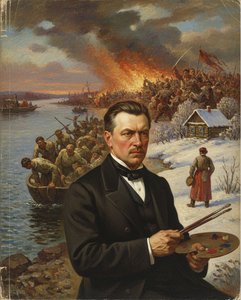
Ilya Repin: Realism, Revolution & the Russian Soul – A Comprehensive Exploration of Life and Legacy
Explore the life & legacy of Ilya Repin, Russia's leading realist painter. Discover his iconic works like 'Barge Haulers on the Volga,' social commentary, and profound portraits. A comprehensive guide for art enthusiasts.

Vladimir Makovsky: Realism, Social Commentary & Russian Life in Late 19th-Century Painting
Explore the captivating world of Vladimir Makovsky, a leading Russian realist painter. Discover his insightful depictions of 19th-century life, social commentary & legacy with OriginalUniqueArt.

Discover Russian Realism: Soulful Masterpieces and the Timeless Spirit of the Peredvizhniki for Your Modern Home
Elevate your home with the soulful beauty of Russian Realism. Discover exquisite hand-painted reproductions of Peredvizhniki masterpieces, from lyrical landscapes to profound portraits, curated to bring historical depth and timeless elegance to your modern interior design.


