

 Preverite v realnem okolju
 Pošlji kot čestitko
 Deli
Deli
 Podrobnosti
 Priročnik

 Prenesi
 Podobni artefakti
 Rentgenski posnetek
 Predvajaj diaporama
 Statistika
Arrival tsars Piotr and Ioann


 Preberi več
Ročno izdelana oljna reprodukcija
Ročno slikano olje na platnu v vaši izbiri velikosti in okvirja, izdelano po naročilu naših umetnikov. ( Preklop na tiskanine Preklop na digitalno sliko)




P118B $10

P118H $10

P118W $10

P438Z $10

P508JH $12

P508YH $12

P805H $10

P805Z $10

P919BZ $10

P919G $10

P919XJ $10

P959ZH $10

P968JZ $12

W106C $8

W218G $10

W218JH $8

W218Y $10

W307PJ $10

W316G $10

W316PJ $8

W316Y $10

W398PJ $8

W4111J $10

W500HY $15

W500JH $15

W692G $12

W849H $8

W940BG $15

W953PJ $8




Izberite eno od naših vnaprej določenih velikosti, ki ustrezajo prvotnim proporcijam umetničkega dela.

Svoje dimenzije lahko vnesete tako, da se prilagodite določenemu okvirju ali prostoru. Če izbrana velikost ne ustreza razmerjem originalne slike, bomo umetniško delo obrezali ali sliko dopolnili z dodatnimi ročno naslikanimi elementi. Pred začetkom proizvodnje vam bo poslan digitalni osnutek v odobritev.
Upoštevajte, da predogled na zaslonu ne odraža dejanskega obrezovanja ali podaljšanja. Le osnutek bo natančno prikazal končno kompozicijo.
Čeprav so na voljo velikosti po meri, priporočamo izbiro dimenzije s preddefiniranega seznama, da ohranimo originalne razmere.
Po oddaji naročila bo ekipa OriginalUniqueArt.com stranki po e-pošti poslala navodila in predogled digitalnega predogleda.
Mednarodna dostava () v 3/4 tednih namesto običajnih 5 tednov. (25 september). Brez kompromisov pri kakovosti.

Brezplačna ekspresna dostava po vsem svetu

Visokokakovostno laneno platno

Popolno zavarovanje pošiljke

Garancija povračila carine in uvoznih davkov

Garancija popolnega barvnega ujemanja

Politika vračila v 100 dneh (le v primeru okvar)

Garancija 100% povračila denarja

Popust pri večjem naročilu
 Možnost stekla je na voljo le za velikosti pod 110 cm

Arrival tsars Piotr and Ioann
Tehnika reprodukcije
Velikost reprodukcije
-


Skupna cena
$ 300
A Window Into Imperial Russia
In the grand tapestry of late nineteenth-century Russian art, few works capture the palpable tension of a vanishing era as profoundly as Ilya Yefimovich Repin’s 1900 masterpiece, Arrival tsars Piotr and Ioann. This monumental achievement of Realism serves as much more than a mere historical record; it is a meticulously crafted tableau that breathes life into the anxieties and aspirations of Imperial Russia. At its heart, the painting depicts the formal greeting between Tsar Nicholas II and his brother Mikhail Alexandrovich upon their return from Crete, yet Repin transcends simple documentation. He invites the viewer to step into a moment frozen in time, where the weight of tradition meets the encroaching uncertainty of a new century.
The composition is a masterclass in psychological depth. While the central figures—the two tsars—are rendered with striking detail, Repin avoids the trap of idealized grandeur. Instead, he presents a portrait imbued with a profound sense of human reality. The imperial robes, adorned with opulent embroidery that reflects the immense wealth and prestige of the court, contrast sharply with the subtle tension etched into the monarchs' expressions. There is an unmistakable gravity in their gaze, hinting at the immense pressures of maintaining absolute rule amidst a landscape of growing social unrest. By capturing this deliberate ambiguity, Repint forces us to confront the uncomfortable truths of power and the fragile nature of authority.
The Mastery of Realist Technique
To behold this work is to witness the pinnacle of the Peredvizhniki spirit—the movement dedicated to truth and social observation. Repin’s technique is rooted in an uncompromising commitment to accuracy. He employs a sophisticated, muted color palette dominated by earthy tones—deep browns, warm ochres, and mossy greens—which grounds the historical scene in an atmosphere of authenticity and weight. Every texture, from the heavy fabric of the royal garments to the weathered faces of the onlookers, is rendered with a precision that feels almost tactile.
The artist’s ability to manage light and shadow creates a sense of dramatic presence, drawing the eye through the diverse crowd that populates the scene. This inclusion of various strata of Russian society—from the high-ranking members of the royal court to the common observers—underscores the complex interplay between the ruling elite and the people. The subtle inclusion of details, such as a dog resting near the periphery, adds a layer of domestic realism that softens the monumental scale of the event, making the historical moment feel intimately accessible.
An Enduring Legacy for the Discerning Collector
For art lovers and collectors, Arrival tsars Piotr and Ioann offers an unparalleled opportunity to possess a piece of history that resonates with emotional and intellectual depth. As a reproduction, this work brings the soulful truth of Russian Realism into the modern interior, providing a sophisticated focal point that sparks conversation and contemplation. Its rich, earthy tones and classical composition make it an exquisite addition to any curated space, whether it be a formal gallery or a refined living area.
For interior designers, this painting serves as a profound anchor for decor inspired by historical grandeur or academic elegance. The painting’s ability to evoke a sense of "the Russian soul"—a blend of resilience, tragedy, and majesty—allows it to complement textures like dark wood, velvet, and antique metals. Owning a high-quality reproduction of this Repin masterpiece is not merely about decorating a wall; it is about inviting the profound narrative of human history and the masterful hand of a legendary painter into one's personal sanctuary.
Biografija umetnika
Ilya Yefimovich Repin (1844–1930): The Soul of Russian Realism
Ilya Yefimovich Repin, a name that resonates with the very soul of Russian art, was born in 1844 in the humble Ukrainian town of Chuguev. His origins were far removed from the aristocratic circles often associated with artistic patronage; his father, a former soldier who traded horses, and his mother, deeply rooted in local traditions, instilled in young Ilya a profound connection to the land and its people. This early immersion into rural life – its hardships, its vibrant spirit, and its unwavering resilience – would become the bedrock of his artistic vision. Formal education began at a local school where his mother taught, but a period at a military cantonist school followed, an experience Repin later recalled with little fondness. Yet, even within the rigid confines of military discipline, his innate talent for drawing blossomed. At sixteen, he apprenticed himself to Ivan Bunakov, an icon painter, embarking on a rigorous training in religious art that honed his skills in meticulous detail and compositional precision. These formative years were not merely technical exercises; they represented a crucial immersion into the visual language of Russian culture, laying the groundwork for his later explorations of national identity and social commentary. Through restoring ancient icons and fulfilling portrait commissions, Repin began to observe and capture the essence of human character – a skill he would master throughout his illustrious career.Early Life and Artistic Foundations
Repin’s childhood was marked by modest circumstances but imbued with a strong familial bond. His father's military service instilled in him a sense of duty and discipline, while his mother’s connection to local traditions fostered an appreciation for the everyday realities of rural Russia. This formative experience profoundly shaped Repin’s artistic sensibility—a sensitivity to human emotion and suffering that would characterize much of his oeuvre. Despite initial difficulties with formal schooling, Repin's talent for drawing quickly emerged, demonstrating a natural aptitude for visual representation. His apprenticeship with Ivan Bunakov provided invaluable training in icon painting, mastering the techniques of meticulous detail and compositional precision – skills honed during those years that would prove crucial to his later artistic endeavors. The influence of Bunakov’s teachings extended beyond mere technical proficiency; it instilled a deep understanding of Russian religious iconography and its symbolic language.St. Petersburg and the Peredvizhniki Movement
Driven by ambition and fueled by an unwavering belief in the transformative power of art, Repin moved to St. Petersburg in 1863, seeking admission to the Imperial Academy of Arts. Despite facing initial rejection—a setback he overcame through diligent study and perseverance—Repin embraced the city’s vibrant artistic milieu. It was here that he encountered Ivan Kramskoi, a pivotal figure in the Peredvizhniki movement – a collective of realist artists who vehemently opposed academic conventions and championed an honest depiction of Russian life. Kramskoi became Repin's mentor, guiding him toward a more socially conscious art and fostering connections with fellow artists who shared his commitment to portraying the human condition with unflinching honesty. This encounter marked a turning point in Repin’s artistic trajectory—introducing him to the intellectual currents of the time and shaping his worldview. The Peredvizhniki's rejection of idealized beauty and embrace of social realism profoundly influenced Repin’s artistic vision, inspiring him to tackle challenging subjects and convey powerful emotions.Major Works: Capturing Russian Life and History
Repin’s artistic output spanned decades, producing a remarkable body of work that cemented his reputation as Russia's foremost realist painter. His breakthrough masterpiece, *Barge Haulers on the Volga* (1873), captured the grueling labor of ordinary men hauling barges along the Volga River—a scene rendered with breathtaking detail and imbued with palpable emotion. The painting’s monumental scale and dramatic lighting powerfully conveyed the hardships endured by the working class while simultaneously serving as a critique of social injustice. This work established Repin's mastery of realism and solidified his place among the leading artists of his time. He continued to explore themes of Russian history and society in subsequent paintings, including *Reply of the Zaporozhian Cossacks* (1880–1891), which celebrated the defiant spirit of Ukrainian Cossacks resisting Ottoman rule—a scene brimming with dynamism and expressive gesture. Repin’s portrayal of Ivan the Terrible killing his son (*Ivan the Terrible and His Son Ivan*) (1885) remains one of his most unsettling masterpieces, delving into psychological complexity and confronting viewers with uncomfortable truths about power and remorse.Legacy and Influence
Repin's artistic legacy extends far beyond his individual paintings—he profoundly shaped the trajectory of Russian art history. He championed realism as a means of conveying social commentary and capturing the human condition with empathy and insight, influencing generations of artists who followed him. His unwavering commitment to portraying everyday life and historical events established him as a towering figure in European art, securing his place among the most celebrated painters of the 19th century. Repin’s work continues to inspire admiration for its technical brilliance and emotional depth—a testament to his enduring artistic vision and his profound understanding of the human spirit. His influence can be seen in the works of numerous artists who embraced realism as a means of expressing social concerns and exploring psychological complexities, ensuring that Repin's legacy persists as one of the cornerstones of Russian art history.
Ilya Repin
1844 - 1930 , Rusija
Ključne informacije
- Artistic Movement Or Style: Realizem
- Artists Who Influenced This Artist:
- Ivan Kramskoi
- Vladimir Stasov
- Date Of Birth: 5 avgusta 1844
- Date Of Death: 29 septembra 1930
- Full Name: Ilya Yefimovich Repin
- Nationality: Rus
- Notable Artworks:
- Barge Haulers on the Volga
- Odgovor Zaporozhskih kozakov
- Ivan Tišči in njegov sin Ivan
- Place Of Birth (City And Country): Čugujev, Rusija
Sorodni članki
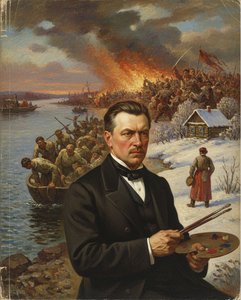
Ilya Repin: Realism, Revolution & the Russian Soul – A Comprehensive Exploration of Life and Legacy
Explore the life & legacy of Ilya Repin, Russia's leading realist painter. Discover his iconic works like 'Barge Haulers on the Volga,' social commentary, and profound portraits. A comprehensive guide for art enthusiasts.

Vladimir Makovsky: Realism, Social Commentary & Russian Life in Late 19th-Century Painting
Explore the captivating world of Vladimir Makovsky, a leading Russian realist painter. Discover his insightful depictions of 19th-century life, social commentary & legacy with OriginalUniqueArt.

Soul of the Steppes: Capturing the Majesty and Social Realism of 19th Century Russian Art
Explore the profound beauty of 19th-century Russian art. From Ilya Repin's realism to pastoral landscapes, discover the soul of the steppes through our expert historical analysis and museum-quality hand-painted reproductions for discerning collectors.

Vasily Surikov: Historical Epic & Psychological Realism in 19th-Century Russian Painting
Explore the powerful historical paintings of Vasily Surikov, a leading figure of Russian Realism. Discover his dramatic compositions, psychological depth & lasting influence on 19th-century art. Learn about collecting Surikov's masterpieces.

Russian Realism: The Soulful Power of Truth and the Unyielding Spirit of the Peredvizhniki
Explore the profound depth of Russian Realism. From the social truths of the Peredvizhniki to epic folklore, discover the soulful power of masters like Perov and Yaroshenko through our expert art history insights and museum-quality reproductions.


