

 Preverite v realnem okolju
 Pošlji kot čestitko
 Deli
Deli
 Podrobnosti
 Priročnik

 Prenesi
 Podobni artefakti
 Rentgenski posnetek
 Predvajaj diaporama
 Statistika
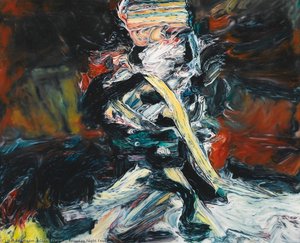
Saturday Night Fever
 79.0 x 97.0 cm
 Preberi več
Giclée tisk / Umetniški tisk
Giclée ali platnati odtis muzejske kakovosti z hitro proizvodnjo in prilagodljivimi možnostmi končne obdelave. ( Naročite ročno slikano reprodukcijo Preklop na digitalno sliko)




































Izberite eno od naših vnaprej določenih velikosti, ki ustrezajo prvotnim proporcijam umetničkega dela.

Svoje dimenzije lahko vnesete sami, da bodo ustrezne za določen okvir ali prostor. Če izbrana velikost ne bo skladna z razmerji izvirne slike, bomo umetniško delo orezali ali podaljšali s pomočjo ogledalnega odraza ali barvno polnega roba. Pred začetkom proizvodnje vam bomo poslali digitalni predogled za potrditev.
Upoštevajte, da predogled na zaslonu ne prikazuje dejanskega orezovanja ali podaljševanja. Le digitalni predogled bo natančno prikazal končno kompozicijo.
Čeprav so na voljo prilagojene velikosti, priporočamo izbiro dimenzije s predhodno določenega seznama, da ohranite prvotna razmerja.
Globalna dostava () v 2 tednih namesto standardnih 4/5 tednov. (26 september)

Brezplačna ekspresna dostava po vsem svetu

Visokokakovostno laneno platno

Popolno zavarovanje pošiljke

Garancija povračila carine in uvoznih davkov

Garancija popolnega barvnega ujemanja

Politika vračila v 100 dneh (le v primeru okvar)

Garancija 100% povračila denarja

Popust pri večjem naročilu
 Možnost stekla je na voljo le za velikosti pod 110 cm

Saturday Night Fever
Giclée tisk / Umetniški tisk
Velikost reprodukcije
-


Skupna cena
$ 80
Biografija umetnika
Glenn Brown: A Painter of Dreams and Echoes
Glenn Brown, born in Hexham, Northumberland, in 1966, isn’t simply an artist; he's a conjurer of images, a weaver of narratives drawn from the detritus of art history and the shimmering surfaces of contemporary culture. His work, often unsettling yet undeniably beautiful, invites prolonged contemplation, demanding that we question our assumptions about originality, authorship, and the very nature of seeing. Brown’s career has been marked by a deliberate blurring of boundaries – between painting and drawing, image and reality, past and present – resulting in a body of work that is both deeply personal and profoundly universal.
Early influences shaped Brown's distinctive approach. He began his artistic journey at Norwich School of Art & Design, followed by studies at Bath College of Higher Education and Goldsmiths College, London. These formative years instilled in him a critical awareness of art’s history, but also a rebellious impulse to challenge its established conventions. Crucially, he wasn't interested in replicating the past; instead, he sought to engage with it through a process of appropriation – taking existing images, altering them beyond recognition, and re-presenting them as something entirely new.
The Language of Appropriation
At the heart of Brown’s practice lies his masterful use of appropriation. He doesn't merely copy; he transforms. His sources are remarkably diverse, ranging from Old Masters like Rembrandt and Adolph von Menzel to Surrealists such as Salvador Dalí, and even contemporary sci-fi painters like Chris Foss. These images – often found in exhibition catalogues or reproduced online – become the raw material for his paintings, drawings, and sculptures. He meticulously manipulates colour, scale, orientation, and composition, creating a sense of disorientation and unease. As J.M. Gallais aptly described it, Brown’s work is “deliquescent,” dissolving into a haze of unsettling beauty.
This process isn't without controversy. Critics have questioned whether his appropriation constitutes plagiarism, arguing that he simply re-presents existing images without adding significant artistic value. However, Brown consistently defends his approach, asserting that the act of altering and recombining pre-existing imagery is itself a form of creative expression. He sees himself as engaging in a dialogue with art history, using it not as a source of inspiration but as a springboard for exploring fundamental questions about representation and perception.
Technique and Aesthetic
Brown’s technical skill is undeniable. His paintings are characterized by their remarkable smoothness – an illusion created through the application of thin layers of oil paint, meticulously built up to create a surface that appears almost photographic in its clarity. Yet, beneath this veneer of realism lies a profound sense of unease. The colours are often jarring and discordant, the forms distorted and grotesque, and the overall effect is deeply unsettling. This tension between beauty and horror is a defining feature of his work.
He frequently employs trompe-l'oeil techniques, creating the illusion that his paintings are three-dimensional objects. His use of impasto – thick layers of paint applied to the surface – further enhances this effect, giving the impression that he’s working directly on the canvas with a palette knife. This deliberate manipulation of texture and form challenges our conventional understanding of painting, blurring the boundaries between image and reality.
Major Achievements and Legacy
Glenn Brown's career has been marked by numerous solo exhibitions at prestigious institutions around the world, including the Serpentine Gallery in London, the Kunsthistorisches Museum in Vienna, Tate Liverpool, and the Fondation Sandretto Re Rebaudengo in Turin. He was nominated for the Turner Prize in 2000, a recognition of his significant contribution to contemporary art. In 2019, he received the Commander of the Order of the British Empire (CBE) for his services to the arts.
Brown’s influence extends beyond his own work. He has inspired a generation of artists to explore the possibilities of appropriation and to challenge traditional notions of originality. His willingness to embrace ambiguity, contradiction, and unsettling imagery has paved the way for new approaches to painting and sculpture. His establishment of The Brown Collection in London further solidifies his legacy as an artist deeply invested in both creating and curating art, offering a unique perspective on the relationship between the past, present, and future of artistic expression.
glenn brown
1966 -
Ključne informacije
- Artistic Movement Or Style: Appropriation art
- Artists Or Movements Influenced By This Artist:
- School of London
- Mannerism
- Artists Who Influenced This Artist:
- Rembrandt
- Baselitz
- Dalí
- Date Of Birth: 13 February 1966
- Full Name: Glenn Emerson Keith Brown
- Nationality: British
- Notable Artworks:
- The Day the World Turned Auerbach
- N***** of the World
- Place Of Birth: Hexham, Northumberland