Oljna izvedba
 Vse o Spring







































 Za umetniška dela ali reprodukcije, ki so po katerikoli strani širše od 105 cm (približno 41 palč), bo okvir poslan v razstavljeni obliki kot komplet. Ta metoda zagotavlja varno dostavo in preprečuje poškodbe med transportom.


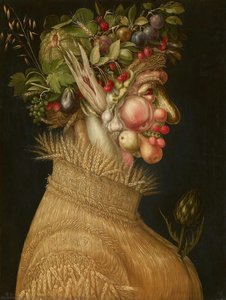
A Botanical Portrait: Unveiling Giuseppe Arcimboldo's "Spring"
Step into a world where nature intertwines with human form in this captivating artwork, “Spring,” created by the ingenious Italian painter, Giuseppe Arcimboldo in 1563. This piece is far more than just a portrait; it’s a vibrant exploration of transformation and the enduring power of the natural world. The subject, almost entirely obscured by an elaborate arrangement of flowers, foliage, and fruits, presents a fascinating enigma. It's a visual riddle that invites viewers to contemplate the relationship between humanity and nature.Mannerism and Artistic Technique
Arcimboldo’s “Spring” exemplifies the Mannerist style, a movement that emerged in 16th-century Italy as a reaction against the High Renaissance's emphasis on classical ideals and naturalism. Notice the elongated proportions of the figure, the dramatic lighting that highlights specific elements, and the overall sense of stylized elegance rather than strict realism. The artwork is skillfully rendered using oil painting techniques, evident in the visible brushstrokes and layered application of pigments which create depth and texture. The dark background serves to amplify the brilliance of the floral components, drawing the eye directly to the central figure’s botanical disguise.Symbolism and Interpretation
Beyond its aesthetic appeal, “Spring” is rich in symbolic meaning. The abundance of flowers and fruits—typical springtime imagery—suggests themes of renewal, growth, and fertility. However, the obscured human form introduces a layer of complexity. It could be interpreted as nature’s dominance over humanity, or perhaps a meditation on the ephemeral quality of human existence compared to the enduring cycle of flora. The composition's asymmetry and unconventional arrangement further contribute to its enigmatic character, prompting viewers to consider multiple interpretations. The careful selection of each botanical element—the type of flower, fruit, or leaf—likely held specific symbolic significance within the context of Renaissance Neo-Platonism, though precise meanings remain open to scholarly debate.Emotional Impact and Legacy
“Spring” evokes a powerful emotional response – one of intense beauty tempered by a slight sense of unease. The distortion of the human form, while visually striking, can be unsettling, prompting reflection on our place within the natural world. Arcimboldo’s innovative approach to portraiture challenged artistic conventions and captivated audiences during his time, particularly at the courts of Ferdinand I, Maximilian II, and Rudolf II. Today, “Spring” stands as a testament to Arcimboldo's unique genius and continues to inspire awe and intrigue in art lovers worldwide. It is a remarkable example of how art can transcend mere representation to become a profound exploration of life, nature, and the human condition.Vprašanja in odgovori
Ali je Spring ročno slikano ali natiskano?
Ročno naslikano: usposobljen slikar kopira Spring v olju na platnu »linen«
Kakšno velikost naj izberem za Spring?
Velikosti so od 36.6 x 27.3 cm (€178) do 243.6 x 182.0 cm (€1460); v tabeli na tej strani so navedeni ključni koraki in njihove cene.
Koliko časa traja dostava?
Dostava traja 4 do 5 tedn"', z brezplačno svetovno ekspresno dostavo; na tej strani je na voljo tudi možnost nujne proizvodnje. Izdelek lahko vrnete v 100 dneh za popoln povračilo denarja, brez kakršnih koli pogojev.
 Predogled v realnem okolju

 Pošlji
 Deli
 Podrobnosti o delu
 Informacijski list


 Prenesi sliko
 Podobni izdelki
 Rentgenski posnetek
 Predvajaj diaporama
 Vprašanja in odgovori

 Statistika