Preklop na tiskanine
 Preberi več







































 Za umetniška dela ali reprodukcije, ki so po katerikoli strani širše od 105 cm (približno 41 palč), bo okvir poslan v razstavljeni obliki kot komplet. Ta metoda zagotavlja varno dostavo in preprečuje poškodbe med transportom.


A Fragment of Surrealist Dreamscape
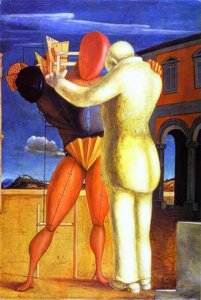
In the hauntingly quiet realm of Giorgio de Chirico’s Piazza d, the boundaries between reality and the subconscious dissolve into a monochrome stillness. This evocative composition serves as a profound exploration of the human psyche, rooted deeply in the existential anxieties that defined early 20th-century Europe. The artwork presents a meticulously crafted illusion, where a solitary statue—a male figure lying prone upon a cobblestone pavement—confronts a nondescript building façade. There is an immediate, unsettling sense of disorientation captured here; the stark juxtaposition of the heavy, resting form against the architectural void mirrors the artist’s lifelong preoccupation with fractured realities and the elusive, often deceptive nature of human perception.
The technique employed by de Chirico is a masterclass in metaphysical tension. While his style is undeniably a precursor to Surrealism, it is anchored by a rigorous, academic draftsmanship learned during his formative years. He utilizes a deliberate flattening of perspective to strip the scene of depth, creating an atmosphere of dreamlike stasis. By choosing a monochrome palette, de Chirico removes the emotional distractions of color, forcing the viewer to confront the raw power of form and texture. The subtle gradations of light and shadow are particularly striking, sculpting the contours of the statue to convey a sense of both monumental permanence and profound vulnerability.
Symbolism and the Weight of Silence
Beyond its visual strikingness, Piazza d is laden with symbolic weight that resonates with anyone who has ever felt the sting of isolation. The statue itself acts as a powerful motif for humanity’s confrontation with mortality and decay. As the figure lies in a state of repose—perhaps sleeping, perhaps eternally still—it embodies a melancholic contemplation of existence. This sense of unease was deeply influenced by the intellectual upheaval of de Chirico's era, particularly the Nietzschean philosophies that challenged traditional moral frameworks and left the individual adrift in an increasingly irrational world.
For the discerning collector or interior designer, this piece offers more than mere decoration; it provides a focal point for deep intellectual engagement. The presence of secondary figures—shadowy individuals engaged in quiet activities near benches—adds layers of narrative complexity, suggesting that even within the vast, empty squares of our dreams, we are never truly alone, yet always fundamentally separate. This artwork is an ideal acquisition for those seeking to infuse a space with sophistication, mystery, and a timeless, contemplative energy.
Vprašanja in odgovori
Katere velikosti tiska "Piazza d" avtorja Željko Čiriko bi ustajali priporočeni sobi?
Priporočena kombinacija za "Piazza d" avtorja Željko Čiriko: tiskanec v velikosti Small v prostorih, kot je Lounge.
Kakšno vzdušje in čustvo izraža "Piazza d" avtorja Željko Čiriko?
Zapisani vzdušje dela "Piazza d" avtorja Željko Čiriko je Mystical, njegov čustveni ton pa je Melancholic.
V kateri umetniški smer spada "Piazza d" avtorja Željko Čiriko?
Umetnostni smer, ki jo zastopa "Piazza d" avtorja Željko Čiriko, je Surrealist Landscape. Ta klasifikacija delo uvršča med sorodne umetnike in umetniška dela.
 Predogled v realnem okolju
 Pošlji
 Deli
Deli
 Podrobnosti o delu
 Priročnik

 Prenesi sliko
 Podobni izdelki
 Rentgenski posnetek
 Predvajaj diaporama
 Q&A
Q&A Statistika