

 Preverite v realnem okolju
 Pošlji kot čestitko
 Deli
Deli
 Podrobnosti
 Priročnik

 Prenesi
 Podobni artefakti
 Rentgenski posnetek
 Predvajaj diaporama
 Statistika
Flow
 Oil On Canvas
- WallArt
- Contemporary Realism
 2013
2013- Contemporary
 100.0 x 200.0 cm
 Preberi več
Umetniška dela, prikazana na tej strani, so zaščitena z avtorskimi pravicami, kar pomeni, da po zakonu ne moremo ustvarjati ali prodajati identičnih reprodukcij. Ta zaščita se izvaja v skladu z mednarodnimi sporazumi, kot so Bernska konvencija in po nacionalnih zakonih, vključno s tistimi, ki jih določa Zakon o avtorskih pravicah ZDA – naslov 17.
Ta način v celoti upošteva zakonodajo o avtorskih pravicah, saj ne vključuje kopiranja ali podvajanja zaščitena umetniškega dela. Namesto tega gre za kreativno preinterpretacijo – novo sliko, ki je navdihnjen rezultat originala, vendar ni z njim identična.
Giclée tisk / Umetniški tisk
Giclée ali platnati odtis muzejske kakovosti z hitro proizvodnjo in prilagodljivimi možnostmi končne obdelave. ( Naročite ročno slikano reprodukcijo Preklop na digitalno sliko)




P118B €10

P118H €10

P118W €10

P438Z €10

P508JH €12

P508YH €12

P805H €10

P805Z €10

P919BZ €10

P919G €10

P919XJ €10

P959ZH €10

P968JZ €12

W106C €8

W218G €10

W218JH €8

W218Y €10

W307PJ €10

W316G €10

W316PJ €8

W316Y €10

W398PJ €8

W4111J €10

W500HY €15

W500JH €15

W692G €12

W849H €8

W940BG €15

W953PJ €8




Izberite eno od naših vnaprej določenih velikosti, ki ustrezajo prvotnim proporcijam umetničkega dela.

Vnesite širino in višino, ki jih potrebujete za svoj okvir ali steno. Tiskanje se lahko le odreže, vendar ga ni mogoče narediti večjega od slike, zato format z drugačno obliko pomeni izgubo dela slike. Pred tiskanjem vam pošljemo digitalni predogled za potrditev. Slika, prikazana na tej strani, ne prikazuje dejanskega izrezkov — le predogled to omogoča.
Globalna dostava () v 2 tednih namesto standardnih 4/5 tednov. (16 oktober)

Brezplačna ekspresna dostava po vsem svetu

Visokokakovostno laneno platno

Popolno zavarovanje pošiljke

Garancija povračila carine in uvoznih davkov

Garancija popolnega barvnega ujemanja

Politika vračila v 100 dneh (le v primeru okvar)

Garancija 100% povračila denarja

Popust pri večjem naročilu
 Možnost stekla je na voljo le za velikosti pod 110 cm

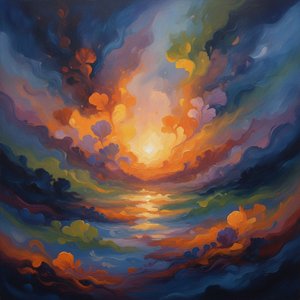
Flow
Giclée tisk / Umetniški tisk
Velikost reprodukcije
-


Skupna cena
€ 70
A Symphony of Light and Memory
In the vast landscape of contemporary abstraction, few works possess the ethereal magnetism of Gerhard Richter’s “Flow.” Painted in 2013, this monumental canvas serves as a profound meditation on the intersection of nature and human perception. At first glance, the viewer is swept into a breathtaking mountain vista, where an expansive sky erupts in a celestial dance of turquoise, magenta, ochre, and gold. Yet, to look merely at the scenery is to miss the deeper resonance of the piece. Richter does not simply depict a landscape; he captures the very essence of how we remember it—the way edges blur, colors bleed into one another, and certain moments remain etched in our minds with a luminous, dreamlike clarity.
The composition is masterfully understated, anchored by the presence of a solitary figure standing at the edge of the frame. This small, contemplative silhouette gazes upward toward the heavens, acting as a surrogate for the viewer. Through this deliberate inclusion, Richter establishes a poignant connection between the individual and the infinite grandeur of the natural world. It is an invitation to pause, to breathe, and to confront the existential beauty of our place within the cosmos. For the collector or interior designer, this piece offers more than just visual splendor; it provides a window into a state of quiet introspection, making it a transformative centerpiece for any sophisticated space.
The Mastery of Glasurtechnik
Richter’s technical prowess is nowhere more evident than in his application of Glasurtechnik. This meticulous method involves the layering of thin, translucent glazes over textured underpaintings, a process that imbues the canvas with an extraordinary sense of depth and luminosity. As light interacts with these various strata of pigment, it creates a shimmering effect reminiscent of sunlight filtering through mountain mist or reflecting off glacial ice. This technique allows the artist to bridge the gap between the tangible and the ephemeral, moving seamlessly between the recognizable forms of the mountains and the purely atmospheric qualities of the sky.
The style of “Flow” represents a sophisticated evolution of Richter’s career-long dialogue between photorealism and abstraction. While his earlier works often sought to deconstruct the photographic image through blurring, “Flow” leans into a more impressionistic, layered approach. The result is a painting that prioritizes atmosphere over precise detail, allowing the viewer's eye to wander through washes of color that feel both solid and fluid. This mastery of texture and light ensures that the artwork remains dynamic, revealing new nuances and subtle shifts in tone every time it is viewed from a different angle or under varying light conditions.
A Legacy of Questioning Reality
To understand the emotional weight of “Flow,” one must consider the historical context of Richter’s journey. Born in Dresden in 1932, his early life was shaped by the fractures and uncertainties of a divided Germany. This background instilled in him a lifelong skepticism toward fixed truths and grand narratives. His art became a way to question the very nature of representation—to ask whether we can ever truly "see" reality or if we are merely seeing our own filtered perceptions. In “Flow,” this questioning reaches a state of grace; the tension between what is seen (the mountains) and what is felt (the atmospheric haze) becomes a beautiful, harmonious equilibrium.
For those seeking to adorn a home or gallery with a piece of profound significance, “Flow” stands as a testament to the enduring power of abstraction. It is an artwork that does not demand attention through noise, but rather commands it through a quiet, overwhelming beauty. Whether viewed as a study in color, a technical marvel of glazing, or a philosophical inquiry into memory, this work remains a timeless jewel of 21st-century art, offering a sense of peace and wonder to all who encounter it.
Vprašanja in odgovori
Katera narodna pripadnost stoji za Contemporary Realism dela "Flow"?
"Flow" je ustvaril/a Gerhard Michalski, rojen/a v državi Nemčija, v okviru gibanja Contemporary Realism. Umetnikovo poreklo povezuje del z Contemporary Realism, kot ga je praticirali umetniki iz države Nemčija.
V katero umetnostno smernico in v katero dobo je uvrščeno delo "Flow" avtorja Gerhard Michalski?
"Flow" pripada slogu Contemporary Realism, njegov ustvarjalec pa je deloval v obdobju Moderna doba."
Zakaj je "Flow" avtorja Gerhard Michalski priporočljivo za darilo?
Calm ton dela "Flow" avtorja Gerhard Michalski se ujema z njegovim priporočilom za darilo: Corporate Gift.
Biografija umetnika
A Life Shaped by Division: The Early Years and Artistic Formation of Gerhard Richter
Gerhard Richter’s story is inextricably linked to the fractured history of 20th-century Germany. Born in Dresden in 1932, his childhood unfolded under the shadow of a rising National Socialist regime. This formative period, marked by displacement – his family moved several times during the war years – instilled within him a profound sense of uncertainty and a questioning spirit that would permeate his artistic practice for decades to come. The idyllic landscapes of his early upbringing in Reichenau and Waltersdorf were soon disrupted by conflict, leaving an indelible mark on his psyche. His father, though not a fervent supporter of the Nazi party, navigated the complexities of life under authoritarian rule as a schoolteacher, while his mother fostered a love for literature and music within the family. This duality – a pragmatic acceptance of circumstance alongside a yearning for cultural expression – became a defining characteristic of Richter’s own artistic approach. He began formal training at the Dresden Academy of Fine Arts in 1951, initially immersed in the tradition of socialist realism demanded by the East German state. However, even within this constrained environment, a desire for artistic freedom simmered beneath the surface, fueled by a growing dissatisfaction with ideological constraints and a longing to explore more expansive creative possibilities.Escaping Constraints: Düsseldorf and the Exploration of Style
The year 1961 proved pivotal. Richter, along with his wife Marianne Eufinger, made the daring decision to flee East Germany, seeking refuge in the burgeoning art scene of Düsseldorf. This move marked a radical shift in his artistic trajectory. The West German landscape offered a liberating environment where experimentation and innovation were not only permitted but actively encouraged. In Düsseldorf, he encountered a vibrant community of artists grappling with questions of identity, representation, and the legacy of history. He quickly began to dismantle the rigid stylistic conventions of socialist realism, embarking on a period of intense exploration that would define his early mature work. This era saw him oscillate between seemingly disparate approaches – from photorealism, meticulously recreating photographic images with astonishing precision, to abstract compositions characterized by bold colors and dynamic brushstrokes. His collaboration with Sigmar Polke led to the coining of the term ‘Capitalist Realism,’ a deliberately ambiguous label that reflected their shared skepticism towards established artistic norms and their appropriation of imagery from advertising and mass media. This period wasn’t about finding *a* style, but rather questioning the very notion of stylistic coherence, embracing contradiction as a fundamental principle.Blurring Boundaries: Photorealism, Abstraction, and the Power of Chance
Richter's artistic vocabulary expanded throughout the 1960s and beyond, encompassing a remarkable range of techniques and themes. His photorealistic paintings, often based on family photographs or newspaper images, are not merely copies of reality but rather investigations into the nature of perception and representation. By meticulously rendering these images with an almost clinical detachment, he forces viewers to confront the inherent ambiguity of photographic truth. Simultaneously, Richter delved deeper into abstraction, creating canvases layered with vibrant colors and gestural marks. These abstract works are often created using a unique technique involving squeegees – tools typically used for cleaning windows – which he drags across the surface of the canvas, manipulating the paint in unpredictable ways. This embrace of chance and spontaneity is central to his artistic philosophy, allowing him to relinquish control and invite unexpected outcomes. His ‘Color Charts,’ systematic arrangements of colored squares, further challenge traditional notions of artistic expression, questioning the very definition of painting itself. These works are not about individual aesthetic preferences but rather about exploring the inherent properties of color and its organizational possibilities.Major Achievements and Artistic Influence
Richter’s contribution to contemporary art is undeniable. He has consistently resisted easy categorization, defying attempts to pigeonhole his work into a single stylistic framework. This refusal to be defined, coupled with his technical virtuosity and intellectual rigor, has earned him widespread critical acclaim and commercial success – his paintings regularly fetch record prices at auction. Beyond the market value, however, lies a deeper significance. Richter’s art speaks to the complexities of modern existence, grappling with issues of memory, identity, and the search for meaning in a fragmented world. He doesn't offer answers but rather poses questions, prompting viewers to confront their own preconceptions and engage in critical dialogue. His influence can be seen in the work of countless artists who have followed in his footsteps, drawn to his innovative techniques and his unwavering commitment to artistic exploration. Richter’s legacy is not simply about creating beautiful objects; it's about expanding the possibilities of painting itself. He remains a vital force in contemporary art, continuing to inspire and provoke audiences with his challenging and deeply resonant work.
Gerhard Michalski
1932 - , Nemčija
Ključne informacije
- Artistic Movement Or Style:
- Lovski pilot
- Fotorealizem
- Artists Or Movements Influenced By This Artist: ['Sigmar Polke']
- Artists Who Influenced This Artist:
- Pablo Picasso
- Jean Arp
- Date Of Birth: 25. junij 1917
- Full Name: Gerhard Michalski
- Nationality: Nemški
- Notable Artworks:
- Lovski pilot
- Živo barvo
- Place Of Birth: Augsdorf, Nemčija
Sorodni članki
The Soul of Color: A Journey into the Emotional Resonance of Lyrical Abstraction
Embark on a cultural journey through Lyrical Abstraction. Explore how masters like Kandinsky used color and motion to translate emotion into visual poetry. Discover the profound beauty of abstract expressionism and learn to curate emotional resonance in your own art collection.

Kandinsky's Masterpieces: 25 Paintings That Define Abstract Art | OriginalUniqueArt
Journey through Wassily Kandinsky's 25 most iconic abstract paintings. Explore his revolutionary use of color, form & spiritual expressionism. Find museum-quality Kandinsky reproductions and elevate your home decor with OriginalUniqueArt.com. Discover all masterpieces on OriginalUniqueArt.com!

Romantična pokrajina: 10 mojstrovin, ki so definirale gibanje | Umetnost za vaš dom z OriginalUniqueArt.com
Odkrijte 10 mojstrovin romantizma v slikarstvu! Caspar David Friedrich, Turner in drugi. Preučite zgodbe, tehnike in čustva teh ikoničnih krajinskih slik. Kvalitetne reprodukcije za vaš dom na OriginalUniqueArt.com

Absolutni Izrazi: 10 Mojstrin Del, Ki So Definirali Gibanje
Odkrijte 10 mojstrin del abstraktnega ekspresionizma! Pollock, Rothko & De Kooning - zgodbe za kulise ikoničnih umetnin. Inspirirajte se in poiščite reprodukcije na OriginalUniqueArt.com!

Geometrična Abstraktna Umetnost: 10 Mojstrovin za Vaš Dom | OriginalUniqueArt.com
Odkrijte 10 mojstrovin geometrične abstrakcije! Mondrian, Malevich, Kandinsky in drugi. Zgodbe umetnikov, tehnike ter navdih za vaš dom. Kvalitetne reprodukcije slik na OriginalUniqueArt.com. Raziskajte celotno zbirko online!


