Cubist Style
Mechanical Elements (Fernand Léger)
Fernand Léger (1881–1955) je izdelal Mechanical Elements. Spada v smer Cubist Style. Izdelano je iz Oil On Canvas. Del se nahaja v muzeju Metropolitanski muzej umetnosti v mestu New York, Združene države Amerike.
- Oil On Canvas
- Metropolitanski muzej umetnosti, New York

 Predogled v realnem okolju

 Ročno izdelano oljno slikarstvo
 Pošlji
 Deli
 Informacijski list


 Prenesi sliko
 Podobni izdelki
 Rentgenski posnetek
 Predvajaj diaporama
 Vprašanja in odgovori

 Statistika
Mechanical Elements, na kratek
- Naslov
- Mechanical Elements
- Avtor
- Fernand Léger (1881–1955)
- Umetnik, rojen v
- Argentan, Francija
- Tehnika
- Oil On Canvas
- Kje je videti
- Metropolitanski muzej umetnosti, New York, Združene države Amerike
- Gibanje
- Cubist Style
- Obdobje
- Modern
- Tema
- mechanical elements, cubism, geometry, industrial design, abstraction, assemblage
Kaj prikazuje Mechanical Elements?
A Vision of Industrial Harmony
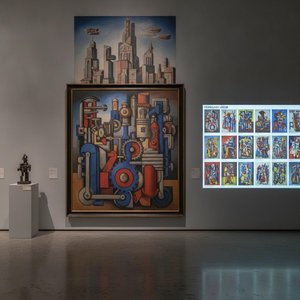
Fernand Léger’s “Mechanical Elements,” painted in 1924, stands as a striking testament to the burgeoning fascination with technology during the interwar period. More than just a depiction of gears and pipes—though undeniably prominent—the artwork embodies Léger's ambitious goal: to synthesize Cubist fragmentation with the dynamism of the machine age, creating an aesthetic that simultaneously challenged artistic conventions and reflected the transformative realities of modern life.
Born Joseph Fernand Henri Léger in Argentan, Normandy, 1881, Léger embarked on a journey from rural landscapes to the epicenter of Parisian avant-garde. Initially drawn to architecture, his artistic path swiftly pivoted toward painting after arriving in Paris around 1900, fueled by an unwavering conviction that art could engage with the complexities of its time.
Cubism Revisited: Geometric Precision
Léger’s stylistic evolution is inextricably linked to Cubism. Influenced profoundly by Picasso and Braque, he adopted the fractured perspective and simultaneous viewpoints characteristic of this revolutionary movement—a deliberate rejection of traditional representation in favor of exploring spatial relationships through geometric forms. However, Léger didn't simply replicate Cubist principles; he pushed them further, distilling them into a simplified vocabulary of circles, squares, and lines.
“Mechanical Elements” exemplifies this approach brilliantly. The canvas is dominated by interlocking geometric shapes—primarily circles and squares—arranged in a rhythmic pattern that evokes the precision and repetition found in industrial machinery. These forms aren’t merely decorative; they actively contribute to conveying a sense of movement and energy, mirroring the ceaseless pace of urban life.
Symbolism Beyond Mechanism
While the artwork's visual language speaks directly to the influence of technology, Léger imbued “Mechanical Elements” with deeper symbolic resonance. The repetition of geometric shapes isn’t merely a stylistic device; it represents an attempt to capture the impersonal logic and order inherent in industrial processes—a deliberate contrast to the organic forms favored by Impressionism and Post-Impressionism.
Furthermore, Léger's use of color – predominantly shades of gray punctuated by vibrant accents – underscores this thematic preoccupation. Gray symbolizes the materiality of metal and concrete, while bursts of color represent human vitality and creativity—a harmonious blend reflecting Léger’s belief that art could coexist with technological advancement without sacrificing beauty or emotional depth.
A Legacy of Innovation
"Mechanical Elements" cemented Léger's position as a pioneer of Tubism – a variant of Cubism developed by Léger himself—characterized by the use of tubular forms to represent objects and figures. This innovative technique anticipated developments in Pop Art decades later, demonstrating Léger’s enduring influence on subsequent generations of artists.
Today, reproductions of “Mechanical Elements” continue to captivate audiences with their bold aesthetic and intellectual ambition. They serve as a powerful reminder that art can not only reflect the spirit of its time but also actively shape our understanding of it—a timeless masterpiece celebrating both geometric precision and human resilience.
V katerem muzeju se nahaja Mechanical Elements?
Metropolitanski muzej umetnosti
New York, Združene države Amerike
Zgodovina in korenine Metropolitanskega muzeja umetnosti Metropolitanski muzej umetnosti se je rodil iz vizije, ki so jo delili poslovni vodje, finančniki ter vrhunski umetniki in misleci. Po ustanovitvi leta 1870 je institucija iskala stalni dom, ki bi pregledal nenehno rastočo zbirko pridobljenih umetniških del. Preden se je muzej dokončno udomovil na svoji trenutni lokaciji, je bil na kratko prisrčen v posestju Douglas Mansion na West 14th Street.


Visokoresolucijske slike dela Mechanical Elements

Javna lastnina: umetnik je umrl leta 1955.
Druge velikosti, izrezave in citiranje →Fernand Léger, Mechanical Elements, Metropolitanski muzej umetnosti. Javna lastnina
Barve so digitalno prilagojene originalu, datoteka pa je strokovno retuširana in zvesta umetnikovemu čopičku.
Pridobite visokofrekvenčni posnetekOdgovori na vprašanja o Mechanical Elements
V katerem muzeju se nahaja original dela "Mechanical Elements"?
Originalno delo "Mechanical Elements" avtorja Fernand Léger se nahaja v muzeju Metropolitanski muzej umetnosti, New York, Združene države Amerike. Reprodukcija omogoča, da ta sklad prikazujete tudi v svojem domu.
い哪種媒介是用來創作 "Mechanical Elements" avtorja Fernand Léger 的?
Tehnika za delo "Mechanical Elements" avtorja Fernand Léger je Oil On Canvas. Različice imajo za namen natančno prikazati videz te tehnike.
Katere teme se pojavljajo v delu "Mechanical Elements" avtorja Fernand Léger?
"Mechanical Elements" avtorja Fernand Léger prikazuje: mechanical elements, cubism, geometry, industrial design, abstraction, assemblage, modern art.
Ali se lahko slika "Mechanical Elements" avtorja Fernand Léger prosto reproducira?
Status avtorskih pravic za "Mechanical Elements" avtorja Fernand Léger: del je v javni domeni – avtorska pravica je zastarela. To določa, ali se lahko reprodukcije slike izdelujejo prosto.
Kdo je avtor dela "Mechanical Elements"?
Delo "Mechanical Elements" je ustvaril Fernand Léger. Informacije na tej strani opisujejo izvirno delo umetnika Fernand Léger.
V kateri umetniški smer spada "Mechanical Elements" avtorja Fernand Léger?
"Mechanical Elements" avtorja Fernand Léger pripada gibanju Cubist Style. To gibanje zagotavlja slogovni kontekst dela.
V katero obdobje kariere Fernand Léger pripada delo "Mechanical Elements"?
"Mechanical Elements" pripada Mechanical Period v karieri umetnika Fernand Léger. Ta razvrstitev povezuje delo z umetnikovim razvojnim obdobjem.
Kaj pojasnjuje status avtorskih pravic za "Mechanical Elements" avtorja Fernand Léger?
Status avtorske pravice za "Mechanical Elements" – v javni domeni – avtorska pravica je zastarela – izhaja iz smrti umetnika v letu 1955.
Ali se "Mechanical Elements" avtorja Fernand Léger nahaja v matični državi umetnika?
Ne – umetniško delo se nahaja v tujini. Delo "Mechanical Elements" se nahaja v državi Združene države Amerike, medtem ko je Fernand Léger rojen/a v državi Francija.
O umetniku, Fernand Léger

1881–1955, Francija
Fernand Léger
Fernand Léger: Izoblikovano v Oblikah – Življenje in Ustvarjanje Joseph Fernand Henri Léger, rojen leta 1881 v Argentanu, Normandiji, je bil francoski slikar, kipar in filmski ustvarjalec, ki se je uveljavil kot ključna figura moderne umetnosti. Njegovo potovanje od ruralnega podeželja do epicentra pariškega avantgardizma priča o neomajni viziji in nenehni želji po zajemanju duha industrijske dobe. Za razliko od mnogih sodobnikov, ki so abstraktnost razumeli kot pobeg od realnosti, je Léger iskal integracijo moderne – njene dinamike, mehanskih oblik, bistva – v nov vizualni jezik, ki je bil hkrati močno abstrakten in globoko zakoreninjen v opazovalnem svetu. Njegovo zgodnje življenje, prežeto s fizičnostjo kmetijskega dela, mu je nudilo trdno podlago, ki jo je kontrirala strastna priprostranost industrijske prihodnosti, ki jo je tako navdušeno prikazoval.
Tudi dela avtorja Fernand Léger
 Mesto1919
 Mehanik1920
 Three Women1921
 Nudeži v goščini1910

Eseji o delu Mechanical Elements
 Cubism Unveiled: How Picasso and Braque Redefined Modern Art through Geometric RevolutionExplore the revolutionary world of Cubism. Discover how Pablo Picasso and Georges Braque dismantled perspective to redefine modern art thro…
 Mastering the Machine Age: The 25 Best Artworks by Fernand LégerImmerse yourself in the vibrant world of Fernand Léger. Explore 25 iconic masterpieces of Cubism and Tubism, from bold geometric forms to m…
 Industrial Revolution on Canvas: 10 Artworks That Define a Modern AestheticExplore 10 iconic artworks capturing the Industrial Revolution’s grit & beauty. From Monet to Manet, discover realism, impressionism & powe…