

 Predogled
 Pošlji
 Deli
Deli
 Podrobnosti o delu

 Prenesi
 Podobni izdelki
 Rentgenski posnetek
 Predvajaj diaporama
Forest Landscape
 Acrylic On Canvas
- WallArt
- Pseudo-Italianate landscapes
 1690
1690 81.0 x 117.0 cm
 Hermitage Museum
 Razviljaj več
Giclée tisk / Umetniški tisk
Giclée ali platnati odtis muzejske kakovosti z hitro proizvodnjo in prilagodljivimi možnostmi končne obdelave. ( Kupi ročno naslikano sliko Kupi digitalno sliko)




P118B $10

P118H $10

P118W $10

P438Z $10

P508JH $12

P508YH $12

P805H $10

P805Z $10

P919BZ $10

P919G $10

P919XJ $10

P959ZH $10

P968JZ $12

W106C $8

W218G $10

W218JH $8

W218Y $10

W307PJ $10

W316G $10

W316PJ $8

W316Y $10

W398PJ $8

W4111J $10

W500HY $15

W500JH $15

W692G $12

W849H $8

W940BG $15

W953PJ $8




Izberite eno od naših vnaprej določenih velikosti, ki ustrezajo prvotnim proporcijam umetničkega dela.

Svoje dimenzije lahko vnesete sami, da bodo ustrezne za določen okvir ali prostor. Če izbrana velikost ne bo skladna z razmerji izvirne slike, bomo umetniško delo orezali ali podaljšali s pomočjo ogledalnega odraza ali barvno polnega roba. Pred začetkom proizvodnje vam bomo poslali digitalni predogled za potrditev.
Upoštevajte, da predogled na zaslonu ne prikazuje dejanskega orezovanja ali podaljševanja. Le digitalni predogled bo natančno prikazal končno kompozicijo.
Čeprav so na voljo prilagojene velikosti, priporočamo izbiro dimenzije s predhodno določenega seznama, da ohranite prvotna razmerja.
Globalna dostava () v 2 tednih namesto standardnih 4/5 tednov. (29 avgust)

Brezplačna ekspresna dostava po vsem svetu

Visokokakovostno laneno platno

Popolno zavarovanje pošiljke

Garancija povračila carine in uvoznih davkov

Garancija popolnega ujemanja barv

60-dnevna politika vračanja (le v primeru napak)

Garancija 100% povračila denarja

Popust pri večjem naročilu
 Možnost stekla je na voljo le za velikosti pod 110 cm

Forest Landscape
Giclée tisk / Umetniški tisk
Velikost reprodukcije
-


Skupna končna cena
$ 80
Cornelis Huysmans: Bridging Mannerism & The Dutch Baroque Landscape
Cornelis Huysmans stands as a pivotal figure in Flemish landscape painting during the late 17th and early 18th centuries, marking a crucial transition from the more meticulous styles of Mannerism towards the burgeoning aesthetic ideals of the Dutch Baroque. His oeuvre embodies this shift, skillfully blending detailed observation with an expressive handling of light and color—a hallmark that cemented his place among the most celebrated artists of his era.Early Life & Artistic Training
Born in Antwerp in 1648, Huysmans’s formative years were shaped by a familial legacy steeped in craftsmanship – his father served as either a master builder or a craftsman within the mint—a profession that instilled in him an appreciation for precision and meticulous detail. Recognizing his talent, he sought guidance from Gaspar de Witte, a prominent landscape painter whose influence would permeate Huysmans’s artistic vision. Further honing his skills in Brussels under Jacques d'Arthois – a collaborator known for incorporating decorative elements into his compositions – established Huysmans as an adept student of the prevailing artistic currents.Career & Artistic Development: Embracing Innovation
Huysmans achieved independence as a master of Saint Luke’s Guild in Brussels around 1675, embarking on a prolific career that spanned decades and encompassed commissions for noble patrons across Europe. Notably, he traveled to London between 1686 and 1688, producing landscapes destined for influential figures—a testament to his reputation as a respected artist within the intellectual circles of the time. Settling in Mechelen around 1688, he married Maria Anna Scheppers, establishing a family life alongside his artistic pursuits. His most enduring achievement remains “The Road to Emmaus,” an altarpiStyle & Technique: A Synthesis of Observation & Emotion
Huysmans’s distinctive style is characterized by an unwavering commitment to capturing the essence of nature—particularly forests and trees—with remarkable accuracy. However, he transcended mere replication; instead, he imbued his canvases with a palpable sense of atmosphere and emotion. Influenced profoundly by Jacques d'Arthois, Huysmans skillfully employed decorative elements within his landscapes, mirroring the stylistic preferences of his time. Diagonal lines dominate many compositions, creating depth and perspective—a technique that elevates the artwork beyond a simple depiction of scenery.Historical Context & Symbolism: Echoes of Italy
Huysmans’s artistic output flourished during a period marked by significant cultural exchange between Flanders and Italy – a phenomenon known as “pseudo-Italianate.” This stylistic impulse is evident in his depictions of mountains and vegetation, mirroring the grandeur and idealized beauty championed by Italian artists. Huysmans's masterful use of light contrasts—particularly shadows cast by trees against roads—generated dramatic visual effects that conveyed both realism and spiritual contemplation. His paintings resonate with a timeless quality, reflecting the humanist ideals prevalent during the Baroque era.Legacy & Recognition: Enduring Influence
Huysmans’s legacy extends beyond his individual artworks; he profoundly impacted subsequent generations of Flemish painters, including his son Pieter Balthasar Huysmans and brother Jan Baptiste Huysmans. His meticulous observation combined with expressive brushwork established him as a cornerstone of Dutch Baroque landscape art—a style that continues to inspire artists today. Recognized for his contribution to artistic excellence, Huysmans’s paintings are housed in prestigious museums worldwide – including the Louvre and the Hermitage Museum – ensuring that his vision persists as an emblem of Flemish artistic heritage.Biografija umetnika
Cornelis Huysmans: A Flemish Landscape Master
- Born: Antwerp, Belgium (1648)
- Died: 1727
Early Life and Training
- Cornelis Huysmans was baptized on April 2, 1648, in Antwerp. His parents were Hendrik Huysmans and Catharina van der Meyden.
- His father's profession is described as either a master builder or a craftsman in the mint.
- Following his parent’s early death, he was sent to study under the landscape painter Gaspar de Witte.
- He later moved to Brussels to further his studies and may have worked as an assistant in the studio of Jacques d'Arthois.
- Around 1675, he collaborated with Adam Frans van der Meulen in Maastricht.
Career and Artistic Development
- In 1675, Huysmans became an independent master of the Guild of Saint Luke in Brussels.
- He spent time in London from approximately 1686 to 1688, creating landscapes for prominent members of society.
- Around 1688, he settled in Mechelen and married Maria Anna Scheppers.
- In 1690, he created a significant altarpiece, "The Road to Emmaus," for the Onze-Lieve-Vrouw-over-de-Dijle church in Mechelen.
- He returned to Antwerp in 1706 and was admitted as a master in the local guild of Saint Luke.
- Huysmans eventually returned to Mechelen, where he continued working until his death in 1727.
Artistic Style and Influences
- Huysmans is primarily known for his landscape paintings, though he also created religious and history works.
- His style is characterized by detailed observations of nature, particularly forests and trees.
- He was significantly influenced by Jacques d'Arthois, evident in the decorative compositions depicting forest edges with sandy banks.
- Huysmans incorporated a "pseudo-Italianate" aesthetic, featuring mountains and vegetation reminiscent of Italy.
- His use of dramatic light contrasts between roads and tree shadows created a striking visual effect.
- He often employed diagonal lines within his compositions to create depth and perspective.
Legacy and Historical Significance
- Cornelis Huysmans held a prominent position in Flemish landscape painting during the late 17th and early 18th centuries.
- His works demonstrate a transition from earlier, more detailed styles towards a more decorative and atmospheric approach to landscape art.
- He influenced younger artists, including his son Pieter Balthasar Huysmans and his brother Jan Baptiste Huysmans.
- Huysmans's paintings are represented in numerous museum collections worldwide, including the Louvre, the Hermitage Museum, and various museums in Belgium and elsewhere.
- His ability to capture both the realism of nature and a sense of idealized beauty contributed to his lasting reputation as a significant Flemish landscape painter.

Cornelis Huysmans
1648 - 1727 , Belgium
Hitri podatki
- Artistic Movement Or Style: Pseudo-Italianate landscapes
- Artists Or Movements Influenced By This Artist:
- Pieter Balthasar Huysmans
- Jan Baptiste Huysmans
- Artists Who Influenced This Artist:
- Nicolas Poussin
- Jacques d'Arthois
- Date Of Birth: 1648
- Date Of Death: 1727
- Full Name: Cornelis Huysmans
- Nationality: Flemish
- Place Of Birth (City And Country): Antwerp, Belgium
Sorodni članki

Golden Light & Dutch Skies: The Timeless Magic of Dutch Golden Age Landscapes
Discover the breathtaking beauty of Dutch Golden Age landscapes. Explore the mastery of light, chiaroscuro, and 17th-century realism through an expert art history lens, celebrating the enduring legacy of the Dutch Masters for discerning collectors and art lovers.
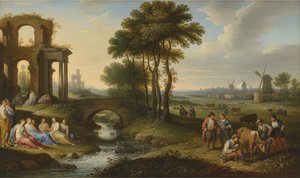
Cornelis van Poelenburch: Bridging Mannerism & the Dutch Baroque Landscape
Discover Cornelis van Poelenburch, a pivotal Dutch Baroque landscape painter bridging Mannerism & Italianate styles. Explore his life, key works, and lasting influence on 17th-century art with OriginalUniqueArt.

Jan van Goyen: Master of Dutch Landscape & Atmospheric Perspective
Discover Jan van Goyen, the master of Dutch landscape painting. Explore his subtle technique, atmospheric realism & lasting influence on art history. Learn about this 17th-century pioneer at OriginalUniqueArt.

Golden Light & Dutch Skies: Bringing the Magic of Dutch Golden Age Landscapes into Your Home
Transform your home with the breathtaking light of Dutch Golden Age landscapes. Discover how hand-painted oil reproductions of masterworks like Ruisdael and Vermeer bring timeless elegance, atmosphere, and soulful texture to modern interiors. Elevate your space with museum-quality art.
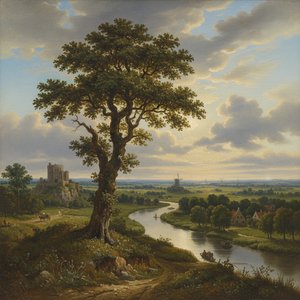
Jacob van Ruisdael: Master of Dutch Landscape & the Evocation of National Identity
Explore the life & work of Jacob van Ruisdael, the preeminent Dutch landscape painter. Discover his technical brilliance, symbolic depth, and lasting influence on art history. Learn about collecting Ruisdael's masterpieces.

