Preklop na tiskanine
 Preberi več







































 Za umetniška dela ali reprodukcije, ki so po katerikoli strani širše od 105 cm (približno 41 palč), bo okvir poslan v razstavljeni obliki kot komplet. Ta metoda zagotavlja varno dostavo in preprečuje poškodbe med transportom.


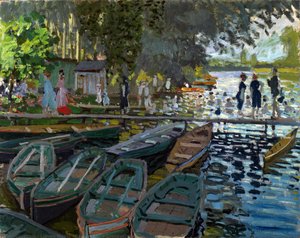
Claude Monet: Red Boats at Argenteuil – A Symphony of Light and Tranquility
Claude Monet’s “Red Boats at Argenteuil,” painted in 1875, transcends mere depiction; it's an invitation to inhabit a fleeting moment of Parisian serenity. This cornerstone Impressionist work embodies the movement’s core philosophy—capturing not precise representation but rather the ephemeral dance of light and atmosphere—a deliberate rejection of academic conventions championed by artists like Monet who sought to portray modern life with subjective perception. Argenteuil, where Monet resided from 1871 to 1878, served as his crucible for experimentation, transforming into a living laboratory for studying how water, sky, and landscape intertwine to create an immersive sensory experience. The canvas breathes with the gentle rhythm of daily life on the Seine, offering a visual respite that continues to resonate powerfully with audiences today.The Technique of Broken Color: Monet’s Revolutionary Approach
Monet's distinctive technique—characterized by “broken color”—immediately grabs the viewer’s attention. Unlike traditional painters who blended pigments meticulously to achieve tonal harmony, Monet applied paint in small, separate strokes, allowing individual colors to mingle optically on the canvas surface. This seemingly haphazard method was anything but accidental; it stemmed from Monet’s meticulous observation of how light refracts and scatters across surfaces—particularly water—creating a vibrant tapestry of hues that defy simple categorization. The resulting impression is not one of photographic accuracy but rather an evocative portrayal of the scene's luminous quality, mirroring the way our eyes perceive color in nature. This bold departure from established artistic norms solidified Monet’s position as a pioneer of Impressionism and profoundly influenced subsequent generations of painters.A Window into Parisian Life: Argenteuil and Its Symbolism
“Red Boats at Argenteuil” offers a glimpse into the burgeoning bohemian culture of Paris during the mid-1870s—a period marked by artistic innovation and social upheaval. The painting depicts Argenteuil, a riverside town known for its picturesque bridges and tranquil landscapes, populated by sailboats and modest dwellings. Monet’s choice to portray this everyday setting wasn't merely aesthetic; it reflected the Impressionists’ desire to depict modern life authentically, capturing not grand narratives but rather fleeting impressions of ordinary moments. The red house anchoring the left side serves as a grounding element, providing visual stability amidst the dynamic expanse of water and sky—a subtle reminder that even in the midst of change, certain elements endure. Furthermore, the boats themselves symbolize movement and vitality, mirroring the ceaseless flow of life along the Seine.The Emotional Resonance: Capturing Light's Transformative Power
Ultimately, “Red Boats at Argenteuil” succeeds in conveying a profound emotional resonance—a palpable sense of peace and contemplation. Monet’s masterful manipulation of color and brushwork evokes feelings of serenity and nostalgia, transporting viewers back to a bygone era. The shimmering surface of the Seine reflects the diffused sunlight, creating an ethereal glow that imbues the scene with warmth and luminosity. As art historian Robert Rosenblum eloquently observed, Monet's paintings “are not merely representations of what we see; they are expressions of how we feel.” This enduring appeal stems from Monet’s ability to capture light’s transformative power—its capacity to illuminate not only physical objects but also the human spirit.Conclusion: An Icon of Impressionism Enduring Beauty
“Red Boats at Argenteuil” remains an undisputed masterpiece of Impressionist art, embodying the movement's revolutionary spirit and its unwavering commitment to capturing subjective experience. Its enduring beauty lies in Monet’s audacious technique—broken color—which brilliantly conveys the fleeting effects of light and atmosphere—a legacy that continues to inspire artists and captivate audiences worldwide. Owning a high-quality reproduction allows one to appreciate this iconic artwork's subtleties and immerse oneself in its timeless tranquility.Vprašanja in odgovori
Ali je "Rdeči čolni Argenteuil" tipično za dela, ki jih je Claude Monet običajno ustvarjal?
Claude Monetove ponavljajoče se teme vključujejo light & atmosphere capture, nature observation style, plein air technique focus, impressionist legacy impact, monet’s artistic vision; "Rdeči čolni Argenteuil" se osredotoča na seine river, argenteuil bridge, monet landscape, impressionist painting, summer light, boat reflections, french impressionism.
Priporočena uporaba in prostor za "Rdeči čolni Argenteuil" avtorja Claude Monet?
"Rdeči čolni Argenteuil" avtorja Claude Monet priporočamo za Akcentni element, idealno v Dnevna soba. Skupni prikaz namerne uporabe in prostora pomaga ugotoviti, kje se reprodukcija najbolje prilega.
Za katero so "Rdeči čolni Argenteuil" avtorja Claude Monet priporočena?
Reprodukcija dela "Rdeči čolni Argenteuil" se v Dnevna soba odlično prilega.
 Predogled v realnem okolju
 Pošlji
 Deli
Deli
 Podrobnosti o delu
 Priročnik

 Prenesi sliko
 Podobni izdelki
 Rentgenski posnetek
 Predvajaj diaporama
 Vprašanja in odgovori
 Statistika