Portrét Utagawa Hirošige

Obrazy umelca Utagawa Hirošige: 100 najznámejších výtvarných diel prostretých pohľadom galérie

Aktualizované november 2026 · zoradené podľa našej miery popularity (vyhľadávanie, návštevy a objednávky pre každú prácu) · 353 dielov umelca Utagawa Hirošige v našom katalógu

Stručne povedané

Z hľadiska galérie je najznámejším obrazom umelca Utagawa Hirošige dielo Early Department from a Daimyo, ktorého originál visí v Nakagawa-machi Bato Hiroshige Museum of Art v meste Nagasaki. The maple leaves of Mama, Tekona shrine and Tsugi bridge (1857) a Hakone (1834) dopĺňajú trojicu, ktorú pozná každé oko. Z 353 diel umelca Utagawa Hirošige v našom katalógu prezentuje galéria nižšie 100 najznámejších, z ktorých je každá originál s uvedeným rokom vzniku, múzeom a unikátnosťou.

1797 – 1858, Tokio Ukiyo-e Najviac diel: Nakagawa-machi Bato Hiroshige Museum of Art

Top 10 obrazov umelca Utagawa Hirošige v galérii

1
Early Department from a Daimyo od Utagawa Hirošige

Early Department from a Daimyo

Woodblock Print · Nakagawa-machi Bato Hiroshige Museum of Art, Nagasaki

In the delicate dance of lines and muted pigments, Utagawa Hiroshige’s Early Department from a Daimyo invites us to step through a portal into the heart of Edo-period Japan. This exquisite woodblock print captures a moment of vibrant communal life along a bustling riverside, where the rigid structures of social hierarchy melt into the shared leisure of a sunny afternoon. As we gaze upon the scene, we are not merely…

2
The maple leaves of Mama, Tekona shrine and Tsugi bridge (1857) od Utagawa Hirošige

The maple leaves of Mama, Tekona shrine and Tsugi bridge

1857 · Woodblock Print · Van Gogh Museum, Amsterdam

Utagawa Hiroshige (1797-1858), arguably the last titan of *ukiyo-e*, didn't merely depict landscapes; he crafted them into meditations on beauty and impermanence. “The Maple Leaves of Mama, Tekona Shrine and Tsugi Bridge,” created in 1857 during a period of significant societal transformation—the waning influence of feudal Japan as Western ideas crept in—stands as a testament to his enduring artistic legacy. More than just a visual record, it’s an embodiment of…

3
Hakone (1834) od Utagawa Hirošige

Hakone

1834 · Woodblock Print · Indianapolis Museum of Art, Indianapolis

Utagawa Hiroshige’s “Hakone,” created in 1834, is more than just a landscape; it's a poetic meditation on the beauty and transience of nature within Edo-period Japan. This woodblock print, part of his renowned series "The Fifty-three Stations of the Tōkaidō," captures a specific moment along the vital trade route connecting Tokyo (then Edo) with Kyoto. However, Hiroshige elevates this seemingly simple depiction of a mountain pass into something profoundly evocative,…

4
Station 36, Goyu; Kyoka Tokaido Series (1855) od Utagawa Hirošige

Station 36, Goyu; Kyoka Tokaido Series

1855 · Woodblock Print · Indianapolis Museum of Art, Indianapolis

In the delicate interplay of ink and paper, Utagawa Hiroshige’s "Station 36, Goyu; Kyoka Tokaido Series" offers much more than a mere topographical record of a journey. Completed in 1855, this exquisite woodblock print serves as a profound distillation of Edo-period sensibilities, capturing a yearning for tranquility amidst the burgeoning dynamism of a Japan in transition. As the nation stood at a pivotal crossroads between ancient feudal traditions and the…

5
Fushimi Stanica č. 51 (1842) od Utagawa Hirošige

Fushimi Stanica č. 51

1842 · Drevenoryt · Indianapolis Museum of Art, Indianapolis

Fushimi, Station # 51 – Hiroshige’s Poetic Echoes of Edo Japan Utagawa Hiroshige (1797–1858) predstavuje vrcholné obdobie japonského umeleckého ruchu *ukiyo-e*, ktorý sa často označuje ako „obraz svetla sveta“. Jeho tvorba nespočetných výškových bodov vykazovala nezvyčajnú kombináciu pozornej estetickej starostlivosti a filozofického hlbokého porozumenia, čím získala uznanie nielen v Japonsku, ale aj neskôr medzi západnými umelcami. Jeho život sa niesol počas obdobia relatívneho mieru pod vládou Tokugawa šogunaátu – časťou…

6
Ichikoku Bridge in the Eastern Capital (Tōto: Ichikoku bashi) (1858) od Utagawa Hirošige

Ichikoku Bridge in the Eastern Capital (Tōto: Ichikoku bashi)

1858 · Woodblock Print · Indianapolis Museum of Art, Indianapolis

The Ichikoku Bridge spans a quiet stretch of water in the Eastern Capital. Beneath its wooden arch, two boats drift through the current. People move across the structure, some carrying backpacks and others clutching small handbags. A mountain rises in the distance, watching over the scene. Trees frame the edges of the view, their leaves casting shadows near the water's edge.

7
Shinagawa Sunrise from the series Fifty-three Stations on the Tokaido Road (1834) od Utagawa Hirošige

Shinagawa Sunrise from the series Fifty-three Stations on the Tokaido Road

1834 · Woodblock Print · Hill-Stead Museum, Farmington

In the soft, burgeoning light of a nineteenth-century morning, Utagawa Hiroshige invites us to witness a moment of profound stillness along the Tōkaidō road. Shinagawa Sunrise is not merely a depiction of a coastal village; it is a masterclass in the art of atmosphere. As the sun begins its ascent, the boundary between the heavens and the earth dissolves into a luminous haze. The water of the bay reflects a…

8
The Rokugo River Ferry, Kawasaki, from the series the Fifty-three Stations of the Tokaido (Hoeido edition ) od Utagawa Hirošige

The Rokugo River Ferry, Kawasaki, from the series the Fifty-three Stations of the Tokaido (Hoeido edition )

Woodblock Print · Nakagawa-machi Bato Hiroshige Museum of Art, Nagasaki

In the delicate dance of woodblock printing, few masters captured the ephemeral beauty of Japanese life as profoundly as Utagawa Hiroshige. His masterpiece, The Rokugo River Ferry, Kawasaki, serves as a breathtaking window into the Edo period, inviting the viewer to step onto the bustling banks of one of the most vital crossings on the Tokaido road. This evocative scene from his legendary series, The Fifty-three Stations of the Tokaido,…

9
Itsukushima in Aki Province (1858) od Utagawa Hirošige

Itsukushima in Aki Province

1858 · Woodblock Print · Brooklyn Museum, Brooklyn

In the delicate interplay of mist and water, Itsukushima in Aki Province offers more than a mere glimpse of a Japanese landmark; it provides a profound meditation on the ephemeral nature of existence. Created by the legendary ukiyo-e master Ando Hiroshige in 1858, this woodcut print captures the spiritual essence of the Itsukushima shrine area with a poetic sensitivity that remains unparalleled. As one gazes upon the composition, the eye…

10
Tenryu River Ferry Crossing, Mitsuke, from the series The Fifty-three Stations of the Tokaido (Gyosho Edition) od Utagawa Hirošige

Tenryu River Ferry Crossing, Mitsuke, from the series The Fifty-three Stations of the Tokaido (Gyosho Edition)

Woodblock Print · Nakagawa-machi Bato Hiroshige Museum of Art, Nagasaki

The woodblock print depicts a section of the Tenryu River near the station of Mitsuke. In the center of the composition, a large sandbank divides the water into two distinct currents. Several small wooden boats occupy the river, with figures positioned within them to manage the crossing. Some vessels are moored directly against the central sandbank, while others navigate the moving water. The far shore is visible in the distance,…

Obrazy umelca Utagawa Hirošige, usporiadané od 11 do 100

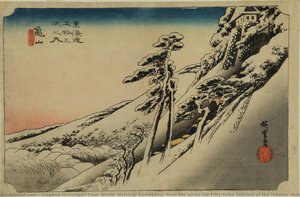
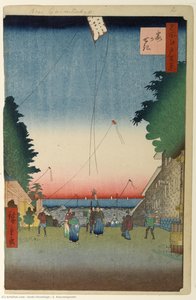
11Papagaň a viniče (1800) od Utagawa HirošigePapagaň a viniče1800 · Indianapolis Museum of Art 12The Pine Woods of Miho in Suruga Province (Suruga Miho no matsubara) (1858) od Utagawa HirošigeThe Pine Woods of Miho in Suruga Province (Suruga Miho no matsubara)1858 · Indianapolis Museum of Art 1362 (55) Komakata Hall and Azuma Bridge (1857) od Utagawa Hirošige62 (55) Komakata Hall and Azuma Bridge1857 · Brooklyn Museum 14Evening Snow at Kanbara (1834) od Utagawa HirošigeEvening Snow at Kanbara1834 · Los Angeles County Museum of Art 15Dawn in the licensed quarters (1857) od Utagawa HirošigeDawn in the licensed quarters1857 · Art Gallery of New South Wales 16Night View of Saruwakacho od Utagawa HirošigeNight View of Saruwakacho 17Station 28, Fukuroi (1855) od Utagawa HirošigeStation 28, Fukuroi1855 · Indianapolis Museum of Art 18Evening Snow at Asakusa or Woman with Umbrella from the series Eight Views of the Environs of Edo (1800) od Utagawa HirošigeEvening Snow at Asakusa or Woman with Umbrella from the series Eight Views of the Environs of Edo1800 · Hill-Stead Museum 19Keishi (Kyoto), Capital (1834) od Utagawa HirošigeKeishi (Kyoto), Capital1834 · Indianapolis Museum of Art 20Hara: View of Ashitakayama and Fuji (1855) od Utagawa HirošigeHara: View of Ashitakayama and Fuji1855 · Indianapolis Museum of Art 21Yokkaichi (Station #44) (1834) od Utagawa HirošigeYokkaichi (Station #44)1834 · Indianapolis Museum of Art 22Desolate Wintry Scene, Hamamatsu, from the series the Fifty-three Stations of the Tokaido (Hoeido edition) od Utagawa HirošigeDesolate Wintry Scene, Hamamatsu, from the series the Fifty-three Stations of the Tokaido (Hoeido edition)Nakagawa-machi Bato Hiroshige Museum of Art 23Noge and Yokohama in Musashi Province (Musashi, Noge, Yokohama) (1858) od Utagawa HirošigeNoge and Yokohama in Musashi Province (Musashi, Noge, Yokohama)1858 · Indianapolis Museum of Art 24Wild sea breaking on the rocks (1856) od Utagawa HirošigeWild sea breaking on the rocks1856 25Výhľad na Shiomiho úbočie (1833) od Utagawa HirošigeVýhľad na Shiomiho úbočie1833 · Indianapolis Museum of Art 26Mt.Fuji on the Left, Yoshiwara, from the series the Fifty-three Stations of the Tokaido (Hoeido edition) od Utagawa HirošigeMt.Fuji on the Left, Yoshiwara, from the series the Fifty-three Stations of the Tokaido (Hoeido edition)Nakagawa-machi Bato Hiroshige Museum of Art 27Tsukuda Offing in the Eastern Capital (Tōto: Tsukuda oki) (1858) od Utagawa HirošigeTsukuda Offing in the Eastern Capital (Tōto: Tsukuda oki)1858 · Indianapolis Museum of Art 28Kawachi (1853) od Utagawa HirošigeKawachi1853 · Indianapolis Museum of Art 29The Dye Craft Shops of Arimatsu, Narumi, from the series The Fifty-three Stations of the Tokaido (Gyosho edition) od Utagawa HirošigeThe Dye Craft Shops of Arimatsu, Narumi, from the series The Fifty-three Stations of the Tokaido (Gyosho edition)Nakagawa-machi Bato Hiroshige Museum of Art 30View of Shiomi Slope, Shirasuka, from the series The Fifty-three Stations of the Tokaido (Gyosho edition) od Utagawa HirošigeView of Shiomi Slope, Shirasuka, from the series The Fifty-three Stations of the Tokaido (Gyosho edition)Nakagawa-machi Bato Hiroshige Museum of Art 31Entrance to Enoshima in Sagami Province (Sagami Enoshima iriguchi) (1858) od Utagawa HirošigeEntrance to Enoshima in Sagami Province (Sagami Enoshima iriguchi)1858 · Indianapolis Museum of Art 32Morning Mist, Mishima, from the series the Fifty-three Stations of the Tokaido (Hoeido edition ) od Utagawa HirošigeMorning Mist, Mishima, from the series the Fifty-three Stations of the Tokaido (Hoeido edition )Nakagawa-machi Bato Hiroshige Museum of Art 33The Imagire Sea Ferry, Maisaka, from the series The Fifty-three Stations of the Tokaido (Gyosho edition) od Utagawa HirošigeThe Imagire Sea Ferry, Maisaka, from the series The Fifty-three Stations of the Tokaido (Gyosho edition)Nakagawa-machi Bato Hiroshige Museum of Art 34Sukiya Riverbank in the Eastern Capital (Tōto sukiya kaigan) (1858) od Utagawa HirošigeSukiya Riverbank in the Eastern Capital (Tōto sukiya kaigan)1858 · Indianapolis Museum of Art 35Satta Pass, Yui, from the series the Fifty-three Stations of the Tokaido (Hoeido edition) od Utagawa HirošigeSatta Pass, Yui, from the series the Fifty-three Stations of the Tokaido (Hoeido edition)Nakagawa-machi Bato Hiroshige Museum of Art 36True View of Imagire, Maisaka, from the series the Fifty-three Stations of the Tokaido (Hoeido edition) od Utagawa HirošigeTrue View of Imagire, Maisaka, from the series the Fifty-three Stations of the Tokaido (Hoeido edition)Nakagawa-machi Bato Hiroshige Museum of Art 37Clear Winter Morning, Kameyama, from the series the Fifty-three Stations of the Tokaido (Hoeido edition) od Utagawa HirošigeClear Winter Morning, Kameyama, from the series the Fifty-three Stations of the Tokaido (Hoeido edition)Nakagawa-machi Bato Hiroshige Museum of Art 38The Tenryu River, Mitsuke, from the series the Fifty-three Stations of the Tokaido (Hoeido edition) od Utagawa HirošigeThe Tenryu River, Mitsuke, from the series the Fifty-three Stations of the Tokaido (Hoeido edition)Nakagawa-machi Bato Hiroshige Museum of Art 39The Seven-ri Ferry Crossing, Kuwana, from the series the Fifty-three Stations of the Tokaido (Hoeido edition) od Utagawa HirošigeThe Seven-ri Ferry Crossing, Kuwana, from the series the Fifty-three Stations of the Tokaido (Hoeido edition)Nakagawa-machi Bato Hiroshige Museum of Art 40Aronia and Bullfinch od Utagawa HirošigeAronia and Bullfinch 41Gejzy vracejúce sa na Katatú (1834) od Utagawa HirošigeGejzy vracejúce sa na Katatú1834 · Indianapolis Museum of Art 42Yugyoji Temple, Fujisawa, from the series the Fifty-three Stations of the Tokaido (Hoeido edition) od Utagawa HirošigeYugyoji Temple, Fujisawa, from the series the Fifty-three Stations of the Tokaido (Hoeido edition)Nakagawa-machi Bato Hiroshige Museum of Art 43Travellers and Soliciting Women, Goyu, from the series the Fifty-three Stations of the Tokaido (Hoeido edition) od Utagawa HirošigeTravellers and Soliciting Women, Goyu, from the series the Fifty-three Stations of the Tokaido (Hoeido edition)Nakagawa-machi Bato Hiroshige Museum of Art 44The Totoumi Bank of the Oi River, Kanaya, from the series the Fifty-three Stations of the Tokaido (Hoeido edition) od Utagawa HirošigeThe Totoumi Bank of the Oi River, Kanaya, from the series the Fifty-three Stations of the Tokaido (Hoeido edition)Nakagawa-machi Bato Hiroshige Museum of Art 45The Suruga Bank of the Oi River, Shimada, from the series the Fifty-three Stations of the Tokaido (Hoeido edition) od Utagawa HirošigeThe Suruga Bank of the Oi River, Shimada, from the series the Fifty-three Stations of the Tokaido (Hoeido edition)Nakagawa-machi Bato Hiroshige Museum of Art 46Kyoka Tokaido Series, Kanagawa (Yokohama) od Utagawa HirošigeKyoka Tokaido Series, Kanagawa (Yokohama)Indianapolis Museum of Art 47Distant View of Miho, Ejiri, from the series the Fifty-three Stations of the Tokaido (Hoeido edition) od Utagawa HirošigeDistant View of Miho, Ejiri, from the series the Fifty-three Stations of the Tokaido (Hoeido edition)Nakagawa-machi Bato Hiroshige Museum of Art 48Mt. Fuji in the Morning, Hara, from the series the Fifty-three Stations of the Tokaido (Hoeido edition) od Utagawa HirošigeMt. Fuji in the Morning, Hara, from the series the Fifty-three Stations of the Tokaido (Hoeido edition)Nakagawa-machi Bato Hiroshige Museum of Art 49A Horse Fair, Chiriu, from the series the Fifty-three Stations of the Tokaido (Hoeido edition) od Utagawa HirošigeA Horse Fair, Chiriu, from the series the Fifty-three Stations of the Tokaido (Hoeido edition)Nakagawa-machi Bato Hiroshige Museum of Art 50Wakasa (1853) od Utagawa HirošigeWakasa1853 · Indianapolis Museum of Art 51Distant View of Mt.Akiba, Kakegawa, from the series the Fifty-three Stations of the Tokaido (Hoeido edition) od Utagawa HirošigeDistant View of Mt.Akiba, Kakegawa, from the series the Fifty-three Stations of the Tokaido (Hoeido edition)Nakagawa-machi Bato Hiroshige Museum of Art 52The Ichiri-Han Sea Ferry, Arai, from the series The Fifty-three Stations of the Tokaido (Gyosho edition) od Utagawa HirošigeThe Ichiri-Han Sea Ferry, Arai, from the series The Fifty-three Stations of the Tokaido (Gyosho edition)Nakagawa-machi Bato Hiroshige Museum of Art 53Gateway Entrance to the Atsuta Shrine on the Beach, Miya, from the series The Fifty-three Stations of the Tokaido (Gyosho edition) od Utagawa HirošigeGateway Entrance to the Atsuta Shrine on the Beach, Miya, from the series The Fifty-three Stations of the Tokaido (Gyosho edition)Nakagawa-machi Bato Hiroshige Museum of Art 54Akasaka, from the series The Fifty-three Stations of the Tokaido (Gyosho edition) od Utagawa HirošigeAkasaka, from the series The Fifty-three Stations of the Tokaido (Gyosho edition)Nakagawa-machi Bato Hiroshige Museum of Art 55The Sakawa River, Odawara, from the series the Fifty-three Stations of the Tokaido (Hoeido edition) od Utagawa HirošigeThe Sakawa River, Odawara, from the series the Fifty-three Stations of the Tokaido (Hoeido edition)Nakagawa-machi Bato Hiroshige Museum of Art 56A Footpath between Ricefield, Hiratsuka, from the series the Fifty-three Stations of the Tokaido (Hoeido edition) od Utagawa HirošigeA Footpath between Ricefield, Hiratsuka, from the series the Fifty-three Stations of the Tokaido (Hoeido edition)Nakagawa-machi Bato Hiroshige Museum of Art 57Awa Province: Whirlpool at Naruto (1853) od Utagawa HirošigeAwa Province: Whirlpool at Naruto1853 5873 The City Flourishing, the Tanabata Festival (1857) od Utagawa Hirošige73 The City Flourishing, the Tanabata Festival1857 59Sarugababa Plain, Futagawa, from the series the Fifty-three Stations of the Tokaido (Hoeido edition) od Utagawa HirošigeSarugababa Plain, Futagawa, from the series the Fifty-three Stations of the Tokaido (Hoeido edition)Nakagawa-machi Bato Hiroshige Museum of Art 60Local Specialty Teahouse, Mariko, from the series the Fifty-three Stations of the Tokaido (Hoeido edition) od Utagawa HirošigeLocal Specialty Teahouse, Mariko, from the series the Fifty-three Stations of the Tokaido (Hoeido edition)Nakagawa-machi Bato Hiroshige Museum of Art 61Sakanoshita od Utagawa HirošigeSakanoshitaIndianapolis Museum of Art 62Stanoviště 23, Fujieda od Utagawa HirošigeStanoviště 23, FujiedaIndianapolis Museum of Art 63Marsh Grasses and Mandarin Ducks od Utagawa HirošigeMarsh Grasses and Mandarin Ducks 6450th station, Minakuchi od Utagawa Hirošige50th station, Minakuchi 65Sakanoshita: the Throwing Away the Brush Peak (1834) od Utagawa HirošigeSakanoshita: the Throwing Away the Brush Peak1834 · Brooklyn Museum 66Shibaura Bay of Musashi Province (801) od Utagawa HirošigeShibaura Bay of Musashi Province801 · Metropolitné múzeum umenia 67Koyurugi Beach of Sagami Province (801) od Utagawa HirošigeKoyurugi Beach of Sagami Province801 · Metropolitné múzeum umenia 68Honmoku Bay of Musashi Province (801) od Utagawa HirošigeHonmoku Bay of Musashi Province801 · Metropolitné múzeum umenia 69Untitled (Two Rabbits, Pampas Grass, and Full Moon) (1851) od Utagawa HirošigeUntitled (Two Rabbits, Pampas Grass, and Full Moon)1851 7011. Kiyomizu Hall and Shinobazu Pond at Ueno (1857) od Utagawa Hirošige11. Kiyomizu Hall and Shinobazu Pond at Ueno1857 7185. Kinokuni Hill and Distant View of Akasaka and the Tameike Pond (1857) od Utagawa Hirošige85. Kinokuni Hill and Distant View of Akasaka and the Tameike Pond1857 7276 Bamboo Quay by Kyōbashi Bridge (1857) od Utagawa Hirošige76 Bamboo Quay by Kyōbashi Bridge1857 7358 (52) Sudden Shower over Shin-Ōhashi bridge and Atake (1857) od Utagawa Hirošige58 (52) Sudden Shower over Shin-Ōhashi bridge and Atake1857 · Tokyo Fuji Art Museum 74103. Senju Great Bridge (1857) od Utagawa Hirošige103. Senju Great Bridge1857 7518. The Ōji Inari Shrine (1857) od Utagawa Hirošige18. The Ōji Inari Shrine1857 76113. Aoi Slope Outside Toranomon Gate (1857) od Utagawa Hirošige113. Aoi Slope Outside Toranomon Gate1857 77114. Bikuni Bridge in Snow (1857) od Utagawa Hirošige114. Bikuni Bridge in Snow1857 7870 (60) The Mouth of the Nakagawa River (1857) od Utagawa Hirošige70 (60) The Mouth of the Nakagawa River1857 792. Kasumigaseki (1857) od Utagawa Hirošige2. Kasumigaseki1857 8015. Suwa Bluff in Nippori (1857) od Utagawa Hirošige15. Suwa Bluff in Nippori1857 8163 (69) The Ayase River and Kanegafuchi (1857) od Utagawa Hirošige63 (69) The Ayase River and Kanegafuchi1857 82115. The Takata Riding Grounds (1857) od Utagawa Hirošige115. The Takata Riding Grounds1857 8386. Naitō Shinjuku in Yotsuya (1857) od Utagawa Hirošige86. Naitō Shinjuku in Yotsuya1857 8416. Flower Park and Dangozaka Slope in Sendagi (1857) od Utagawa Hirošige16. Flower Park and Dangozaka Slope in Sendagi1857 8568 (59) Open Garden at the Hachiman Shrine in Fukagawa (1857) od Utagawa Hirošige68 (59) Open Garden at the Hachiman Shrine in Fukagawa1857 8610. Sunrise at Kanda Myōjin Shrine (1857) od Utagawa Hirošige10. Sunrise at Kanda Myōjin Shrine1857 87Peach and Long-tailed Bird od Utagawa HirošigePeach and Long-tailed Bird 88Golden Pheasant in Bracken od Utagawa HirošigeGolden Pheasant in Bracken 89The Imado Bridge at the Foot of Mount Matsuchi (801) od Utagawa HirošigeThe Imado Bridge at the Foot of Mount Matsuchi801 · Metropolitné múzeum umenia 90Dog (1858) od Utagawa HirošigeDog1858 · Indianapolis Museum of Art 91118. Kitsunebi on New Year's Night Under the Enoki Tree near Ōji (1857) od Utagawa Hirošige118. Kitsunebi on New Year's Night Under the Enoki Tree near Ōji1857 92109. Minami Shinagawa and Samezu Coast (1857) od Utagawa Hirošige109. Minami Shinagawa and Samezu Coast1857 93Night View of Matsuchiyama and the San (1857) od Utagawa HirošigeNight View of Matsuchiyama and the San1857 · Los Angeles County Museum of Art 94Akasaka, No. 37 od Utagawa HirošigeAkasaka, No. 37Indianapolis Museum of Art 95Shiojiri Pass in Shinano Province (Shinano Shiojiritōge) (1858) od Utagawa HirošigeShiojiri Pass in Shinano Province (Shinano Shiojiritōge)1858 · Indianapolis Museum of Art 96Yoshiwara od Utagawa HirošigeYoshiwaraIndianapolis Museum of Art 97Fuchu, No. 20 od Utagawa HirošigeFuchu, No. 20Indianapolis Museum of Art 98Woman Walking in the Snow (1850) od Utagawa HirošigeWoman Walking in the Snow1850 · Metropolitné múzeum umenia 9982. Moon Viewing (1857) od Utagawa Hirošige82. Moon Viewing1857 100Station 27, Kakegawa (1855) od Utagawa HirošigeStation 27, Kakegawa1855 · Indianapolis Museum of Art

Slávne obrazy umelca Utagawa Hirošige podľa jednotlivých období

Motívy, ktoré zaujali Utagawa Hirošige

Štyri témy, ktoré sa v týchto origináloch najčastejšie vracajú, každá s jej najvychybenejším príkladom.

Múzeá, ktoré uchovávajú originály umelca Utagawa Hirošige

8 múzeá, v ktorých sa nachádza najviac obrazov z tejto stránky.

Múzeum Mesto Diela umelca Utagawa Hirošige Obrazy z tohto zoznamu
Nakagawa-machi Bato Hiroshige Museum of Art, NagasakiNakagawa-machi Bato Hiroshige Museum of Art Nagasaki 30 Early Department from a Daimyo, The Rokugo River Ferry, Kawasaki, from the series the Fifty-three Stations of the Tokaido (Hoeido edition ), Tenryu River Ferry Crossing, Mitsuke, from the series The Fifty-three Stations of the Tokaido (Gyosho Edition)
Indianapolis Museum of Art, IndianapolisIndianapolis Museum of Art Indianapolis 35 Hakone, Station 36, Goyu; Kyoka Tokaido Series, Fushimi Stanica č. 51
Metropolitné múzeum umenia, New YorkMetropolitné múzeum umenia New York 8 Shibaura Bay of Musashi Province, Koyurugi Beach of Sagami Province, Honmoku Bay of Musashi Province
Brooklyn Museum, BrooklynBrooklyn Museum Brooklyn 4 Itsukushima in Aki Province, 62 (55) Komakata Hall and Azuma Bridge, Sakanoshita: the Throwing Away the Brush Peak
Hill-Stead Museum, FarmingtonHill-Stead Museum Farmington 3 Shinagawa Sunrise from the series Fifty-three Stations on the Tokaido Road, Evening Snow at Asakusa or Woman with Umbrella from the series Eight Views of the Environs of Edo
Los Angeles County Museum of Art, Los AngelesLos Angeles County Museum of Art Los Angeles 2 Evening Snow at Kanbara, Night View of Matsuchiyama and the San
Van Gogh Museum, AmsterdamVan Gogh Museum Amsterdam 1 The maple leaves of Mama, Tekona shrine and Tsugi bridge
Art Gallery of New South Wales, SydneyArt Gallery of New South Wales Sydney 1 Dawn in the licensed quarters

Utagawa Hirošige, jeden ikonický obraz na každé desaťročie

Diela podľa dekád

Vyberte si dekádu a pozrite si originál, ktorý ju definuje.

Obrazy umelca Utagawa Hirošige: odpovede galérie

Ktorý obraz od Utagawa Hirošige je najznámejší zo všetkých?Odhaľte odpoveď

Early Department from a Daimyo, Nakagawa-machi Bato Hiroshige Museum of Art, Nagasaki. Nasledujú The maple leaves of Mama, Tekona shrine and Tsugi bridge (1857) a Hakone (1834).

Ktorých 10 najlepších obrazov má Utagawa Hirošige?Odhaľte odpoveď

Early Department from a Daimyo, The maple leaves of Mama, Tekona shrine and Tsugi bridge, Hakone, Station 36, Goyu; Kyoka Tokaido Series, Fushimi Stanica č. 51, Ichikoku Bridge in the Eastern Capital (Tōto: Ichikoku bashi), Shinagawa Sunrise from the series Fifty-three Stations on the Tokaido Road, The Rokugo River Ferry, Kawasaki, from the series the Fifty-three Stations of the Tokaido (Hoeido edition ), Itsukushima in Aki Province a Tenryu River Ferry Crossing, Mitsuke, from the series The Fifty-three Stations of the Tokaido (Gyosho Edition). Vyššie uvedené hodnotenie uvádza rok a múzeu pre každé z nich.

Koľko diel vytvoril/a Utagawa Hirošige?Odhaľte odpoveď

Náš katalóg obsahuje 353 diel od umelca Utagawa Hirošige z perioda od 1833 do 1858.

Kde visia najznámejšie originály umelca Utagawa Hirošige?Odhaľte odpoveď

Väčšinou v Nakagawa-machi Bato Hiroshige Museum of Art (Nagasaki), Indianapolis Museum of Art (Indianapolis) a Metropolitné múzeum umenia (New York). Tabuľka múzeí vyššie ich všetky uvádza.

Kedy vytvoril/a Utagawa Hirošige svoje najznámejšie obrazy?Odhaľte odpoveď

V období 1850s: 44 z 100 diel na tejto stránke bolo vytvorených vtedy, pričom The maple leaves of Mama, Tekona shrine and Tsugi bridge z nich.

Aké sú najskoršie a najneskoršie známe diela umelca Utagawa Hirošige?Odhaľte odpoveď

Na tejto stránke je najstaršie dielo z Výhľad na Shiomiho úbočie (1833) a najnovšie z Ichikoku Bridge in the Eastern Capital (Tōto: Ichikoku bashi) (1858).

K akým témamam sa Utagawa Hirošige najčastejšie vracia?Odhaľte odpoveď

Landscape (35), Edo period (29) a Japanese landscape (27), v rámci 100 diel na tejto stránke.

V akom médiu tvoril/a Utagawa Hirošige najčastejšie?Odhaľte odpoveď

Woodblock Print, pre 90 z 100 diel na tejto stránke.

S ktorým smerom je spojený/á umenec Utagawa Hirošige?Odhaľte odpoveď

Ukiyo-e, podľa originálov na tejto stránke.

Aké originály umelca Utagawa Hirošige má v zbierkach Nakagawa-machi Bato Hiroshige Museum of Art?Odhaľte odpoveď

Early Department from a Daimyo, The Rokugo River Ferry, Kawasaki, from the series the Fifty-three Stations of the Tokaido (Hoeido edition ) a Tenryu River Ferry Crossing, Mitsuke, from the series The Fifty-three Stations of the Tokaido (Gyosho Edition): múzeá Nakagawa-machi Bato Hiroshige Museum of Art, Nagasaki uchovávajú 29 z diel na tejto stránke.

Utagawa Hirošige: umelec

A Poetic Vision of Edo Japan: The Life and Art of Utagawa Hiroshige

Utagawa Hiroshige, narodený Andō Tokutarō v roku 1797 v pulzujúcom mestečku EDO (moderná Tokio), stojí ako stĺpec v svete *ukiyo-e*, alebo “obrazov svetla”. Hoci je pevne zakorennený v tradíciách japonského drevoruškovej tlače, Hiroshige presiahol jednoduché reprodukcie a obohatil svoje krajinky poetickým citom, ktorý rezonoval hlboko nielen v Japone, ale neskôr aj po celom svete. Jeho život prebiehal počas relatívne pokojnej a prosperznej éry pod Tokugawa šogunátom, no zároveň aj v období rastúceho sociálneho zmeny a nakoniec západného vplyvu – síl, ktoré by nakoniec prispievali k úpadku *ukiyo-e*, hoci zároveň posilňovali Hiroshigeho trvalé dedičstvo. Počiatok jeho života bol určený konvenčnejšou cestou v samurajskej rodine – jeho otec slúžil ako požer, no umelocínske túžby ho nasmerovali k stáže u Utagawy Toyohiro, majstra Utagawského školy. Bol to zásadný zvrat, ktorý ho odosielal preč od populárnych zobrazení kurátorie a hercov, ktoré uprednostňovali mnohí *ukiyo-e* umelci, k krajine, žánru, ktorý by nakoniec predefinoval.

Od Žánrových Scén až po Evokujúce Krajinky

Hiroshigeho skorý prácu dodržiaval konvencie jeho školy, zobrazujúc portréty a scény z každodenného života. No jeho prijatie krajiny bolo to, čo ho skutočne odlišilo. Vplyvom naňho boli starší majstri ako Hokusai – čísovanie *Trigdesaťšesť pohľadov na Fujisanu*, ktoré už uchvátili publikum – Hiroshige vyvinul jedinečný štýl charakterizovaný atmosférickou perspektívou, jemnými farebnými paletami a hlbokou citlivosťou k meniacej sa sezóne. Nevidel krajiny len tak, ako sú, ale evokoval ich náladu, zachytával esenciu konkrétneho okamihu v čase. Séria *Päťdesiatštyri staníc Tokaido* (1833–1834), možno jeho najvýznamnejšie dielo, ilustruje tento prístup. Táto monumentálna práca dokumentovala cestu po ceste Tokaido, hlavnej ceste medzi EDO a Kjótom, nie ako priamočiarne cestopisné dielo, ale ako sériu evokujúcich vignette – náhle dažďové prehánky v Shono, vzdialený pohľad na Fujisanu z Kanaya, živú aktivitu v Odaware. Každá tlač je naplnená pocitom plynnosti a ticha krásy, pozýva divákov, aby zažili cestu spolu s cestovníkmi. Umelo si vytvoril *bokashi*, techniku využívajúcu viackrát tlačené bloky na vytváranie jemných zmeny farieb, čím pridáva hĺbku a atmosféru svojim kompozíciám.

Majster Atmosféry a Techniky

Hiroshigeho technická zručnosť bola rovnako pozoruhodná ako jeho umelecké videnie. Nevidel krajiny len tak, ako sú, ale snažil sa zachytiť *pocit* miesta. Jeho použitie farieb, hoci často obmedzené v porovnaní s niektorými jeho súčasníkmi, bolo kľúčové na dosiahnutie tohto účelu. Často používal viackrát bloky pre jednu farbu, čo mu umožňovalo vytvárať nuansy a atmosférické efekty, ktoré boli ťažko napodobnené. Jemné odtiene modrej v jeho zobrazovaniach dažďa alebo hmliny, teplé tóny jesenných lístných pokrývok – to nebolo náhodné; boli to starostlivo premyslené prvky určené na evokáciu špecifických emócií a pocitov. Okrem *bokashi* bol Hiroshige zručný v používaní prázdneho priestoru – *ma*, japonského konceptu, ktorý umožňuje oblastiam tlače "dýchať" a zvyšuje celkový pocit pokoja. Jeho séria *Stovpäťdesiat známych pohľadov na EDO* (1856–1858) ďalej ukázala jeho mistrovstvo, ponúkla intímne pohľady do života a krajiny jeho obľúbeného mesta.

Vplyv a Trvalé Dedičstvo

Hiroshigeho produkcia bola rozsiahla, čo je pravdepodobné spôsobené tým, že bol platený veľmi málo za sériu. Napriek tomu to nebralo Hiroshige odhodlanie, pretože sa v roku 1856 stal buddhistickým mnichom, aby dokončil svojá brilantná a trvalú *Stovpäťdesiat známych pohľadov na EDO*. Zomrel v roku 1858, o desať rokov predtým ako Monet, Van Gogh, Whistler a množstvo impresionistických umelcov začali byť nadšenými zbieračmi japonského umenia. Hiroshigeho trvalé dedičstvo sa tak stalo trvalým zdrojom inšpirácie pre západných umelcov. V neskorých 19. rokoch 20. storočia japonské tlače začali v Európe, čo vyvolalo fenomén známy ako *Japonizmus*. Umelci ako Édouard Manet, Claude Monet a Edgar Degas boli očarení odvážnymi kompozíciami, plochými perspektívami a nekonvenčnými farebnými schémami *ukiyo-e*, ktoré začali inkorporovať do svojich vlastných diel. Vincent van Gogh bol obzvlášť nadšený Hiroshigeho tlačami, vytvoril kópie niekoľkých z nich, vrátane "Flowering Plum Tree after Hiroshige", čo demonštrovalo jeho hlbokú úctu k umeleckému videniu japonského majstra.

Významné diela

  • Päťdesiatštyri stanice Tokaido: Najznámejšia séria Hiroshigeho, zobrazujúca cestu po ceste Tokaido.
  • Stovpäťdesát známych pohľadov na EDO: Fascinujúci portrét života a krajiny v jeho obľúbenom meste.
  • Vplyv Vincenta van Gogha na sériu Japonaiserie: vrátane "Flowering Plum Tree after Hiroshige", demonštrovaný Van Goghho hlbokou úctou k umeleckému videniu japonského majstra.