


1

The Grand Canal near the Salute
The Grand Canal near the Salute is an oil on canvas painting created by Michele Marieschi in 1733. This artwork is currently housed at the Musée du Louvre in Paris, France.

Aktualizované november 2026 · zoradené podľa našej miery popularity (vyhľadávanie, návštevy a objednávky pre každou prácu) · 46 dielov umelca Michele Marieschi v našom katalógu
Stručne povedané
The Grand Canal near the Salute (1733) je obrazom umelca Michele Marieschi, ktorý priťahuje najviac pohľadov; originál sa nachádza v múzeu Louvre, Paríž. Potom sa pohľad presunie na Capriccio with Classical Arch and Goats (1741) a The Grand Canal with the Ca' Rezzonico and the Campo San Samuele (1742). Z 46 diel umelca Michele Marieschi v našom katalógu je týchto 39 najznámejších; každá z nich je jedinečným originálom prezentovaným s jeho rokom vzniku, múzeom a dôvodom, prečo pretrváva.
The Grand Canal near the Salute is an oil on canvas painting created by Michele Marieschi in 1733. This artwork is currently housed at the Musée du Louvre in Paris, France.

The composition centers on the intersection of human architecture and the persistent force of the natural world. Crumbling stone arches and weathered columns, once symbols of structural precision, now lie partially reclaimed by thick foliage and creeping vines. In the foreground, a man, a boy, and a dog move through the ruins, providing a sense of scale against the heavy, decaying masonry. Beyond this immediate scene, a body of water…

The oil on canvas titled The Grand Canal with the Ca' Rezzonico and the Campo San Samuele captures a specific slice of Venetian life. Painted by Michele Marieschi, the work dates to about 1742. It presents a wide view of the waterways that define the city, focusing on the intersection of grand architecture and the constant movement of the canals.

Courtyard with a Staircase is an oil on canvas work by Michele Marieschi, executed in 1735. The composition functions as an architectural fantasy, presenting a structured arrangement of a staircase within a courtyard setting. This work belongs to the Venetian School, reflecting the topographical and imaginative traditions of 18th-century Italy.

In the heart of the eighteenth century, Venice was not merely a city but a stage, a shimmering spectacle of light and water where every canal served as a corridor for drama and commerce. Michele Marieschi, a master of the veduta, captures this ephemeral magic in his breathtaking work, The Grand Canal in Venice. This painting serves as a portal to a bygone era, inviting the viewer to step onto…

Michele Marieschi: Životopisný obraz Veniecanského Veduta Michele Giovanni Marieschi (1710 – 18 januára 1744) predstavuje jedinečnú figúru umeleckého prostredia Benátky počas Rokoko obdobia, ktorá je hlavne známa svojimi nádhernými krajinskými obrazmi a mestskými výzdobami – vedutami –, ktoré zachytávajú ducha doby s pozoruhodnou živatosťou a inováciou. Jeho biografické údaje však zostávajú nedostatočné; Marieschiho odkázanie spočíva v jeho schopnosti preniesť obyčajné výhľady na obrazové plátna, ktoré sú plné svetla, farieb a…

The oil on canvas depicts the Grand Canal in Venice, Italy, as it appeared in 1730. At the terminus of the waterway, the Santa Maria della Salute church occupies the central focus. The structure features a prominent dome and smaller domes situated on either side. The building's architecture is characterized by its position at the end of the canal, which directs the eye toward the church's facade. Numerous gondolas and…

An Architectural Capriccio with Figures beside a River is an 18th-century architectural capriccio executed in the Veduta style. The work is attributed to the Venetian artist Michele Marieschi. This composition presents a romanticized, imaginary landscape where crumbling classical ruins are integrated with rustic dwellings. The scene depicts a tranquil river and distant mountains, populated by several small figures engaged in various activities near the water's edge.

In this 1740 oil on canvas, we find ourselves observing a specific, quiet moment within the Venetian cityscape. The composition centers on the Rialto Bridge, its structural arches spanning the waterway with a sense of permanence amidst the constant movement of the Grand Canal. There is a particular attention paid to the boats floating below the stone spans and the figures gathered along the water's edge, suggesting a city that…

Fantastic Architecture of a Prison Courtyard is a work by Michele Marieschi, an artist born in Venice in 1710. Created about 1730, the piece belongs to the tradition of 18th-century architectural capriccios. Marieschi, the son of a woodcarver, brought a specific understanding of structure and texture to his depictions of built environments.
 Fantastic Architecture of a Palace Courtyard1730 · Národné múzeum vo Varšave
12
 Riva degli Schiavoni1730 · Národné múzeum vo Varšave
13
 Coastal Landscape1730 · Národné múzeum vo Varšave
14
 Fantastic Landscape with Ruins1730 · Národné múzeum vo Varšave
15
 Italian scenery with figures1727
16
 View of the Piazzetta dei Leoni1734 · Bavarské štátne múzeá výtvarného umenia
17
 Saint Mark's Church and the Square in Venice1739
18
 View of the Grand Canal near Cà Pesaro1734 · Bavarské štátne múzeá výtvarného umenia
19
 Landscape Capriccio1735 · Minneapolis Institute of Art
20
 The Church of Santa Maria della Salute, Venice1740 · Art Institute of Chicago
21
 Courtyard in a Renaissance House1742 · Národné múzeum
22
 Stairwell in a Renaissance Palace1742 · Národné múzeum
23
 Architectural fantasy featuring a palace courtyard1738 · Národné múzeum vo Varšave
24
 The Grand Canal with the Fishmarket (detail)1740
25
 The Grand Canal at San Geremia1740
26
 The Grand Canal with the Fishmarket1740
27
 View of the Rio di Cannareggio1740
28
 The Grand Canal at San Geremia (detail)1740
29
 The Grand Canal with the Palazzo Labia and Entry to the Cannareggio1742 · Staatliche Museen zu Berlin
30
 Capriccio with Gothic Building and Obelisk1741 · Gallerie dell'Accademia di Venezia
31
 Piazza San Marco, Venice, with Saint Mark's Basilica, the Campanile and the Procuratie NuoveNational Gallery of Ireland
32
 View of the Dogana and Santa Maria della SaluteMuseum of Fine Arts, Houston
33
 View of Canale Grande in Venice with the Rialto BridgeStatens Museum For Kunst
34
 View of Canale Grande in VeniceStatens Museum For Kunst
35
 Landscape with ruins and a bridgeNárodné múzeum vo Varšave
36
 Landscape with ruinsNárodné múzeum vo Varšave
37
 Architectural fantasy featuring a prison courtyardNárodné múzeum vo Varšave
38
 Imaginative View with Obelisk
39
 View of Campo SS. Giovanni e Paolo, Venice
Štyri témy, ktoré sa v týchto origináloch najčastejšie vracajú, každá s jej najvychybenejším príkladom.
8 múzeá, v ktorých sa nachádza najviac obrazov z tejto stránky.
| Múzeá | Mesto | Diela umelca Michele Marieschi | Obrazy z tohto zoznamu |
|---|---|---|---|
 Národné múzeum vo Varšave |
Varšava | 10 | Ponte di Rialto, Fantastic Architecture of a Prison Courtyard, Fantastic Architecture of a Palace Courtyard |
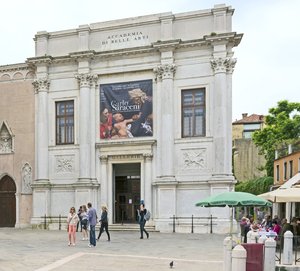 Gallerie dell'Accademia di Venezia |
Venezia | 2 | Capriccio with Classical Arch and Goats, Capriccio with Gothic Building and Obelisk |
 Staatliche Museen zu Berlin |
Berlín | 2 | The Grand Canal with the Ca' Rezzonico and the Campo San Samuele, The Grand Canal with the Palazzo Labia and Entry to the Cannareggio |
 Hermitáž |
Petrohrad | 2 | Courtyard with a Staircase, Most Rialto z Riva del Vin |
 Bavarské štátne múzeá výtvarného umenia |
Mních | 2 | View of the Piazzetta dei Leoni, View of the Grand Canal near Cà Pesaro |
 Národné múzeum |
Stockholm | 2 | Courtyard in a Renaissance House, Stairwell in a Renaissance Palace |
 Statens Museum For Kunst |
Kodaň | 2 | View of Canale Grande in Venice with the Rialto Bridge, View of Canale Grande in Venice |
 Louvre |
Paríž | 1 | The Grand Canal near the Salute |
Vyberte si dekádu a pozrite si originál, ktorý ju definuje.

The artwork titled Italian scenery with figures is a work by the Venetian painter Michele Marieschi. Born in Venice, Italy, in 1710, the artist spent his life capturing the architectural essence of his home city. This specific piece, executed about 1727, offers a glimpse into the structured world of the eighteenth century through its focus on stone and human presence.
The Grand Canal near the Salute is an oil on canvas painting created by Michele Marieschi in 1733. This artwork is currently housed at the Musée du Louvre in Paris, France.
The composition centers on the intersection of human architecture and the persistent force of the natural world. Crumbling stone arches and weathered columns, once symbols of structural precision, now lie partially reclaimed by thick foliage and creeping vines. In the foreground, a man, a boy, and a dog move through the ruins, providing a sense of scale against the heavy, decaying masonry. Beyond this immediate scene, a body of water…
The Grand Canal near the Salute (1733), Louvre, Paríž. Nasledujú Capriccio with Classical Arch and Goats (1741) a The Grand Canal with the Ca' Rezzonico and the Campo San Samuele (1742).
23 rokov: The Grand Canal near the Salute vzniklo v roku 1733 a Michele Marieschi sa narodil/a v roku 1710.
The Grand Canal near the Salute, Capriccio with Classical Arch and Goats, The Grand Canal with the Ca' Rezzonico and the Campo San Samuele, Courtyard with a Staircase, The Grand Canal in Venice, Most Rialto z Riva del Vin, The Grand Canal with Santa Maria della Salute, An Architectural Capriccio with Figures beside a River, Ponte di Rialto a Fantastic Architecture of a Prison Courtyard. Vyššie uvedené hodnotenie uvádza rok a múzeu pre každé z nich.
Náš katalóg obsahuje 46 diel od umelca Michele Marieschi z perioda od 1727 do 1742.
Väčšinou v Národné múzeum vo Varšave (Varšava), Gallerie dell'Accademia di Venezia (Venezia) a Staatliche Museen zu Berlin (Berlín). Tabuľka múzeí vyššie ich všetky uvádza.
V období 1730s: 14 z 39 diel na tejto stránke bolo vytvorených vtedy, pričom The Grand Canal near the Salute z nich.
Na tejto stránke je najstaršie dielo z Italian scenery with figures (1727) a najnovšie z The Grand Canal with the Ca' Rezzonico and the Campo San Samuele (1742).
Architecture (18), Water (14) a Sky (12), v rámci 39 diel na tejto stránke.
Oil On Canvas, pre 20 z 39 diel na tejto stránke.
Rococo, podľa originálov na tejto stránke.
Ponte di Rialto, Fantastic Architecture of a Prison Courtyard a Fantastic Architecture of a Palace Courtyard: múzeá Národné múzeum vo Varšave, Varšava uchovávajú 10 z diel na tejto stránke.
V zlatom veku venetsianského rococó zachytil len málo umelcov éterickú mágiu Serenissimy s takou vitalitou ako Michele Marieschi. Narodený v Benátkach v roku 1710, Marieschi pochádza z rodu remeselníkov, keďže bol synom drevorobca—čo mu pravdepodobne vistoklo hlbokú úctu k štruktúre, textúre a fyzickej podstatě objektov, ktoré vykresloval. Hoci bol jeho život pomerne krátky a skončil včasným úmrtím na začiatku roku 1744, jeho vplyv na tradíciu veduta zostáva nezmazateľný. Nebol len dokumentaristom architektúry Benátok; on vduchoval život do ich kameňa a vody a transformoval statické mestské krajiny na živé, svetelné naratívy plné pohybu.
Vývoj jedinečného štýlu, ktorý vytvoril Michele Marieschi, bol hlboko zakorenený v umeleckých prúdach prebiehajúcich 18. storočím Nemeckom. Vedci často poukazujú na vplyv majstrov ako Gaspare Diziani a legendárneho Canaletta, ktorých diela poskytli vzor pre zachytávanie veľkolepilosti mestských prostredí. Avšak zatiaľ čo Canaletto hľadal určitú topografickú presnosť a striedomnú, klasickú jasnosť, Marieschi našiel svoj hlas v odvážnejšom, emotívnejšom prístupe. Obzaloval paletu, ktorá pulzovala farbami, a používal ťah pędzla, ktorý pôsobil spontánne a energicky. Tento štylistický rozdiel mu umožnil posunúť sa za hranice čisto architektonického záznamu a doplniť svoje krajiny poctom divadelnosti a atmosféry, ktorá naznačovala samotný pulz benetského života.
Príspevok Michele Marieschi k žánru veduta—vysoko detailným, veľkolepilým topografickým malostiam—je charakterizovaný výnimočným ovládaním perspektívy a svetla. Jeho diela často obsahujú ikonické pamiatky, ako je Grand Canal, Salute a rôzne majestátne paláce, no sú oveľa viac než len pouhými pohľadnicami danej éry. Namiesto toho využíval techniku, ktorá spojovala precízny detail s imaginatívnou ozdobnosťou, čím vytváral scény, ktoré pôsobili súčasne reálne aj ako sen. Cez jeho oči sa voda v kanáloch stáva zrkadlom pre meniace sa nebe a tiene vrhané starobylými kostolmi sa premieňajú na nádoby pre mystiku a hĺbku.
Jeho technická zdatnosť je možno najviac zjavná v schopnosti manipulovať so svetlom tak, aby vyvolal konkrétne nálady:
Historický význam, ktorý predstavuje Michele Marieschi, spočíva v jeho schopnosti premostiť medzu medzi prísnou dokumentáciou raného 18. storočia a expresívnejšími, emotívnymi krajinami, ktoré nasledovali. Bol kľúčovou postavou pri transformácii benetskej vidiny z čistě pozorovacieho médiá na umeleckú formu schopnú vyjadriť hlbokú emocionálnu rezonanciu. Jeho práca slúži ako vitalný okná do zaniknutého sveta, ktorý uchováva nádheru Benátok predtým, než seismické zmeny konca 18. storočia navždy zmenili jej spoločenskú a politickú krajinu.
Dnes plátna, ktoré vytvoril Michele Marieschi, naďalej fascinujú zberateľov aj historikov. Či už ide o dychberúci výhľad na Grand Canal pri Salute alebo o jeho intímnejšie architektonické štúdie, jeho obrazy zostávajú majstrovskými lekciami v duchu rococó. Zostáva uznávanou postavou pre tých, ktorí chcú zažiť vibrujúcu energiu, luminiscenčné svetlo a trvajúcu eleganciu Benátok, ktoré neustále mátenú kolektívnu predstavu umeleckého sveta.


