Early Life, Family and Training
Jan Hendrik Doeleman was born on March 5, 1848, in Rotterdam, Netherlands, into a family headed by Jacobus Doeleman and Maria Elisabeth Oldenburg. His early years in the Dutch port city provided the foundation for a life dedicated to the visual arts. In 1871, his burgeoning talent was recognized when he received a scholarship from King Willem III, a distinction that marked his early promise within the Dutch artistic community.
His formal education took place at the Academie van Beeldende Kunsten en Technische Wetenschappen in Rotterdam. This period of study was central to his development as a painter and draughtsman. By 1877, his technical proficiency had reached a level that allowed him to transition from student to instructor. During that same year, he was appointed as a teacher at the Rotterdam Academy, establishing a professional presence in the city where he was raised.
Personal life and professional identity became intertwined in the mid-1870s. On October 29, 1874, in Rotterdam, he married Josina Christina Cornelia Wierikx. This union occurred during the formative years of his career, a time when he was establishing himself as a significant figure in the local art scene. His roots in Rotterdam remained strong throughout his early adulthood, providing a stable base before his eventual move toward The Hague.
Life and Career in Rotterdam and The Hague
After his early training, Doeleman began his professional life near Haastrecht, finding his footing in the Dutch landscape. His connection to Rotterdam remained central to his existence for many years; he lived and worked within the city until 1899. During this period, his professional standing grew, leading to his appointment as a teacher at the Academy of Fine Arts and Technical Sciences in Rotterdam in 1877. His presence in the region was marked by a steady commitment to both his instruction and his personal practice.
The turn of the century brought a change in scenery when he moved to The Hague in 1899. This transition placed him in the heart of a significant artistic community, where he became a member of the Pulchri Studio. His professional life continued to flourish in this setting, eventually earning him honorary membership at the Academy in Rotterdam in 1902. He remained active in these circles, contributing to the local artistic fabric through his presence in the city's most respected clubs and institutions.
The final chapter of his life was spent in the quieter vicinity of Leidschendam-Voorburg. His health eventually failed, and he passed away on May 10, 1913, at the age of 65. He died in a Roman Catholic hospital in The Hague, marking the end of a long career dedicated to the observation of the Dutch landscape.
Artistic Style and Technique
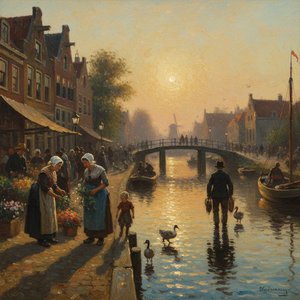
Doeleman’s hand was as versatile as the Dutch landscape he sought to capture. As a painter, draughtsman, and watercolourist, he moved between the heavy textures of oil and the fluid transparency of watercolours. His work is often categorized within the second generation of the Hague School, marked by an impressionist sensibility that favored the immediate impression of light and atmosphere over rigid detail. This approach allowed him to translate the shifting moods of the Netherlands into tangible forms, whether through the precise application of pigment on linen or the delicate touch of a wash on paper.
His subject matter was deeply rooted in the natural world, focusing primarily on the polder landscapes, dune scenes, and river views that defined the Dutch countryside. He possessed a particular talent for capturing the seasonal transitions of these environments, rendering the starkness of winter and the warmth of summer with equal facility. Beyond these expansive vistas, his repertoire included seascapes, woodland scenes, still lifes, and figurative compositions. He was particularly adept at capturing the quietude of nature, often focusing on the subtle interplay of light across water or through dense foliage.
- Autumn Hood in the Forest
- Winter near Rotterdam, farm in winter landscape with canal with boats
- Farm by the lake
Exhibitions and Museum Collections
The visibility of Doeleman's work during his lifetime was marked by regular appearances in the major artistic centers of the Netherlands. Between 1872 and 1903, his paintings were featured in exhibitions held in both The Hague and Amsterdam. These presentations allowed his interpretations of the Dutch landscape to reach a wider public audience during the height of his career.
Today, his artistic output is preserved within several significant institutions. His works are held in the collections of the Valkhof Museum in Nijmegen and the Zeeuws Museum in Middelborg. Additionally, the Historic Museum in Deventer maintains pieces of his oeuvre, ensuring his contribution to the Dutch landscape tradition remains accessible to those studying the regional art of the period.
Otázky a odpovede
Odkiaľ pochádza Jan Hendrik Doeleman?
Jan Hendrik Doeleman sa narodil/a v krajine Netherlands.
Kde a v ktorom roku sa narodil/a Jan Hendrik Doeleman?
Jan Hendrik Doeleman sa narodil v meste Rotterdam v roku 1848.
Kde si môžem pozrieť farebnú paletu tvorby umelca Jan Hendrik Doeleman?
Farebný profil tvorby umelca Jan Hendrik Doeleman si môžete pozrieť na jeho stránke Genetika palety.
Môžem navštíviť virtuálne múzeum diel umelca Jan Hendrik Doeleman?
3D galéria umelca Jan Hendrik Doeleman je stránka, ktorá prezentuje diela tohto umelca v rámci virtuálnej trojrozmernej galérie.