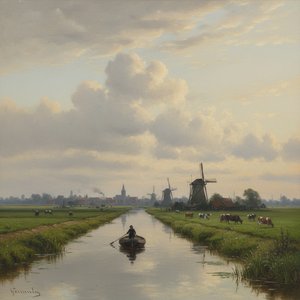
The Architect of the Groningen Landscape
To understand the Dutch expressionist movement, one must look directly at Jan Altink. He did not merely participate in the art scene; he helped uproot it. As a co-founder of the De Ploeg association in 1918, Altink applied a literal philosophy to his work, using the name to signify the ploughing of traditional, stagnant art forms to allow new ideas to take root. His presence in Groningen was foundational. He was the purest representative of this local movement, bringing a specific, grounded energy to the North Drenthe landscapes that others could not replicate.
His technical evolution shows a painter constantly refining his visual language. Early on, Altink was a precise draftsman and graphic artist, a skill honed during his studies at the Kunstnijverheidsschool and Academie Minerva. However, the real shift occurred in 1924. This period marked his breakthrough into expressionism, characterized by the use of wax paint and a sudden, sharp increase in color intensity. By 1927, he had moved away from these heavy textures toward a more disciplined approach. He began limiting his palette to just three or four colors, a calculated move designed to suggest light and spatial depth without unnecessary clutter.
A Life Defined by the Open Air
Altink’s methodology was rooted in the physical environment. He preferred painting in the open air, a practice that demanded a direct response to changing light and atmosphere. This connection to the land remained constant even as his personal geography shifted. After moving to the south of Groningen in 1933, his focus tightened on the specific topography of North Drenthe. His work was never about abstract decoration; it was about the structural reality of the Dutch landscape.
His career was marked by several concrete milestones that solidified his place in Dutch art history:
- 1918: Co-founded the De Ploeg artists' association to break new ground in the regional art scene.
- 1924–1927: Achieved a major breakthrough using wax paint and bright, expressionist colors.
- 1939: Featured in the Onze Kunst van Heden exhibition at the Rijksmuseum in Amsterdam.
- 1960: Received a retrospective exhibition at the Groninger Museum on his 75th birthday.
Even after retirement, Altink did not cease his production. He traveled to the south of France, continuing to work with various media and techniques long after his most famous expressionist years had passed. He died in Groningen in 1971, leaving behind a body of work that remains a primary reference point for the Groningen art scene.
Otázky a odpovede
Ako je kariéra umelca Jan Altink rozdelená do jednotlivých období?
Kariéra umelca Jan Altink sa na jeho stránke Chronológia odvíja obdobie po období v podobe horizontálnej časovej osi diel, ktoré sú rozdelené do kapitol podľa jednotlivých období jeho tvorby.
Môžem si prehliadať diela umelca Jan Altink podľa kľúčových slov?
Diela umelca Jan Altink si môžete preskúmať podľa kľúčových slov na jeho stránke Podľa kľúčových slov. Každé kľúčové slovo spája súvisiace diela do tematických celkov.
Aké farby používal/a Jan Altink najčastejšie?
Genetika palety umelca Jan Altink je stránka, ktorá predstavuje farebný profil jeho tvorby.